ATI MENTAL HEALTH PRACTICE QUESTIONS
00:00
A community health nurse is planning a health fair at a local shopping mall. Which middle-class socioeconomic cultural group should the nurse anticipate would most value preventive medicine and primary health care?
A.
Northern European Americans
B. Native Americans
C.
D.
Rationale
The most appropriate selection for "Which middle-class socioeconomic cultural group should the nurse anticipate would most value preventive medicine and primary health care" is "".
A. Northern European Americans
This choice is off-target for what the stem is asking. It may be loosely connected, but it doesn't match the priority concept. This answer centers "Northern European Americans," but the stem highlights "A community health nurse is planning a health fair at a local shopping mall. Which...." A good elimination step is to remove choices that stereotype or drift away from the stem's priority.
B. Native Americans
This choice misses the focus of the question and would lead the clinician away from the best clinical judgment. The statement "Native Americans" is not supported by the scenario ("A community health nurse is planning a health fair at a local shopping mall. Which..."). In practice, the clinician should stay with assessment cues and culturally safe interpretation.
**Conclusion**
The focus of this question is A community health nurse is planning a health fair at a local shopping mall. Which middle-class socioeconomic cultural.... The correct response should be the one that addresses the concept being tested using only the information given. The strongest answers in this set stay closely tied to what is stated in the scenario and avoid adding extra meaning. In practice, this approach supports accurate assessment and respectful, client-centered care.

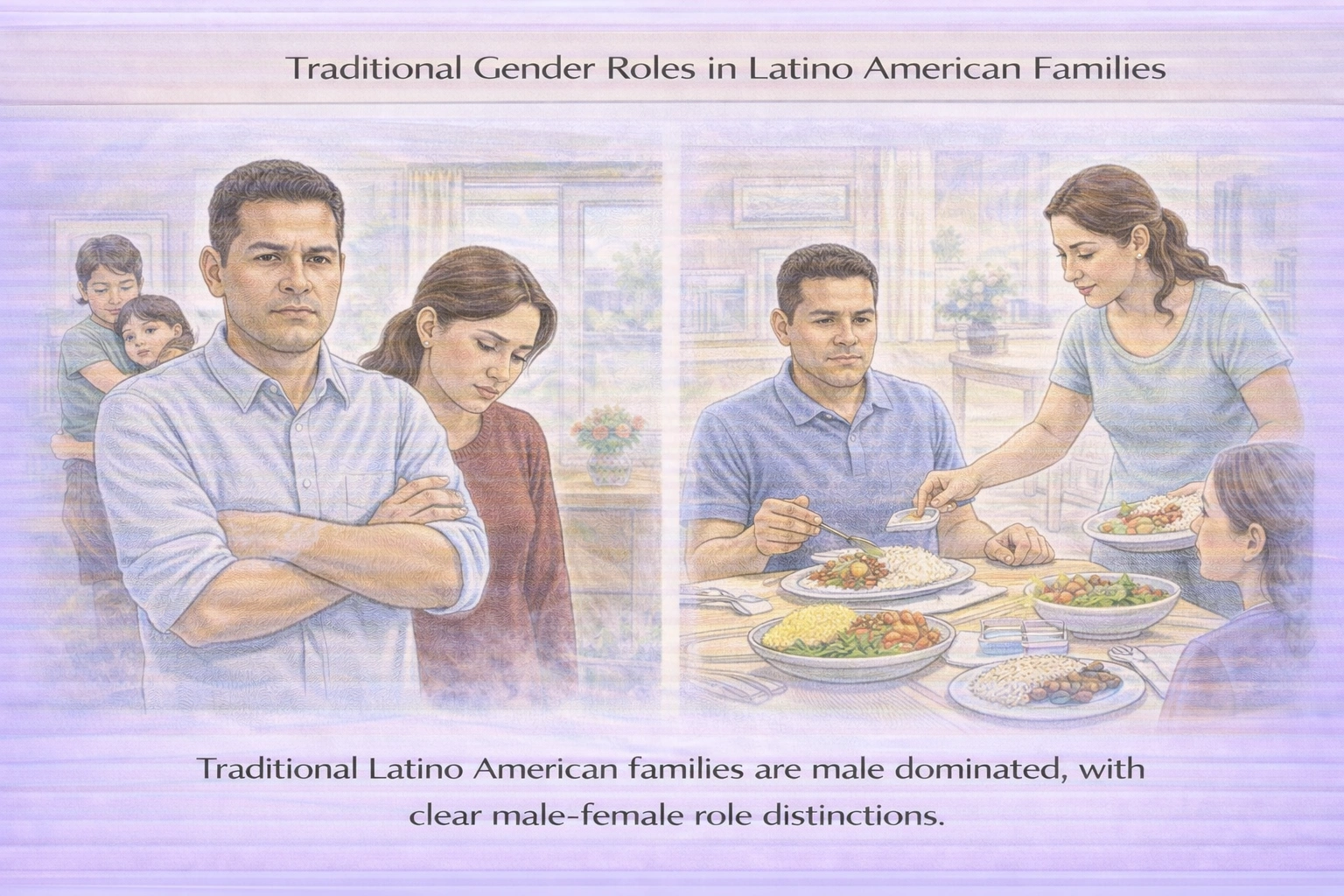
A Latino American man refuses to acknowledge responsibility for hitting his wife, stating instead, Its the mans job to keep his wife in line. Which cultural belief may be associated with this clients behavior?
A.
Traditional Latino American families are male dominated with clear malefemale role distinctions.
B. Religious tenets of Latino American culture support the use of violence within a marriage.
C. Latino American families are female dominated and the mother possesses ultimate authority.
D. Marriage dynamics are controlled by dominant females in Latin American families.
Rationale
The most appropriate selection for "Which cultural belief may be associated with this clients behavior" is "Traditional Latino American families are male dominated with clear malefemale role distinctions.".
A. Traditional Latino American families are male dominated with clear malefemale role distinctions.
This is the best answer because it directly reflects the key cue in the stem. It addresses the stem's priority ("A Latino American man refuses to acknowledge responsibility for hitting his wife,...") in a straightforward way. In practice, this supports respectful communication and accurate assessment.
B. Religious tenets of Latino American culture support the use of violence within a marriage.
This choice misses the focus of the question and would lead the nurse away from the best clinical judgment. Compared with the stem ("A Latino American man refuses to acknowledge responsibility for hitting his wife,..."), this choice introduces a different emphasis ("Religious tenets of Latino American culture support the use of violence within a marriage."). Clinically, this would risk misinterpretation because it is not grounded in the presented data.
C. Latino American families are female dominated and the mother possesses ultimate authority.
This choice misses the focus of the question and would lead the nurse away from the best clinical judgment. The statement "Latino American families are female dominated and the mother possesses ultimate authority." is not supported by the scenario ("A Latino American man refuses to acknowledge responsibility for hitting his wife,..."). Choose the option that answers the question directly without adding extra assumptions.
D. Marriage dynamics are controlled by dominant females in Latin American families.
This option is off-target for what the stem is asking. It may be loosely connected, but it doesn't match the priority concept. Here, "Marriage dynamics are controlled by dominant females in Latin American families." pulls the nurse away from the stem's cue ("A Latino American man refuses to acknowledge responsibility for hitting his wife,..."). In practice, the nurse should stay with assessment cues and culturally safe interpretation.
**Conclusion**
The focus of this question is A Latino American man refuses to acknowledge responsibility for hitting his wife, stating instead, Its the mans job to.... The most appropriate response is Traditional Latino American families are male dominated with clear malefemale role..., which aligns with the concept tested in the scenario. The better reasoning here is the one that connects directly to the scenario details and the concept being tested. Clinically, this reasoning helps maintain rapport while guiding safe nursing decision-making.
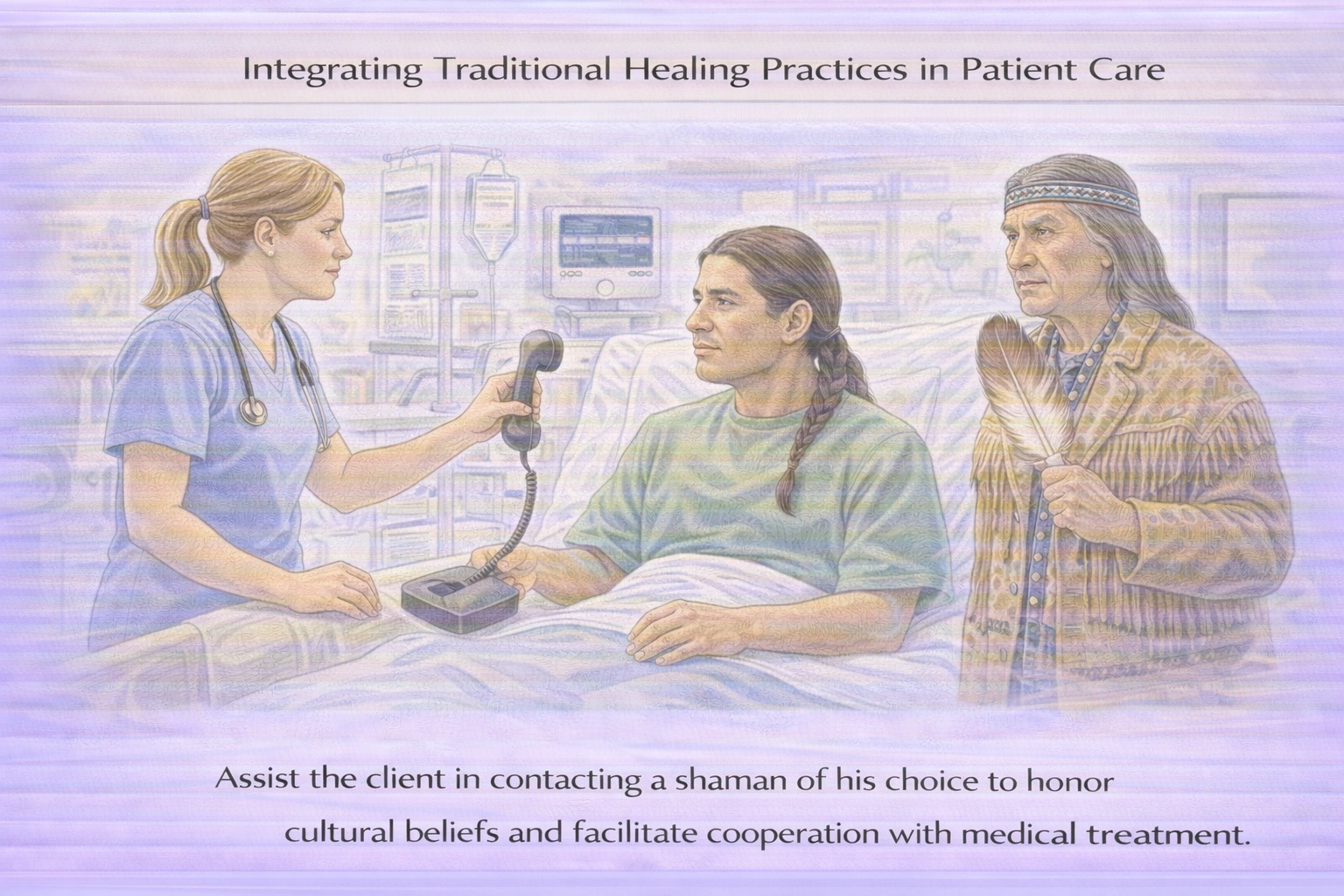
A Native American client is admitted to an emergency department (ED) with an ulcerated toe secondary to uncontrolled diabetes mellitus. The client refuses to talk to a physician unless a shaman is present. Which nursing intervention is most appropriate?
A.
Assist the client in contacting a shaman of his choice.
B. Explain to the client that voodoo medicine will not heal the ulcerated toe.
C. Ask the client to explain what the shaman can do that the physician cannot.
D. Inform the client that refusing treatment is a clients right.
Rationale
What the nurse should choose for "Which nursing intervention is most appropriate" is "Assist the client in contacting a shaman of his choice.".
A. Assist the client in contacting a shaman of his choice.
This choice fits because it stays grounded in the scenario and avoids added assumptions. It matches what the stem emphasizes ("A Native American client is admitted to an emergency department (ED) with an ulcerated...") and guides appropriate nursing judgment. Clinically, it helps preserve rapport while interpreting behavior through context.
B. Explain to the client that voodoo medicine will not heal the ulcerated toe.
This choice moves away from supportive communication. The nurse should avoid blame and instead use calm, client-centered language. This answer centers "Explain to the client that voodoo medicine will not heal the ulcerated toe.," but the stem highlights "A Native American client is admitted to an emergency department (ED) with an ulcerated...." In practice, the nurse should stay with assessment cues and culturally safe interpretation.
C. Ask the client to explain what the shaman can do that the physician cannot.
This answer does not address the stem's main point. It either answers a different question or adds meaning not provided in the scenario. This answer centers "Ask the client to explain what the shaman can do that the physician cannot.," but the stem highlights "A Native American client is admitted to an emergency department (ED) with an ulcerated...." Clinically, this would risk misinterpretation because it is not grounded in the presented data.
D. Inform the client that refusing treatment is a clients right.
This choice misses the focus of the question and would lead the clinician away from the best clinical judgment. The statement "Inform the client that refusing treatment is a clients right." is not supported by the scenario ("A Native American client is admitted to an emergency department (ED) with an ulcerated..."). Choose the option that answers the question directly without adding extra assumptions.
**Conclusion**
In this situation, the main issue is A Native American client is admitted to an emergency department (ED) with an ulcerated toe secondary to uncontrolled... Assist the client in contacting a shaman of his choice.. Choices that minimize feelings or imply blame are inconsistent with therapeutic communication and are less likely to help the client engage. This interpretation promotes culturally safe care and reduces the risk of misunderstanding client behavior.
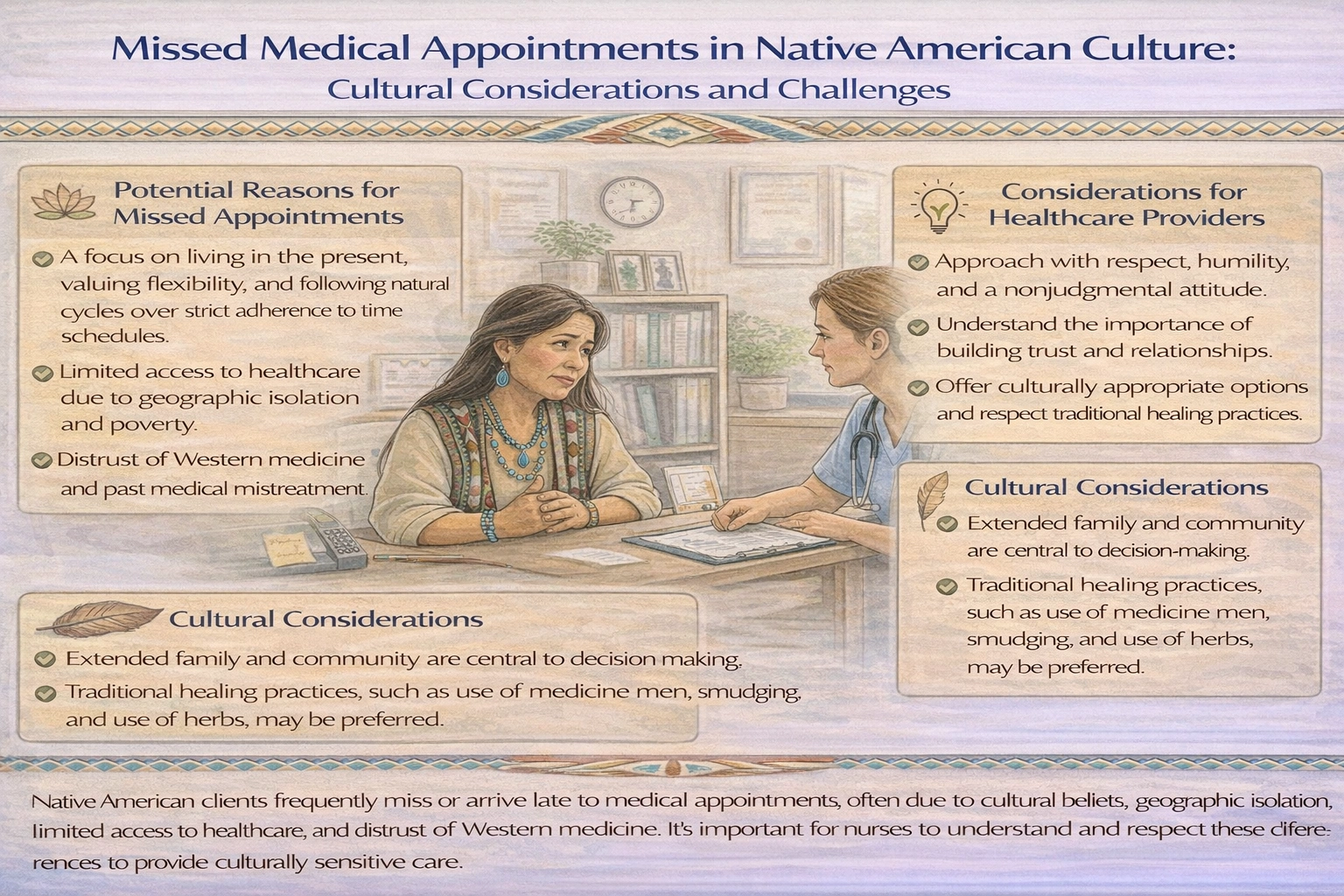
A nurse should recognize that clients who have a history of missed or late medical appointments are most likely to come from which cultural group?
A.
Northern European Americans
B. Asian Americans
C. Native Americans
D. Jewish Americans
Rationale
What the nurse should choose for "A nurse should recognize that clients who have a history of missed or late medical appointments are most likely to come from which cultural group" is "Native Americans".
A. Northern European Americans
This choice is off-target for what the stem is asking. It may be loosely connected, but it doesn't match the priority concept. Compared with the stem ("A nurse should recognize that clients who have a history of missed or late medical..."), this choice introduces a different emphasis ("Northern European Americans"). Choose the choice that answers the question directly without adding extra assumptions.
B. Asian Americans
This choice is off-target for what the stem is asking. It may be loosely connected, but it doesn't match the priority concept. Here, "Asian Americans" pulls the nurse away from the stem's cue ("A nurse should recognize that clients who have a history of missed or late medical..."). Clinically, this would risk misinterpretation because it is not grounded in the presented data.
C. Native Americans
This choice fits because it stays grounded in the scenario and avoids added assumptions. It responds to "A nurse should recognize that clients who have a history of missed or late medical..." without stereotyping the client or shifting to a different concept. It promotes safe decision-making by basing interpretation on observable data.
D. Jewish Americans
This option is off-target for what the stem is asking. It may be loosely connected, but it doesn't match the priority concept. This answer centers "Jewish Americans," but the stem highlights "A nurse should recognize that clients who have a history of missed or late medical...." Choose the choice that answers the question directly without adding extra assumptions.
**Conclusion**
The scenario emphasizes A nurse should recognize that clients who have a history of missed or late medical appointments are most likely to.... The most appropriate response is Native Americans, which aligns with the concept tested in the scenario. The better reasoning here is the one that connects directly to the scenario details and the concept being tested. In practice, this approach supports accurate assessment and respectful, client-centered care.
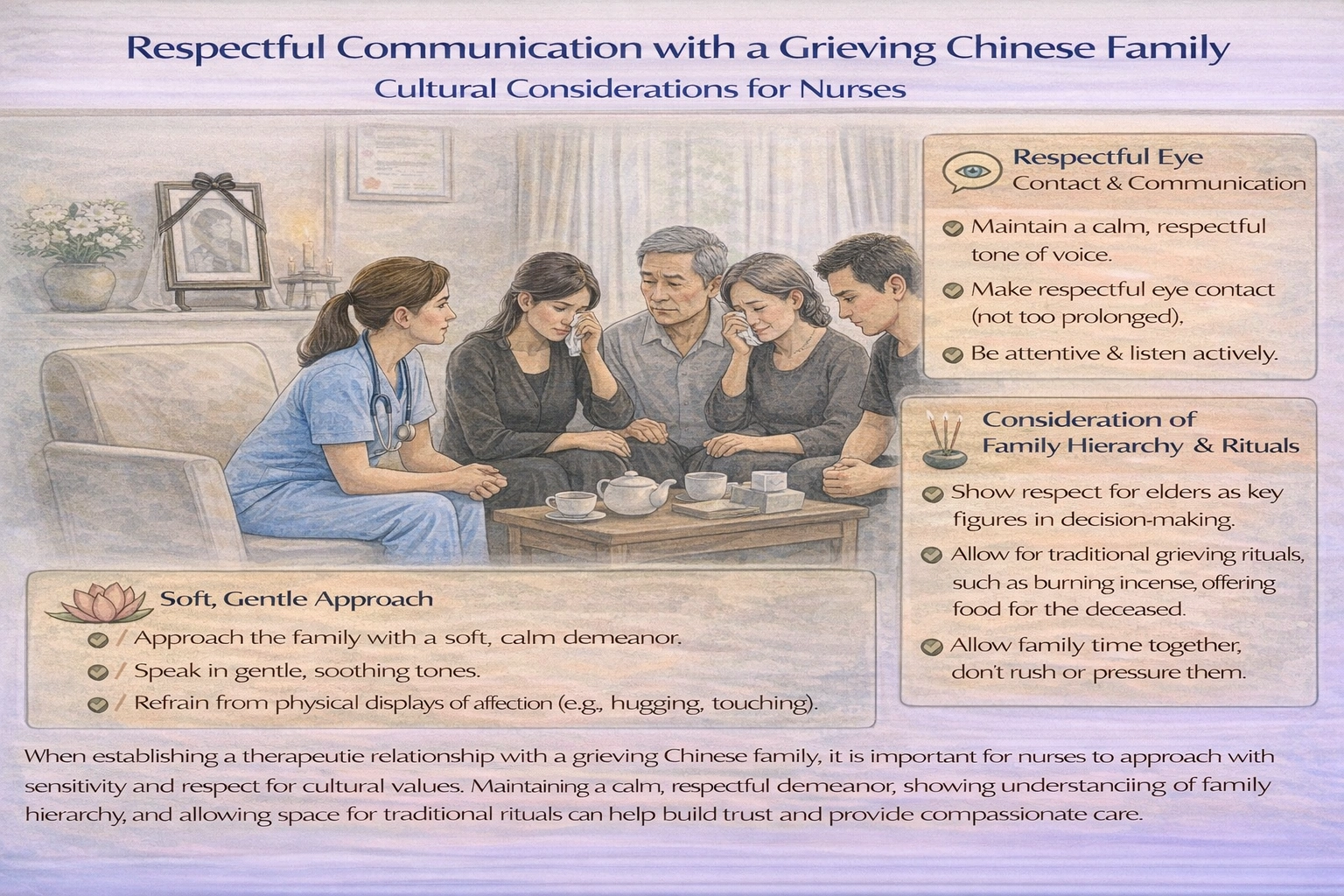
A nurse is preparing to establish a therapeutic relationship with a grieving family from China. Which nursing intervention would be considered most appropriate?
A.
Touch each member lightly, as this enhances the communication process.
B. Direct questions to the young males of the family, as they maintain positions of authority.
C. Avoid direct eye contact, as it implies rudeness.
D.
Rationale
For "Which nursing intervention would be considered most appropriate," the best answer is "".
A. Touch each member lightly, as this enhances the communication process.
This choice misses the priority of the question and would lead the nurse away from the best clinical judgment. The statement "Touch each member lightly, as this enhances the communication process." is not supported by the scenario ("A nurse is preparing to establish a therapeutic relationship with a grieving family..."). Clinically, this would risk misinterpretation because it is not grounded in the presented data.
B. Direct questions to the young males of the family, as they maintain positions of authority.
This answer does not address the stem's main point. It either answers a different question or adds meaning not provided in the scenario. Here, "Direct questions to the young males of the family, as they maintain positions of authority." pulls the nurse away from the stem's cue ("A nurse is preparing to establish a therapeutic relationship with a grieving family..."). Clinically, this would risk misinterpretation because it is not grounded in the presented data.
C. Avoid direct eye contact, as it implies rudeness.
This choice misses the focus of the question and would lead the nurse away from the best clinical judgment. Here, "Avoid direct eye contact, as it implies rudeness." pulls the nurse away from the stem's cue ("A nurse is preparing to establish a therapeutic relationship with a grieving family..."). In practice, the nurse should stay with assessment cues and culturally safe interpretation.
**Conclusion**
In this situation, the main issue is A nurse is preparing to establish a therapeutic relationship with a grieving family from China. Which nursing.... The best answer will be the choice that directly matches the scenario and the concept being assessed. The better reasoning here is the one that connects directly to the scenario details and the concept being tested. Clinically, this reasoning helps maintain rapport while guiding safe nursing decision-making.
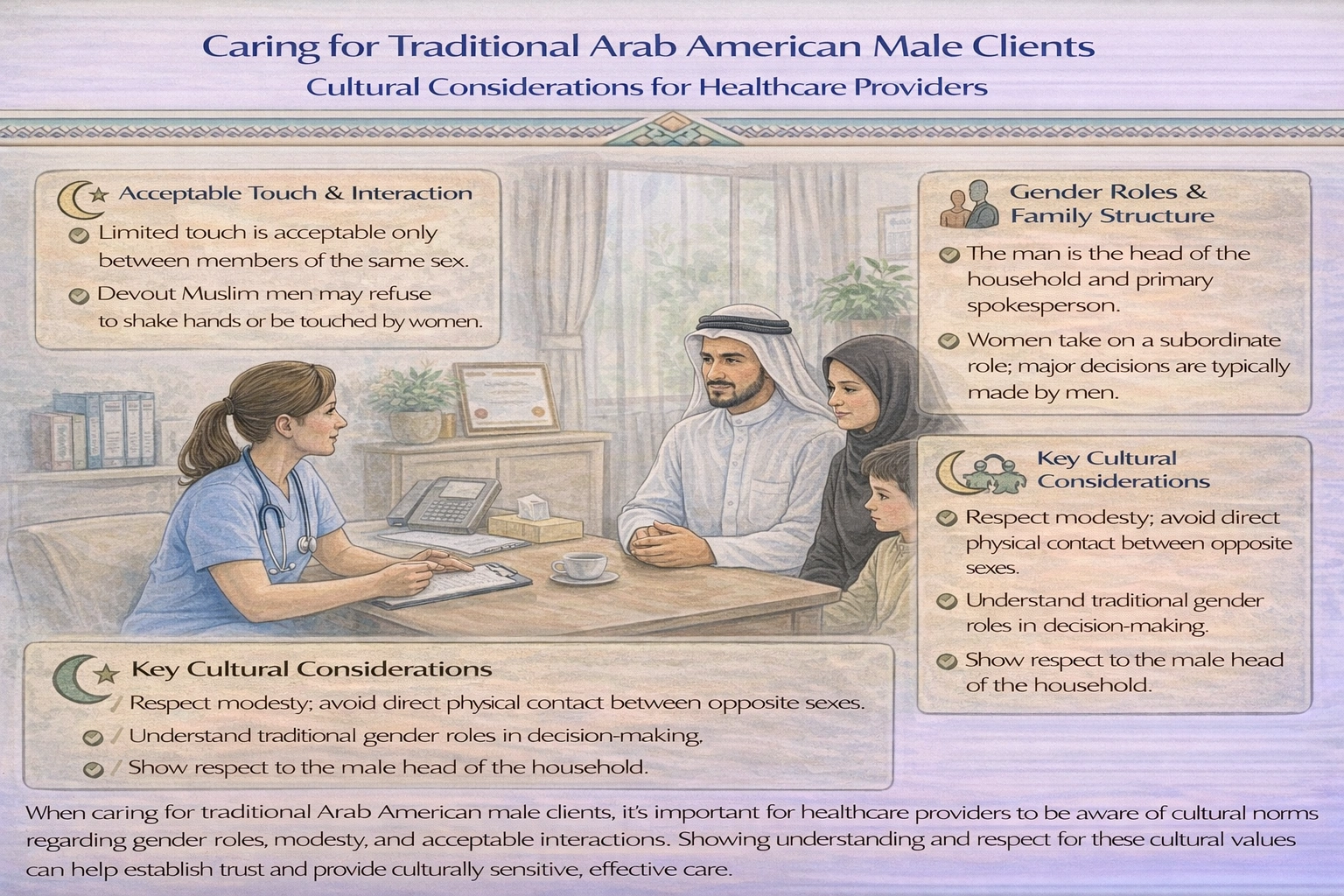
A female nurse is caring for a traditional Arab American male client. When planning effective care for this client, the nurse should be aware of which of the following cultural considerations? Select all that apply.
A.
Limited touch is acceptable only between members of the same sex.
B. Conversing individuals of this culture stand far apart and do not make eye contact.
C. Devout Muslim men may not shake hands with women.
D. The man is the head of the household and women take on a subordinate role.
Rationale
The answer to "When planning effective care for this client, the nurse should be aware of which of the following cultural considerations? Select all that apply." is "Limited touch is acceptable only between members of the same sex., Devout Muslim men may not shake hands with women., The man is the head of the household and women take on a subordinate role.".
A. Limited touch is acceptable only between members of the same sex.
This is the best answer because it directly reflects the key cue in the stem. It matches what the stem emphasizes ("A female clinician is caring for a traditional Arab American male client. When planning...") and guides appropriate nursing judgment. It promotes safe decision-making by basing interpretation on observable data.
B. Conversing individuals of this culture stand far apart and do not make eye contact.
This answer does not address the stem's main point. It either answers a different question or adds meaning not provided in the scenario. Compared with the stem ("A female nurse is caring for a traditional Arab American male client. When planning..."), this choice introduces a different emphasis ("Conversing individuals of this culture stand far apart and do not make eye contact."). A good elimination step is to remove choices that stereotype or drift away from the stem's priority.
C. Devout Muslim men may not shake hands with women.
This option is off-target for what the stem is asking. It may be loosely connected, but it doesn't match the priority concept. This answer centers "Devout Muslim men may not shake hands with women.," but the stem highlights "A female nurse is caring for a traditional Arab American male client. When planning...." In practice, the nurse should stay with assessment cues and culturally safe interpretation.
D. The man is the head of the household and women take on a subordinate role.
This choice misses the priority of the question and would lead the nurse away from the best clinical judgment. Compared with the stem ("A female nurse is caring for a traditional Arab American male client. When planning..."), this choice introduces a different emphasis ("The man is the head of the household and women take on a subordinate role."). A good elimination step is to remove choices that stereotype or drift away from the stem's priority.
E. In traditional culture, men are responsible for the education of their children.
This answer does not address the stem's main point. It either answers a different question or adds meaning not provided in the scenario. The statement "In traditional culture, men are responsible for the education of their children." is not supported by the scenario ("A female nurse is caring for a traditional Arab American male client. When planning..."). A good elimination step is to remove choices that stereotype or drift away from the stem's priority.
**Conclusion**
This item centers on A female nurse is caring for a traditional Arab American male client. When planning effective care for this client,.... The best-supported answer is Limited touch is acceptable only between members of the same sex.; Devout Muslim men may not shake hands with women.; The man is the head of the household and women take on a subordinate role., because it matches the situation described. The strongest answers in this set stay closely tied to what is stated in the scenario and avoid adding extra meaning. In practice, this approach supports accurate assessment and respectful, client-centered care.
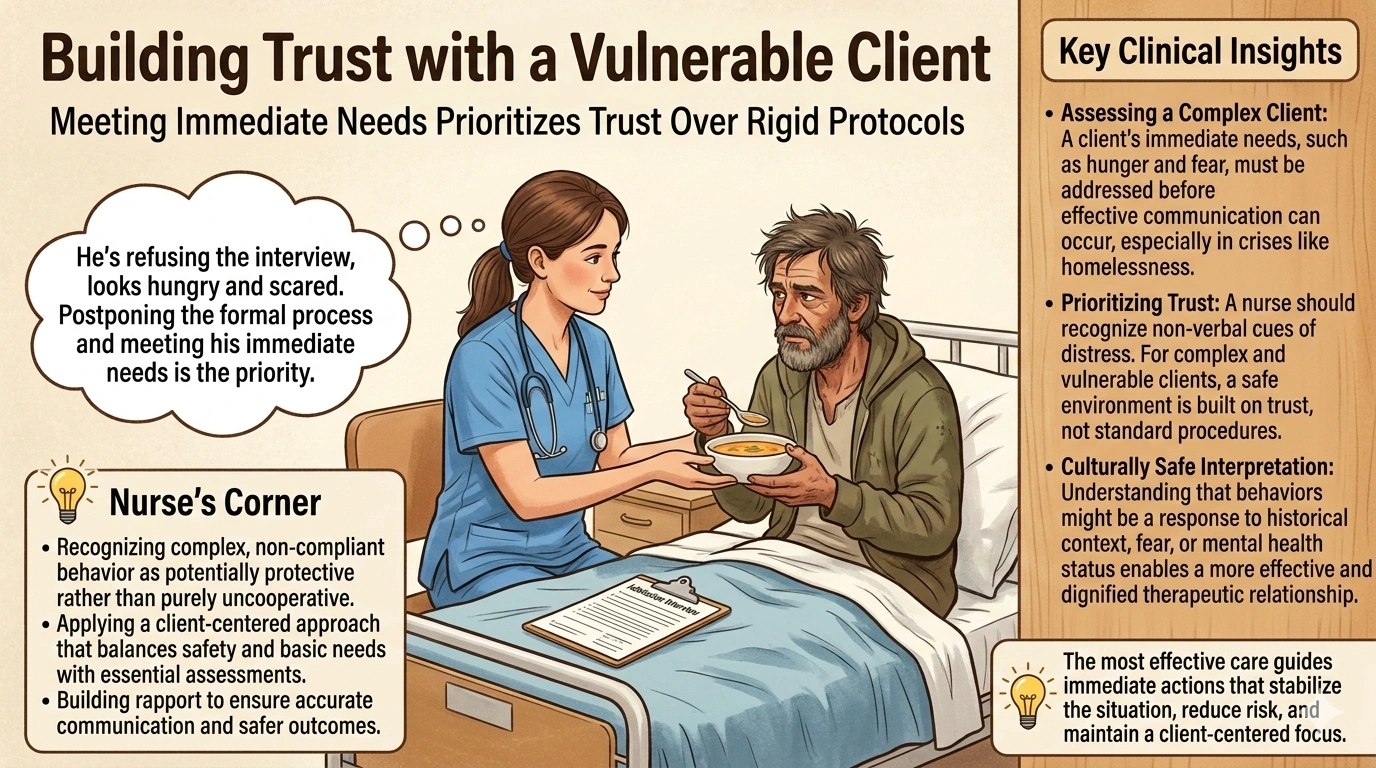
A hungry, homeless client, diagnosed with schizophrenia, refuses to participate in an admission interview. When the nurse postpones the admission interview, verbally assures safety, and provides a warm meal, he or she is promoting which of the following?
A.
Sympathy
B. Trust
C. Veracity
D. Manipulation
Rationale
For "When the nurse postpones the admission interview, verbally assures safety, and provides a warm meal, he or she is promoting which of the following," the best answer is "Trust".
A. Sympathy
This answer does not address the stem's main point. It either answers a different question or adds meaning not provided in the situation. Compared with the stem ("A hungry, homeless client, diagnosed with schizophrenia, refuses to participate in an..."), this choice introduces a different emphasis ("Sympathy"). A good elimination step is to remove choices that stereotype or drift away from the stem's priority.
B. Trust
This answer is supported by the stem and aligns with safe, client-centered nursing care. It keeps attention on "A hungry, homeless client, diagnosed with schizophrenia, refuses to participate in an...," which is what this item is testing. Clinically, it helps preserve rapport while interpreting behavior through context.
C. Veracity
This option is off-target for what the stem is asking. It may be loosely connected, but it doesn't match the priority concept. The statement "Veracity" is not supported by the scenario ("A hungry, homeless client, diagnosed with schizophrenia, refuses to participate in an..."). In practice, the nurse should stay with assessment cues and culturally safe interpretation.
D. Manipulation
This option is off-target for what the stem is asking. It may be loosely connected, but it doesn't match the priority concept. This answer centers "Manipulation," but the stem highlights "A hungry, homeless client, diagnosed with schizophrenia, refuses to participate in an...." A good elimination step is to remove choices that stereotype or drift away from the stem's priority.
**Conclusion**
In this situation, the main issue is A hungry, homeless client, diagnosed with schizophrenia, refuses to participate in an admission interview. When the... Trust. The better reasoning here is the one that connects directly to the scenario details and the concept being tested. This interpretation promotes culturally safe care and reduces the risk of misunderstanding client behavior.
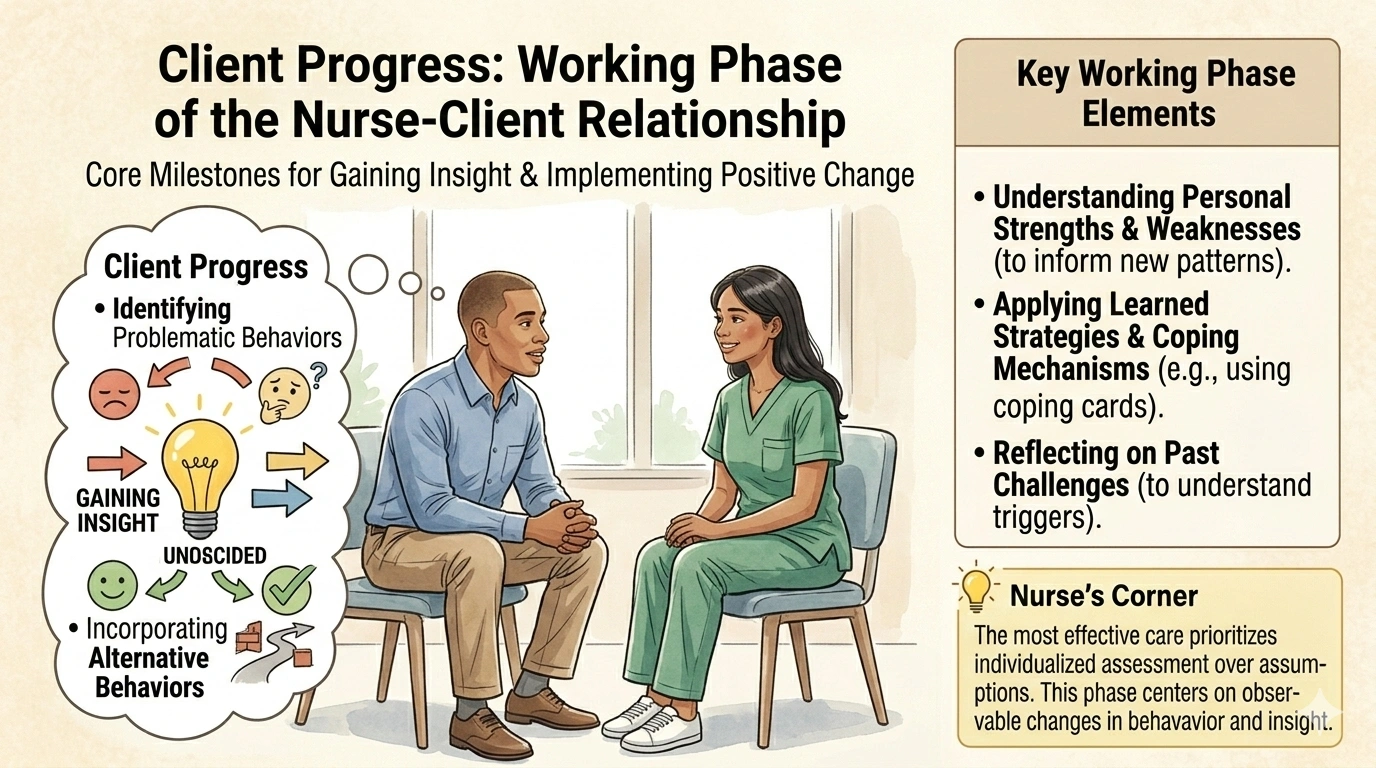
Which client response should a nurse expect during the working phase of the nurseclient relationship?
A.
The client gains insight and incorporates alternative behaviors.
B. The client and nurse establish rapport and mutually develop treatment goals.
C. The client explores feelings related to reentering the community.
D. The client explores personal strengths and weaknesses that impact behaviors.
Rationale
What the nurse should choose for "Which client response should a nurse expect during the working phase of the nurseclient relationship" is "The client gains insight and incorporates alternative behaviors.".
A. The client gains insight and incorporates alternative behaviors.
This is the best answer because it directly reflects the key cue in the stem. It responds to "Which client response should a nurse expect during the working phase of the..." without stereotyping the client or shifting to a different concept. It promotes safe decision-making by basing interpretation on observable data.
B. The client and nurse establish rapport and mutually develop treatment goals.
This choice misses the priority of the question and would lead the nurse away from the best clinical judgment. Compared with the stem ("Which client response should a nurse expect during the working phase of the..."), this choice introduces a different emphasis ("The client and nurse establish rapport and mutually develop treatment goals."). Choose the option that answers the question directly without adding extra assumptions.
C. The client explores feelings related to reentering the community.
This choice is off-target for what the stem is asking. It may be loosely connected, but it doesn't match the priority concept. Here, "The client explores feelings related to reentering the community." pulls the nurse away from the stem's cue ("Which client response should a nurse expect during the working phase of the..."). Choose the option that answers the question directly without adding extra assumptions.
D. The client explores personal strengths and weaknesses that impact behaviors.
This choice misses the focus of the question and would lead the clinician away from the best clinical judgment. This answer centers "The client explores personal strengths and weaknesses that impact behaviors.," but the stem highlights "Which client response should a nurse expect during the working phase of the...." A good elimination step is to remove choices that stereotype or drift away from the stem's priority.
**Conclusion**
The scenario emphasizes Which client response should a nurse expect during the working phase of the nurseclient relationship?. The most appropriate response is The client gains insight and incorporates alternative behaviors., which aligns with the concept tested in the scenario. Options written in sweeping terms tend to replace individualized assessment with assumptions; that approach weakens accuracy and rapport. Clinically, this reasoning helps maintain rapport while guiding safe nursing decision-making.
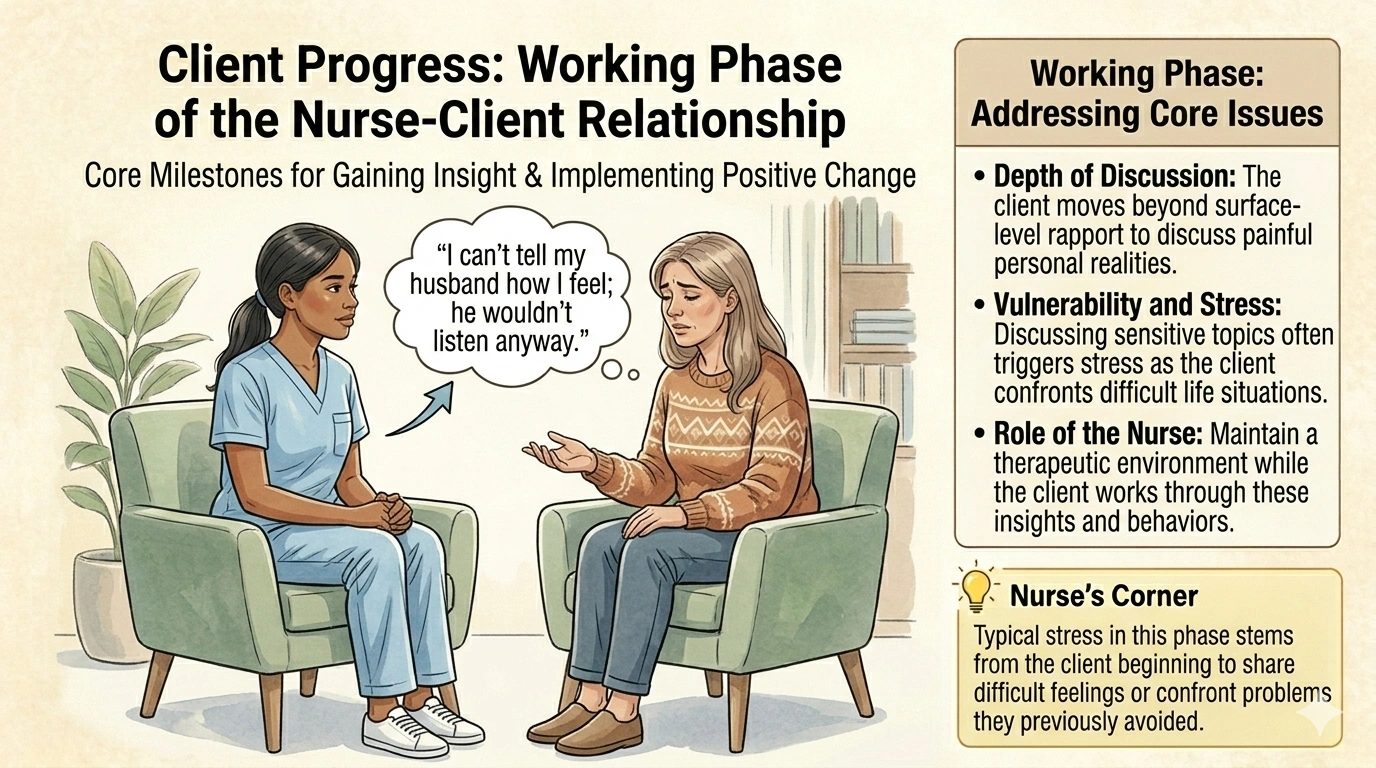
Which client statement should a nurse identify as a typical response to stress most often experienced in the working phase of the nurseclient relationship?
A.
I cant bear the thought of leaving here and failing.
B. I might have a hard time working with you. You remind me of my mother.
C. I cant tell my husband how I feel; he wouldnt listen anyway.
D. Im not sure that I can count on you to protect my confidentiality.
Rationale
For "Which client statement should a nurse identify as a typical response to stress most often experienced in the working phase of the nurseclient relationship," the best answer is "I cant tell my husband how I feel; he wouldnt listen anyway.".
A. I cant bear the thought of leaving here and failing.
This choice misses the focus of the question and would lead the clinician away from the best clinical judgment. Compared with the stem ("Which client statement should a nurse identify as a typical response to stress most..."), this choice introduces a different emphasis ("I cant bear the thought of leaving here and failing."). A good elimination step is to remove choices that stereotype or drift away from the stem's priority.
B. I might have a hard time working with you. You remind me of my mother.
This option is off-target for what the stem is asking. It may be loosely connected, but it doesn't match the priority concept. Compared with the stem ("Which client statement should a nurse identify as a typical response to stress most..."), this choice introduces a different emphasis ("I might have a hard time working with you. You remind me of my mother."). Choose the option that answers the question directly without adding extra assumptions.
C. I cant tell my husband how I feel; he wouldnt listen anyway.
This is the best answer because it directly reflects the key cue in the stem. It responds to "Which client statement should a clinician identify as a typical response to stress most..." without stereotyping the client or shifting to a different concept. It promotes safe decision-making by basing interpretation on observable data.
D. Im not sure that I can count on you to protect my confidentiality.
This choice misses the focus of the question and would lead the clinician away from the best clinical judgment. The statement "Im not sure that I can count on you to protect my confidentiality." is not supported by the scenario ("Which client statement should a nurse identify as a typical response to stress most..."). A good elimination step is to remove choices that stereotype or drift away from the stem's priority.
**Conclusion**
In this situation, the main issue is Which client statement should a nurse identify as a typical response to stress most often experienced in the working.... The best-supported answer is I cant tell my husband how I feel; he wouldnt listen anyway., because it matches the situation described. The better reasoning here is the one that connects directly to the scenario details and the concept being tested. This interpretation promotes culturally safe care and reduces the risk of misunderstanding client behavior.
If an individual is two-faced, which characteristic essential to the development of a therapeutic relationship should a nurse identify as missing?
A.
Respect
B. Genuineness
C. Sympathy
D. Rapport
Rationale
The most appropriate selection for "If an individual is two-faced, which characteristic essential to the development of a therapeutic relationship should a nurse identify as missing" is "Genuineness".
A. Respect
This option is off-target for what the stem is asking. It may be loosely connected, but it doesn't match the priority concept. Compared with the stem ("If an individual is two-faced, which characteristic essential to the development of a..."), this choice introduces a different emphasis ("Respect"). Choose the option that answers the question directly without adding extra assumptions.
B. Genuineness
This is the strongest option because it applies culturally informed, nonjudgmental nursing interpretation. It addresses the stem's priority ("If an individual is two-faced, which characteristic essential to the development of a...") in a straightforward way. It promotes safe decision-making by basing interpretation on observable data.
C. Sympathy
This choice misses the focus of the question and would lead the clinician away from the best clinical judgment. The statement "Sympathy" is not supported by the scenario ("If an individual is two-faced, which characteristic essential to the development of a..."). Clinically, this would risk misinterpretation because it is not grounded in the presented data.
D. Rapport
This option is off-target for what the stem is asking. It may be loosely connected, but it doesn't match the priority concept. Here, "Rapport" pulls the nurse away from the stem's cue ("If an individual is two-faced, which characteristic essential to the development of a..."). A good elimination step is to remove choices that stereotype or drift away from the stem's priority.
**Conclusion**
This item centers on If an individual is two-faced, which characteristic essential to the development of a therapeutic relationship should.... The best-supported answer is Genuineness, because it matches the situation described. The strongest answers in this set stay closely tied to what is stated in the scenario and avoid adding extra meaning. This interpretation promotes culturally safe care and reduces the risk of misunderstanding client behavior.
A nurse moving out of state speaks to a client about the need to work with a new nurse. The client states, Im not well enough to switch to a different nurse. What does this client response indicate to the nurse?
A.
The client is using manipulation to receive secondary gain.
B. The client is using the defense mechanism of denial.
C.
D.
Rationale
For "What does this client response indicate to the nurse," the best answer is "".
A. The client is using manipulation to receive secondary gain.
This choice is off-target for what the stem is asking. It may be loosely connected, but it doesn't match the priority concept. Compared with the stem ("A nurse moving out of state speaks to a client about the need to work with a new..."), this choice introduces a different emphasis ("The client is using manipulation to receive secondary gain."). A good elimination step is to remove choices that stereotype or drift away from the stem's priority.
B. The client is using the defense mechanism of denial.
This choice misses the focus of the question and would lead the nurse away from the best clinical judgment. Here, "The client is using the defense mechanism of denial." pulls the nurse away from the stem's cue ("A nurse moving out of state speaks to a client about the need to work with a new..."). Choose the option that answers the question directly without adding extra assumptions.
**Conclusion**
The focus of this question is A nurse moving out of state speaks to a client about the need to work with a new nurse. The client states, Im not well.... The best answer will be the choice that directly matches the scenario and the concept being assessed. The better reasoning here is the one that connects directly to the scenario details and the concept being tested. Clinically, this reasoning helps maintain rapport while guiding safe nursing decision-making.
As the client and nurse move from the orientation stage to the working stage of the therapeutic relationship, which is the nurses most therapeutic statement?
A.
B.
C.
D.
Rationale
The statement that best answers "As the client and nurse move from the orientation stage to the working stage of the therapeutic relationship, which is the nurses most therapeutic statement" is "".
**Conclusion**
The scenario emphasizes As the client and nurse move from the orientation stage to the working stage of the therapeutic relationship, which is.... The best answer will be the choice that directly matches the scenario and the concept being assessed. The strongest answers in this set stay closely tied to what is stated in the scenario and avoid adding extra meaning. In practice, this approach supports accurate assessment and respectful, client-centered care.
Which nursing action demonstrates the role of the teacher in a therapeutic milieu?
A.
The nurse implements a self-affirmation exercise during a one-to-one client interaction.
B. The nurse holds a group meeting to present common side effects of psychiatric medications.
C. The nurse introduces the concept of fair play while playing cards with a group of clients.
D. The nurse models adaptive and effective coping mechanisms with clients on the psychiatric unit.
Rationale
The nursing action that fits the question is "The nurse holds a group meeting to present common side effects of psychiatric medications.".
A. The nurse implements a self-affirmation exercise during a one-to-one client interaction.
This choice misses the focus of the question and would lead the nurse away from the best clinical judgment. The statement "The nurse implements a self-affirmation exercise during a one-to-one client interaction." is not supported by the scenario ("Which nursing action demonstrates the role of the teacher in a therapeutic milieu?"). In practice, the nurse should stay with assessment cues and culturally safe interpretation.
B. The nurse holds a group meeting to present common side effects of psychiatric medications.
This choice fits because it stays grounded in the situation and avoids added assumptions. It matches what the stem emphasizes ("Which nursing action demonstrates the role of the teacher in a therapeutic milieu?") and guides appropriate nursing judgment. Clinically, it helps preserve rapport while interpreting behavior through context.
C. The nurse introduces the concept of fair play while playing cards with a group of clients.
This choice misses the focus of the question and would lead the nurse away from the best clinical judgment. The statement "The nurse introduces the concept of fair play while playing cards with a group of clients." is not supported by the scenario ("Which nursing action demonstrates the role of the teacher in a therapeutic milieu?"). Choose the option that answers the question directly without adding extra assumptions.
D. The nurse models adaptive and effective coping mechanisms with clients on the psychiatric unit.
This answer does not address the stem's main point. It either answers a different question or adds meaning not provided in the scenario. The statement "The nurse models adaptive and effective coping mechanisms with clients on the psychiatric unit." is not supported by the scenario ("Which nursing action demonstrates the role of the teacher in a therapeutic milieu?"). Clinically, this would risk misinterpretation because it is not grounded in the presented data.
**Conclusion**
The focus of this question is Which nursing action demonstrates the role of the teacher in a therapeutic milieu? The nurse holds a group meeting to present common side effects of psychiatric medications.. The strongest answers in this set stay closely tied to what is stated in the scenario and avoid adding extra meaning. In practice, this approach supports accurate assessment and respectful, client-centered care.
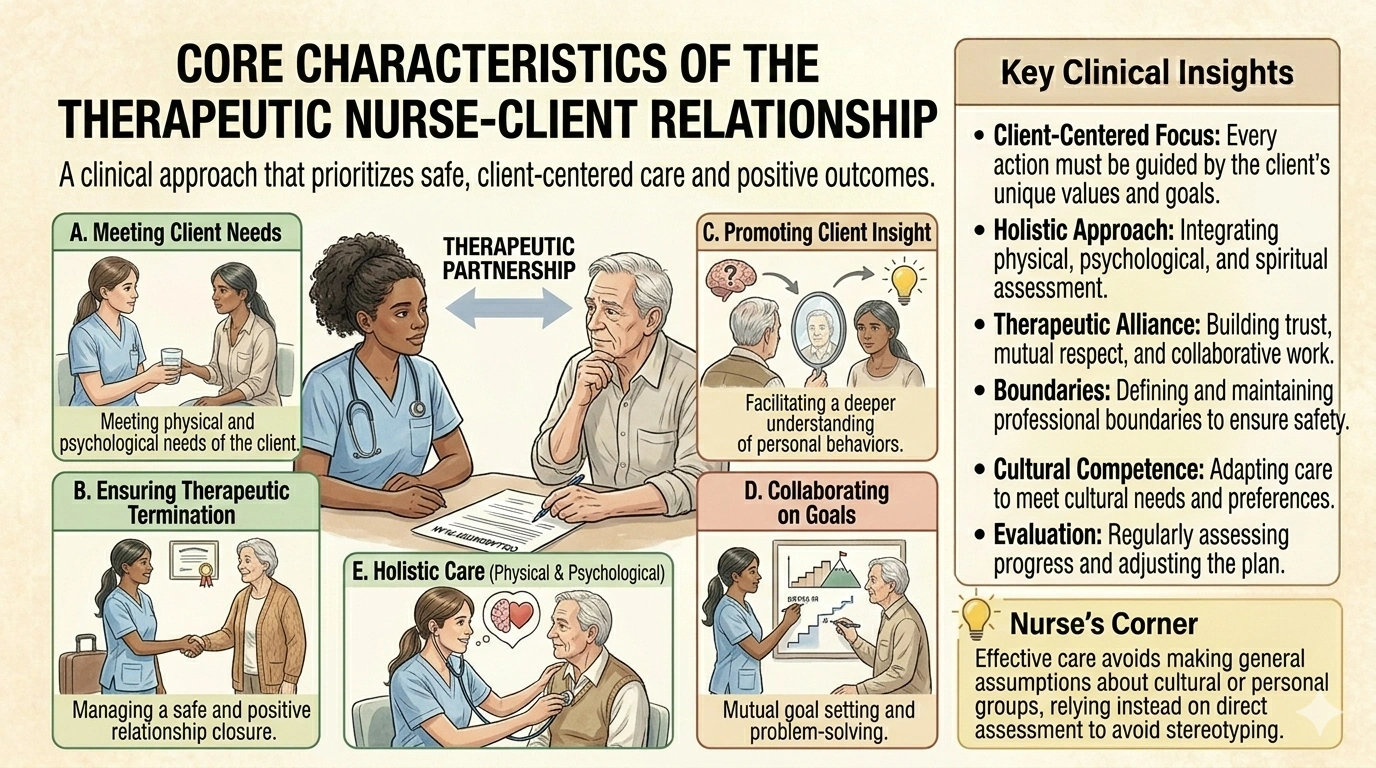
The nurseclient therapeutic relationship includes which of the following characteristics? Select all that apply.
A.
Meeting the psychological needs of the nurse and the client
B. Ensuring therapeutic termination
C. Promoting client insight into problematic behavior
D. Collaborating to set appropriate goals
Rationale
The most appropriate selection for "The nurseclient therapeutic relationship includes which of the following characteristics? Select all that apply." is "Ensuring therapeutic termination, Promoting client insight into problematic behavior, Collaborating to set appropriate goals, Meeting both the physical and psychological needs of the client".
A. Meeting the psychological needs of the nurse and the client
This choice misses the priority of the question and would lead the nurse away from the best clinical judgment. Compared with the stem ("The nurseclient therapeutic relationship includes which of the following..."), this choice introduces a different emphasis ("Meeting the psychological needs of the nurse and the client"). In practice, the nurse should stay with assessment cues and culturally safe interpretation.
B. Ensuring therapeutic termination
This is the best answer because it directly reflects the key cue in the stem. It addresses the stem's focus ("The clinicianclient therapeutic relationship includes which of the following...") in a straightforward way. In practice, this supports respectful communication and accurate assessment.
C. Promoting client insight into problematic behavior
This option is off-target for what the stem is asking. It may be loosely connected, but it doesn't match the priority concept. Here, "Promoting client insight into problematic behavior" pulls the nurse away from the stem's cue ("The nurseclient therapeutic relationship includes which of the following..."). Clinically, this would risk misinterpretation because it is not grounded in the presented data.
D. Collaborating to set appropriate goals
This option is off-target for what the stem is asking. It may be loosely connected, but it doesn't match the priority concept. The statement "Collaborating to set appropriate goals" is not supported by the scenario ("The nurseclient therapeutic relationship includes which of the following..."). In practice, the nurse should stay with assessment cues and culturally safe interpretation.
E. Meeting both the physical and psychological needs of the client
This answer does not address the stem's main point. It either answers a different question or adds meaning not provided in the scenario. The statement "Meeting both the physical and psychological needs of the client" is not supported by the scenario ("The nurseclient therapeutic relationship includes which of the following..."). In practice, the nurse should stay with assessment cues and culturally safe interpretation.
**Conclusion**
In this situation, the main issue is The nurseclient therapeutic relationship includes which of the following characteristics? Select all that apply.. The best-supported answer is Ensuring therapeutic termination; Promoting client insight into problematic behavior; Collaborating to set appropriate goals; Meeting both the physical and psychological needs of the client, because it matches the situation described. The strongest answers in this set stay closely tied to what is stated in the scenario and avoid adding extra meaning. In practice, this approach supports accurate assessment and respectful, client-centered care.
Chapter 8. Therapeutic Communication
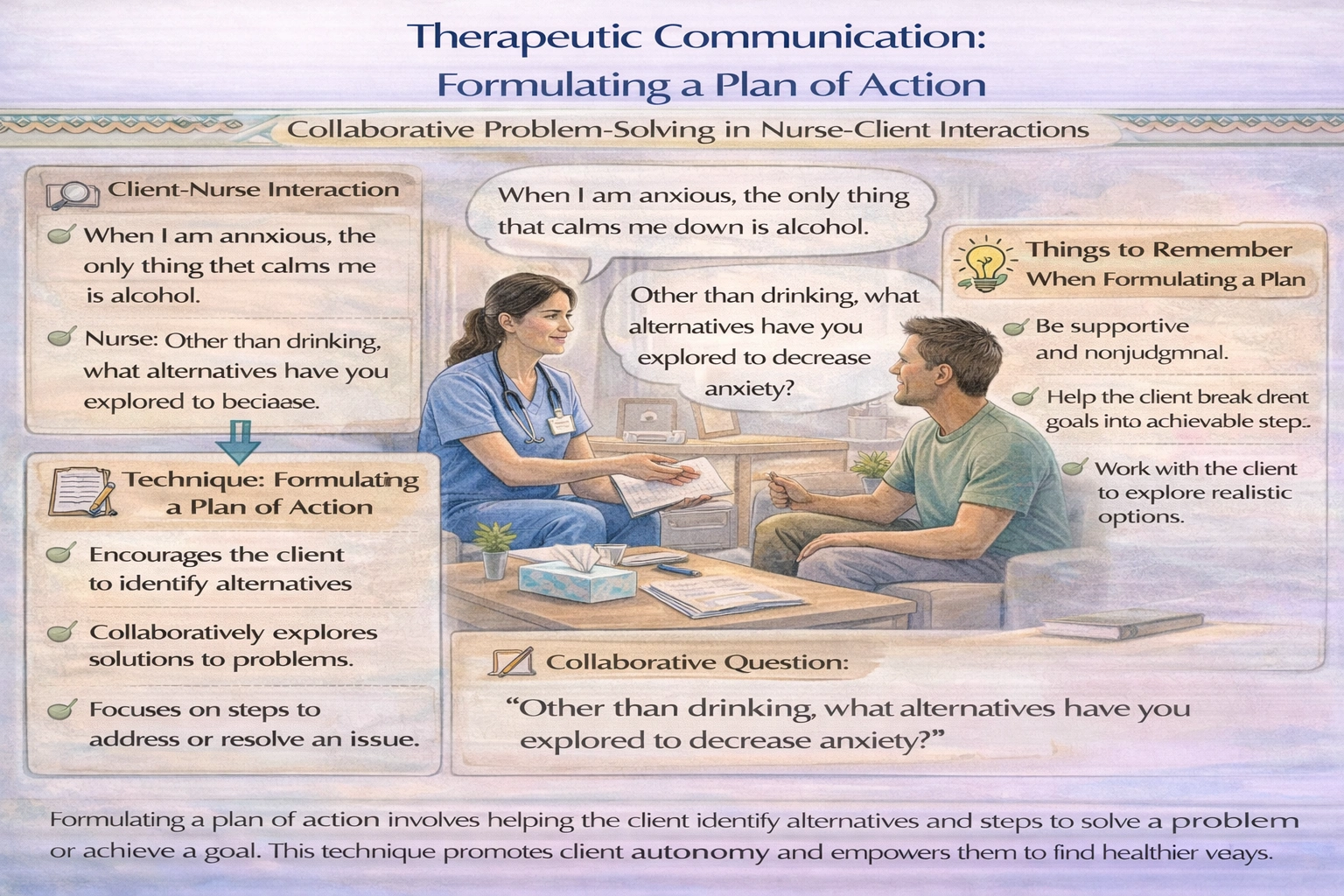
Which therapeutic communication technique is being used in this nurseclient interaction? Client: When I am anxious, the only thing that calms me down is alcohol. Nurse: Other than drinking, what alternatives have you explored to decrease anxiety?
A.
Reflecting
B. Making observations
C. Formulating a plan of action
D. Giving recognition
Rationale
The correct response to "When I am anxious, the only thing that calms me down is alcohol. Nurse: Other than drinking, what alternatives have you explored to decrease anxiety" is "Formulating a plan of action".
A. Reflecting
This choice misses the focus of the question and would lead the nurse away from the best clinical judgment. The statement "Reflecting" is not supported by the scenario ("Which therapeutic communication technique is being used in this nurseclient..."). A good elimination step is to remove choices that stereotype or drift away from the stem's priority.
B. Making observations
This choice misses the focus of the question and would lead the clinician away from the best clinical judgment. The statement "Making observations" is not supported by the scenario ("Which therapeutic communication technique is being used in this nurseclient..."). Choose the option that answers the question directly without adding extra assumptions.
C. Formulating a plan of action
This is the best answer because it directly reflects the key cue in the stem. It keeps attention on "Which therapeutic communication technique is being used in this nurseclient...," which is what this item is testing. From a nursing-process perspective, it prioritizes assessment and therapeutic effectiveness.
D. Giving recognition
This choice misses the focus of the question and would lead the nurse away from the best clinical judgment. Here, "Giving recognition" pulls the nurse away from the stem's cue ("Which therapeutic communication technique is being used in this nurseclient..."). Choose the choice that answers the question directly without adding extra assumptions.
**Conclusion**
The focus of this question is Which therapeutic communication technique is being used in this nurseclient interaction? Client: When I am anxious,.... The best-supported answer is Formulating a plan of action, because it matches the situation described. The strongest answers in this set stay closely tied to what is stated in the scenario and avoid adding extra meaning. In practice, this approach supports accurate assessment and respectful, client-centered care.
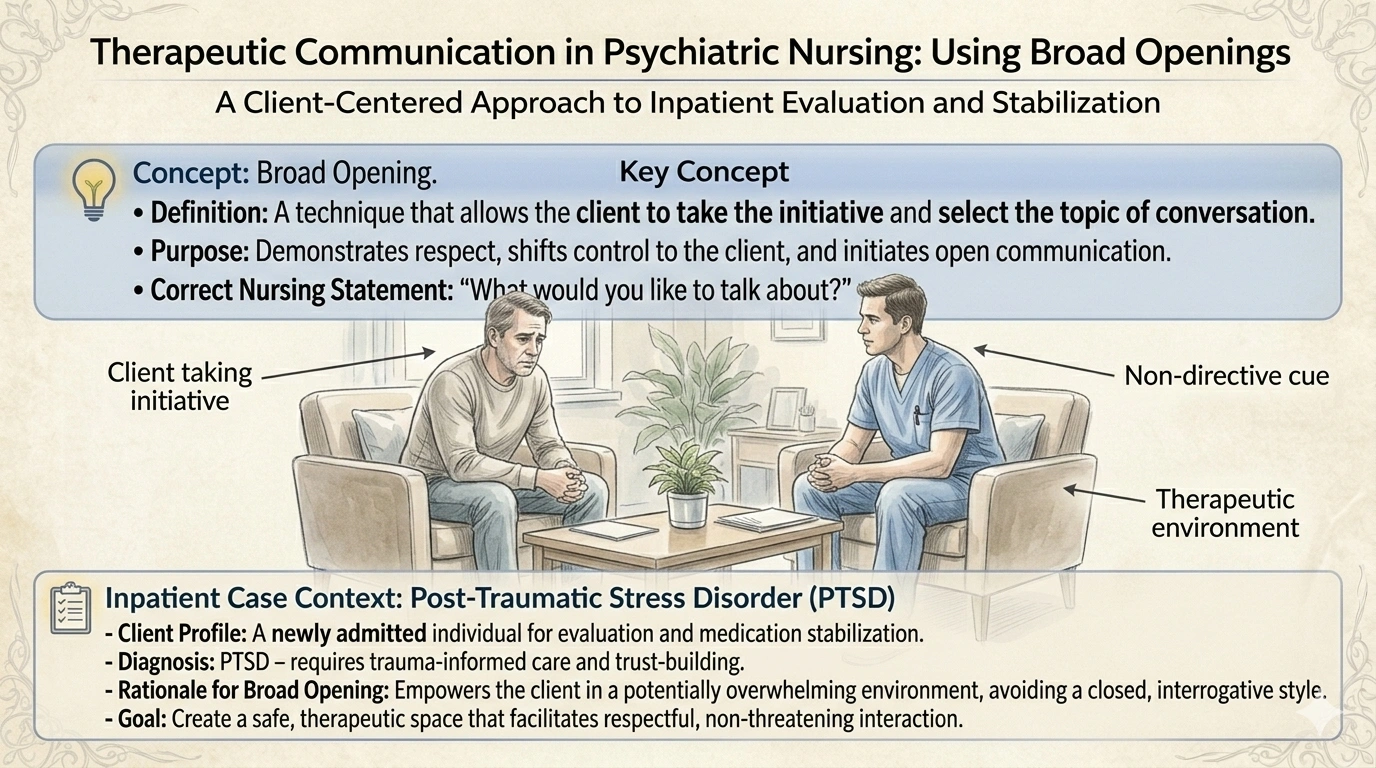
A client diagnosed with post-traumatic stress disorder is admitted to an inpatient psychiatric unit for evaluation and medication stabilization. Which therapeutic communication technique used by the nurse is an example of a broad opening?
A.
What occurred prior to the rape, and when did you go to the emergency department?
B. What would you like to talk about?
C. I notice you seem uncomfortable discussing this.
D. How can we help you feel safe during your stay here?
Rationale
The therapeutic communication technique being used is "What would you like to talk about?".
A. What occurred prior to the rape, and when did you go to the emergency department?
This answer does not address the stem's main point. It either answers a different question or adds meaning not provided in the scenario. The statement "What occurred prior to the rape, and when did you go to the emergency department?" is not supported by the scenario ("A client diagnosed with post-traumatic stress disorder is admitted to an inpatient..."). In practice, the nurse should stay with assessment cues and culturally safe interpretation.
B. What would you like to talk about?
This answer is supported by the stem and aligns with safe, client-centered nursing care. It responds to "A client diagnosed with post-traumatic stress disorder is admitted to an inpatient..." without stereotyping the client or shifting to a different concept. In practice, this supports respectful communication and accurate assessment.
C. I notice you seem uncomfortable discussing this.
This option is off-target for what the stem is asking. It may be loosely connected, but it doesn't match the priority concept. This answer centers "I notice you seem uncomfortable discussing this.," but the stem highlights "A client diagnosed with post-traumatic stress disorder is admitted to an inpatient...." Choose the option that answers the question directly without adding extra assumptions.
D. How can we help you feel safe during your stay here?
This choice is off-target for what the stem is asking. It may be loosely connected, but it doesn't match the priority concept. Compared with the stem ("A client diagnosed with post-traumatic stress disorder is admitted to an inpatient..."), this choice introduces a different emphasis ("How can we help you feel safe during your stay here?"). A good elimination step is to remove choices that stereotype or drift away from the stem's priority.
**Conclusion**
This item centers on A client diagnosed with post-traumatic stress disorder is admitted to an inpatient psychiatric unit for evaluation and... What would you like to talk about?. The strongest answers in this set stay closely tied to what is stated in the scenario and avoid adding extra meaning. In practice, this approach supports accurate assessment and respectful, client-centered care.
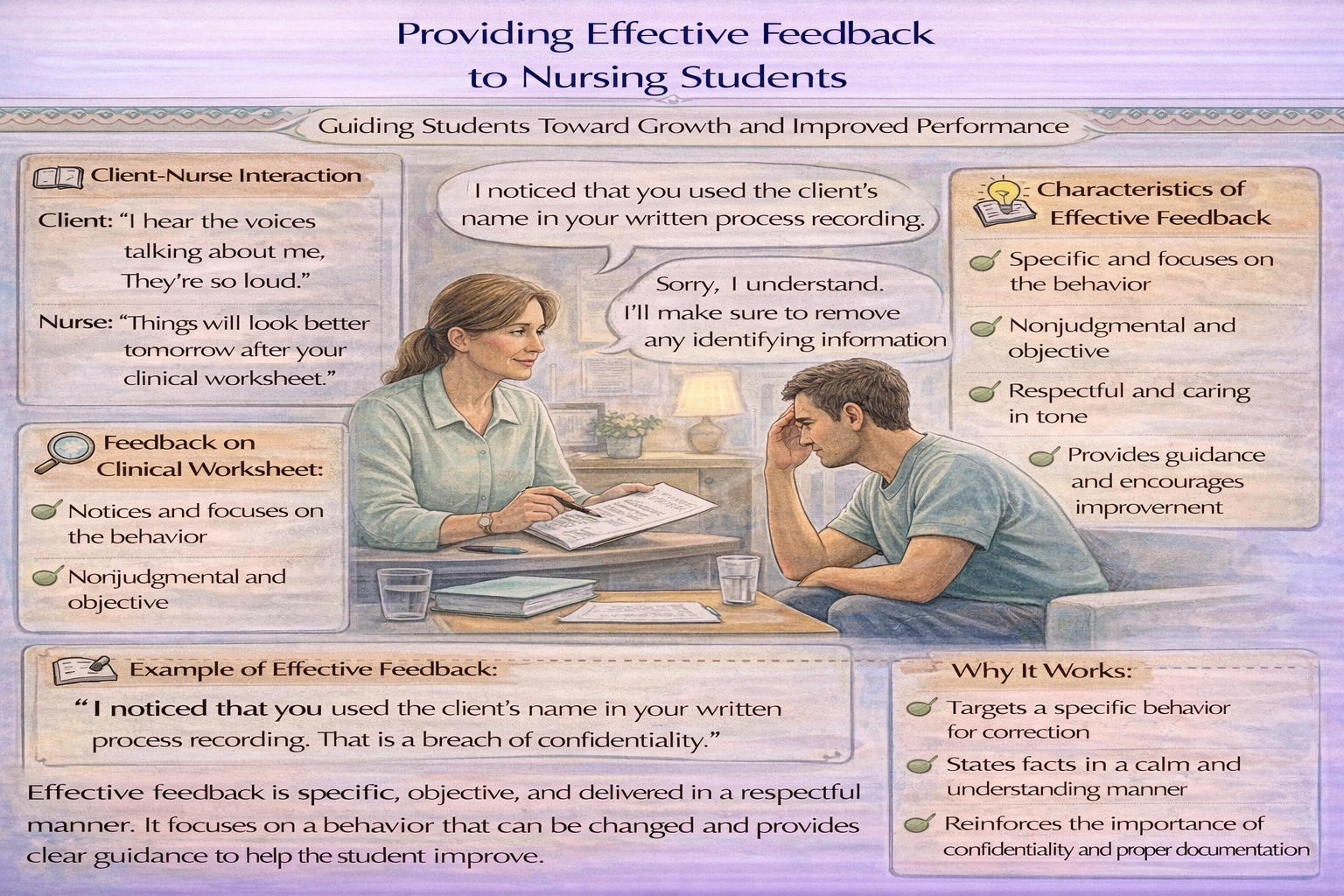
An instructor is correcting a nursing students clinical worksheet. Which instructor statement is the best example of effective feedback?
A.
Why did you use the clients name on your clinical worksheet?
B. You were very careless to refer to your client by name on your clinical worksheet.
C. I noticed that you used the clients name in your written process recording. That is a breach of confidentiality.
D. It is disappointing that after being told, youre still using client names on your worksheet.
Rationale
The answer to "Which instructor statement is the best example of effective feedback" is "I noticed that you used the clients name in your written process recording. That is a breach of confidentiality.".
A. Why did you use the clients name on your clinical worksheet?
This choice is off-target for what the stem is asking. It may be loosely connected, but it doesn't match the priority concept. This answer centers "Why did you use the clients name on your clinical worksheet?," but the stem highlights "An instructor is correcting a nursing students clinical worksheet. Which instructor...." A good elimination step is to remove choices that stereotype or drift away from the stem's priority.
B. You were very careless to refer to your client by name on your clinical worksheet.
This choice is off-target for what the stem is asking. It may be loosely connected, but it doesn't match the priority concept. The statement "You were very careless to refer to your client by name on your clinical worksheet." is not supported by the scenario ("An instructor is correcting a nursing students clinical worksheet. Which instructor..."). A good elimination step is to remove choices that stereotype or drift away from the stem's priority.
C. I noticed that you used the clients name in your written process recording. That is a breach of confidentiality.
This choice fits because it stays grounded in the scenario and avoids added assumptions. It responds to "An instructor is correcting a nursing students clinical worksheet. Which instructor..." without stereotyping the client or shifting to a different concept. In practice, this supports respectful communication and accurate assessment.
D. It is disappointing that after being told, youre still using client names on your worksheet.
This option is off-target for what the stem is asking. It may be loosely connected, but it doesn't match the priority concept. Compared with the stem ("An instructor is correcting a nursing students clinical worksheet. Which instructor..."), this choice introduces a different emphasis ("It is disappointing that after being told, youre still using client names on your worksheet."). In practice, the nurse should stay with assessment cues and culturally safe interpretation.
**Conclusion**
The focus of this question is An instructor is correcting a nursing students clinical worksheet. Which instructor statement is the best example of.... The best-supported answer is I noticed that you used the clients name in your written process recording. That is a..., because it matches the situation described. The better reasoning here is the one that connects directly to the scenario details and the concept being tested. Clinically, this reasoning helps maintain rapport while guiding safe nursing decision-making.
A client who frequently exhibits angry outbursts is diagnosed with antisocial personality disorder. Which appropriate feedback should a nurse provide when this client experiences an angry outburst?
A.
Why do you continue to alienate your peers by your angry outbursts?
B. You accomplish nothing when you lose your temper like that.
C.
D.
Rationale
The answer to "Which appropriate feedback should a nurse provide when this client experiences an angry outburst" is "".
A. Why do you continue to alienate your peers by your angry outbursts?
The tone of this option can increase defensiveness or anxiety. Therapeutic care keeps the focus on feelings, meaning, and safety. This answer centers "Why do you continue to alienate your peers by your angry outbursts?," but the stem highlights "A client who frequently exhibits angry outbursts is diagnosed with antisocial...." A good elimination step is to remove choices that stereotype or drift away from the stem's priority.
B. You accomplish nothing when you lose your temper like that.
This answer does not address the stem's main point. It either answers a different question or adds meaning not provided in the situation. The statement "You accomplish nothing when you lose your temper like that." is not supported by the scenario ("A client who frequently exhibits angry outbursts is diagnosed with antisocial..."). A good elimination step is to remove choices that stereotype or drift away from the stem's priority.
**Conclusion**
In this situation, the main issue is A client who frequently exhibits angry outbursts is diagnosed with antisocial personality disorder. Which appropriate.... The correct response should be the one that addresses the concept being tested using only the information given. The better reasoning here is the one that connects directly to the scenario details and the concept being tested. Clinically, this reasoning helps maintain rapport while guiding safe nursing decision-making.
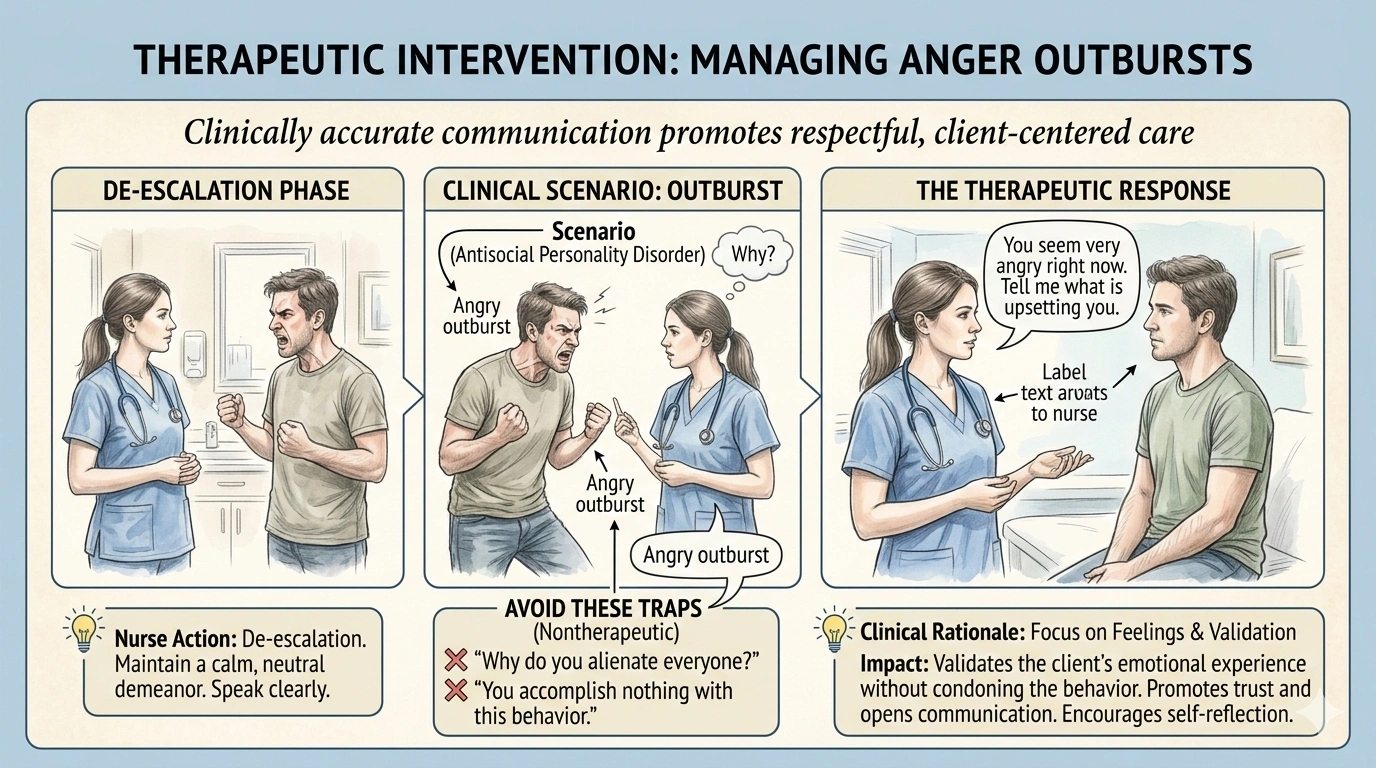
A mother rescues two of her four children from a house fire. In an emergency department, she cries, I should have gone back in to get them. I should have died, not them. Which of the following responses by the nurse is an example of reflection?
A.
The smoke was too thick. You couldnt have gone back in.
B. Youre feeling guilty because you werent able to save your children.
C. Focus on the fact that you could have lost all four of your children.
D. Its best if you try not to think about what happened. Try to move on.
Rationale
The correct response to "Which of the following responses by the nurse is an example of reflection" is "Youre feeling guilty because you werent able to save your children.".
A. The smoke was too thick. You couldnt have gone back in.
This choice misses the focus of the question and would lead the clinician away from the best clinical judgment. The statement "The smoke was too thick. You couldnt have gone back in." is not supported by the scenario ("A mother rescues two of her four children from a house fire. In an emergency..."). Choose the option that answers the question directly without adding extra assumptions.
B. Youre feeling guilty because you werent able to save your children.
This is the best answer because it directly reflects the key cue in the stem. It responds to "A mother rescues two of her four children from a house fire. In an emergency..." without stereotyping the client or shifting to a different concept. Clinically, it helps preserve rapport while interpreting behavior through context.
C. Focus on the fact that you could have lost all four of your children.
The wording here is sweeping and risks stereotyping. The item is asking for an interpretation grounded in the scenario, not a blanket statement. Here, "Focus on the fact that you could have lost all four of your children." pulls the nurse away from the stem's cue ("A mother rescues two of her four children from a house fire. In an emergency..."). Choose the option that answers the question directly without adding extra assumptions.
D. Its best if you try not to think about what happened. Try to move on.
This option is off-target for what the stem is asking. It may be loosely connected, but it doesn't match the priority concept. The statement "Its best if you try not to think about what happened. Try to move on." is not supported by the scenario ("A mother rescues two of her four children from a house fire. In an emergency..."). A good elimination step is to remove choices that stereotype or drift away from the stem's priority.
**Conclusion**
The scenario emphasizes A mother rescues two of her four children from a house fire. In an emergency department, she cries, I should have gone.... The most appropriate response is Youre feeling guilty because you werent able to save your children., which aligns with the concept tested in the scenario. Options written in sweeping terms tend to replace individualized assessment with assumptions; that approach weakens accuracy and rapport. Clinically, this reasoning helps maintain rapport while guiding safe nursing decision-making.
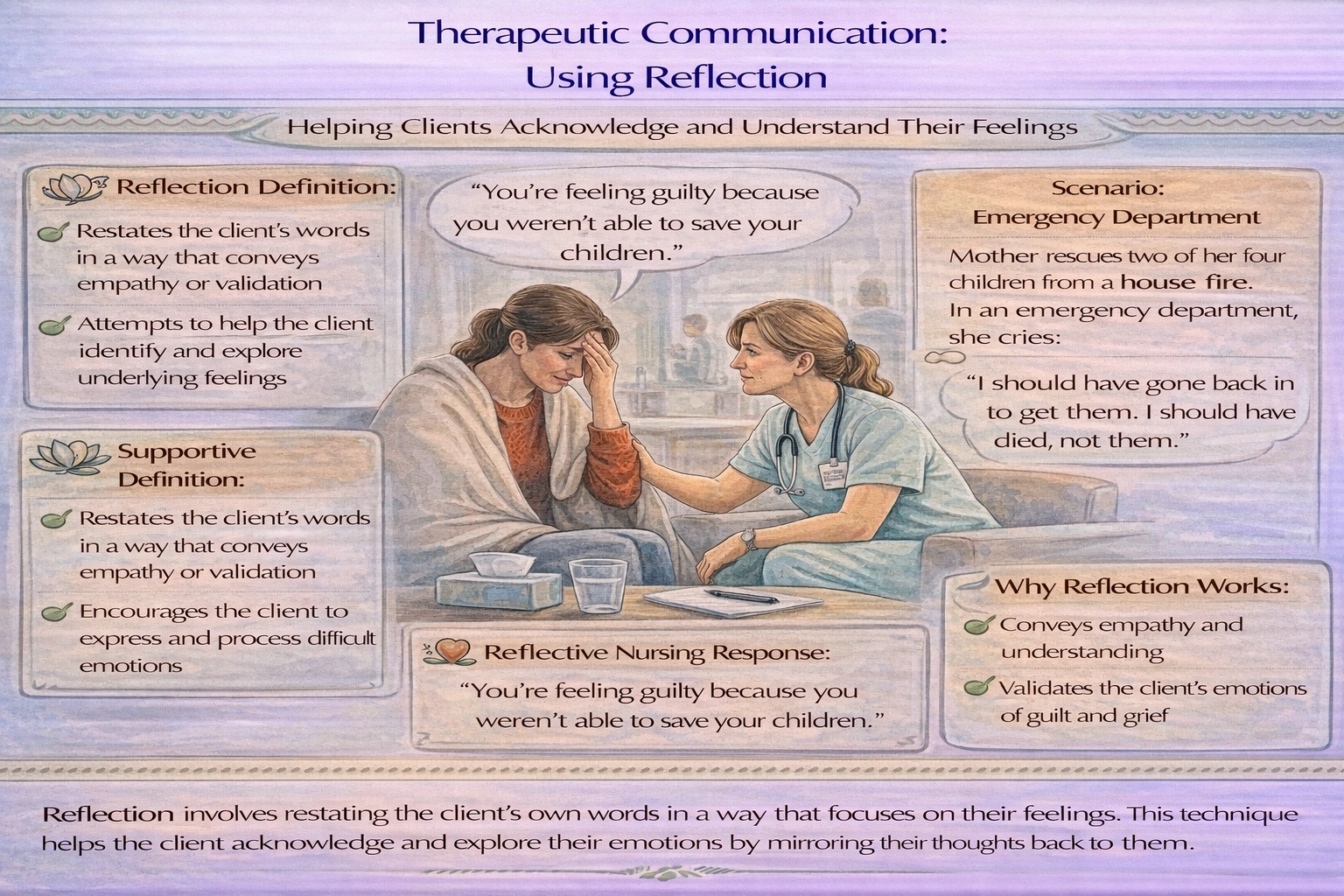
A client tells the nurse, I feel bad because my mother does not want me to return home after I leave the hospital. Which nursing response is therapeutic?
A.
Its quite common for clients to feel that way after a lengthy hospitalization.
B. Why dont you talk to your mother? You may find out she doesnt feel that way.
C. Your mother seems like an understanding person. Ill help you approach her.
D. You feel that your mother does not want you to come back home?
Rationale
For "Which nursing response is therapeutic," the best answer is "You feel that your mother does not want you to come back home?".
A. Its quite common for clients to feel that way after a lengthy hospitalization.
This option is off-target for what the stem is asking. It may be loosely connected, but it doesn't match the priority concept. Here, "Its quite common for clients to feel that way after a lengthy hospitalization." pulls the nurse away from the stem's cue ("A client tells the nurse, I feel bad because my mother does not want me to return home..."). A good elimination step is to remove choices that stereotype or drift away from the stem's priority.
B. Why dont you talk to your mother? You may find out she doesnt feel that way.
This option is off-target for what the stem is asking. It may be loosely connected, but it doesn't match the priority concept. Compared with the stem ("A client tells the nurse, I feel bad because my mother does not want me to return home..."), this choice introduces a different emphasis ("Why dont you talk to your mother? You may find out she doesnt feel that way."). Clinically, this would risk misinterpretation because it is not grounded in the presented data.
C. Your mother seems like an understanding person. Ill help you approach her.
This choice misses the focus of the question and would lead the nurse away from the best clinical judgment. This answer centers "Your mother seems like an understanding person. Ill help you approach her.," but the stem highlights "A client tells the nurse, I feel bad because my mother does not want me to return home...." In practice, the nurse should stay with assessment cues and culturally safe interpretation.
D. You feel that your mother does not want you to come back home?
This answer is supported by the stem and aligns with safe, client-centered nursing care. It addresses the stem's focus ("A client tells the nurse, I feel bad because my mother does not want me to return home...") in a straightforward way. It promotes safe decision-making by basing interpretation on observable data.
**Conclusion**
The scenario emphasizes A client tells the nurse, I feel bad because my mother does not want me to return home after I leave the hospital..... The most appropriate response is You feel that your mother does not want you to come back home?, which aligns with the concept tested in the scenario. The better reasoning here is the one that connects directly to the scenario details and the concept being tested. Clinically, this reasoning helps maintain rapport while guiding safe nursing decision-making.
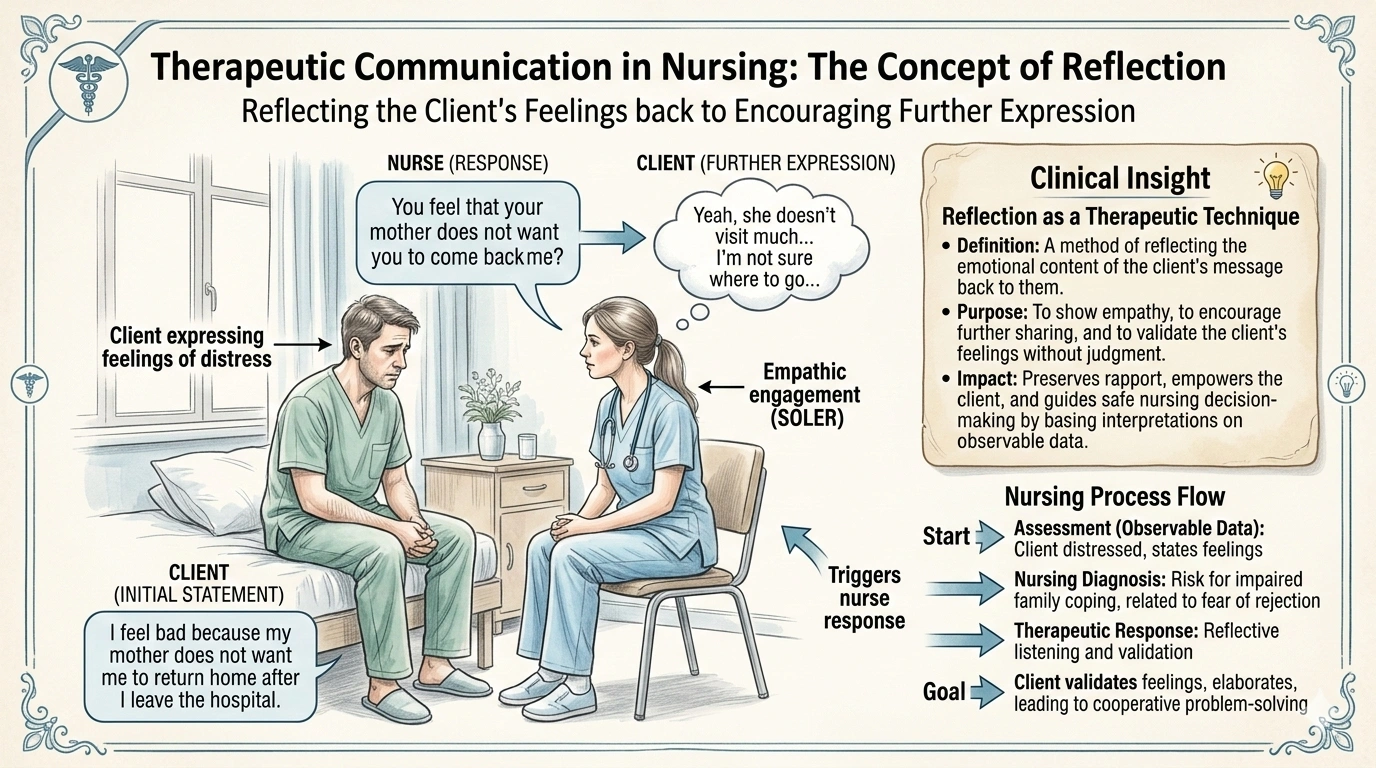
A client is trying to explore and solve a problem. Which nursing statement would be an example of verbalizing the implied?
A.
You seem to be motivated to change your behavior.
B. How will these changes affect your family relationships?
C. Why dont you make a list of the behaviors you need to change.
D. The team recommends that you make only one behavioral change at a time.
Rationale
The nursing statement that answers the question is "You seem to be motivated to change your behavior.".
A. You seem to be motivated to change your behavior.
This choice fits because it stays grounded in the scenario and avoids added assumptions. It matches what the stem emphasizes ("A client is trying to explore and solve a problem. Which nursing statement would be an...") and guides appropriate nursing judgment. In practice, this supports respectful communication and accurate assessment.
B. How will these changes affect your family relationships?
This answer does not address the stem's main point. It either answers a different question or adds meaning not provided in the scenario. The statement "How will these changes affect your family relationships?" is not supported by the scenario ("A client is trying to explore and solve a problem. Which nursing statement would be an..."). A good elimination step is to remove choices that stereotype or drift away from the stem's priority.
C. Why dont you make a list of the behaviors you need to change.
This answer does not address the stem's main point. It either answers a different question or adds meaning not provided in the scenario. The statement "Why dont you make a list of the behaviors you need to change." is not supported by the scenario ("A client is trying to explore and solve a problem. Which nursing statement would be an..."). Clinically, this would risk misinterpretation because it is not grounded in the presented data.
D. The team recommends that you make only one behavioral change at a time.
This choice misses the focus of the question and would lead the nurse away from the best clinical judgment. Here, "The team recommends that you make only one behavioral change at a time." pulls the nurse away from the stem's cue ("A client is trying to explore and solve a problem. Which nursing statement would be an..."). In practice, the nurse should stay with assessment cues and culturally safe interpretation.
**Conclusion**
The focus of this question is A client is trying to explore and solve a problem. Which nursing statement would be an example of verbalizing the.... The best-supported answer is You seem to be motivated to change your behavior., because it matches the situation described. The better reasoning here is the one that connects directly to the scenario details and the concept being tested. Clinically, this reasoning helps maintain rapport while guiding safe nursing decision-making.
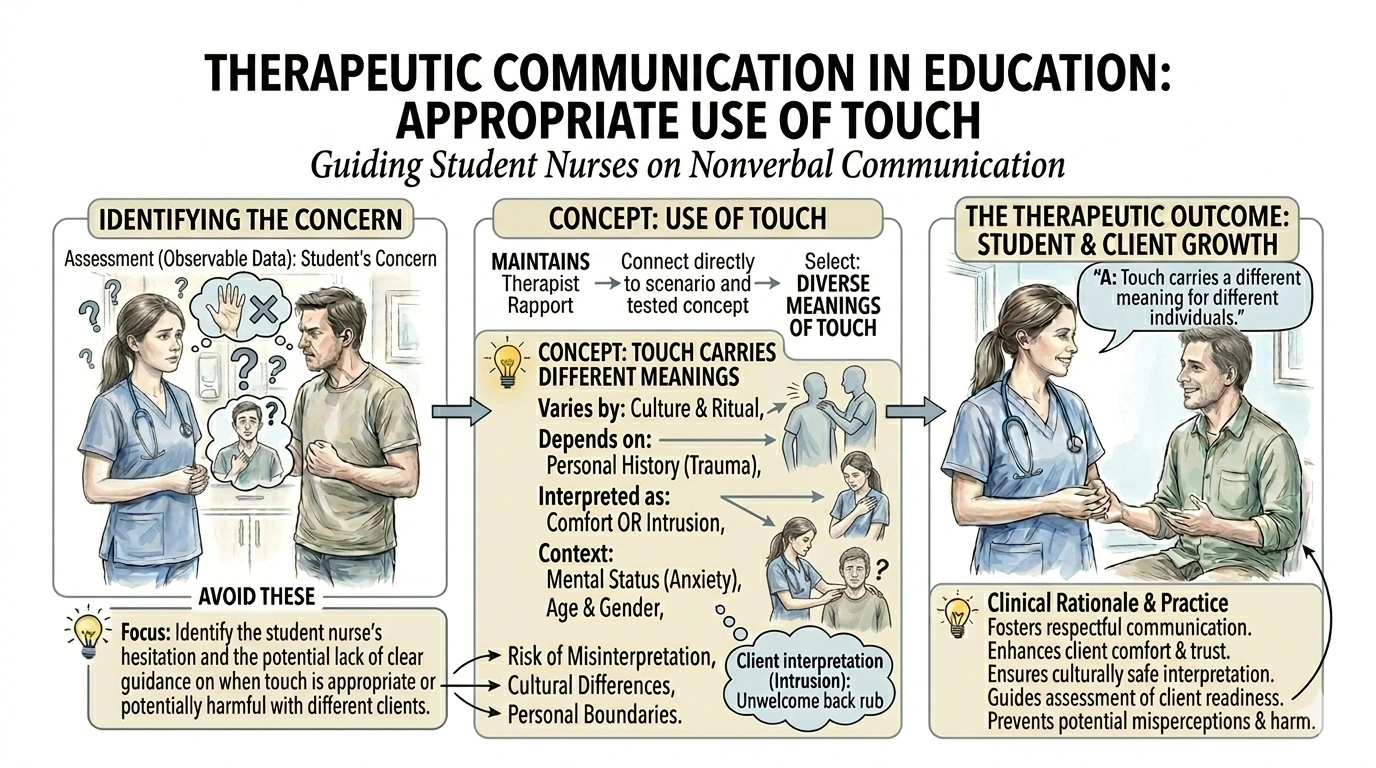
A student nurse is learning about the appropriate use of touch when communicating with clients diagnosed with psychiatric disorders. Which statement by the instructor best provides information about this aspect of therapeutic communication?
A.
Touch carries a different meaning for different individuals.
B. Touch is often used when deescalating volatile client situations.
C. Touch is used to convey interest and warmth.
D. Touch is best combined with empathy when dealing with anxious clients.
Rationale
The answer to "Which statement by the instructor best provides information about this aspect of therapeutic communication" is "Touch carries a different meaning for different individuals.".
A. Touch carries a different meaning for different individuals.
This is the best answer because it directly reflects the key cue in the stem. It keeps attention on "A student nurse is learning about the appropriate use of touch when communicating with...," which is what this item is testing. In practice, this supports respectful communication and accurate assessment.
B. Touch is often used when deescalating volatile client situations.
This answer does not address the stem's main point. It either answers a different question or adds meaning not provided in the scenario. Here, "Touch is often used when deescalating volatile client situations." pulls the nurse away from the stem's cue ("A student nurse is learning about the appropriate use of touch when communicating with..."). In practice, the nurse should stay with assessment cues and culturally safe interpretation.
C. Touch is used to convey interest and warmth.
This choice misses the focus of the question and would lead the nurse away from the best clinical judgment. This answer centers "Touch is used to convey interest and warmth.," but the stem highlights "A student nurse is learning about the appropriate use of touch when communicating with...." Choose the option that answers the question directly without adding extra assumptions.
D. Touch is best combined with empathy when dealing with anxious clients.
This answer does not address the stem's main point. It either answers a different question or adds meaning not provided in the scenario. Compared with the stem ("A student nurse is learning about the appropriate use of touch when communicating with..."), this choice introduces a different emphasis ("Touch is best combined with empathy when dealing with anxious clients."). Choose the option that answers the question directly without adding extra assumptions.
**Conclusion**
In this situation, the main issue is A student nurse is learning about the appropriate use of touch when communicating with clients diagnosed with... Touch carries a different meaning for different individuals.. The strongest answers in this set stay closely tied to what is stated in the scenario and avoid adding extra meaning. Clinically, this reasoning helps maintain rapport while guiding safe nursing decision-making.
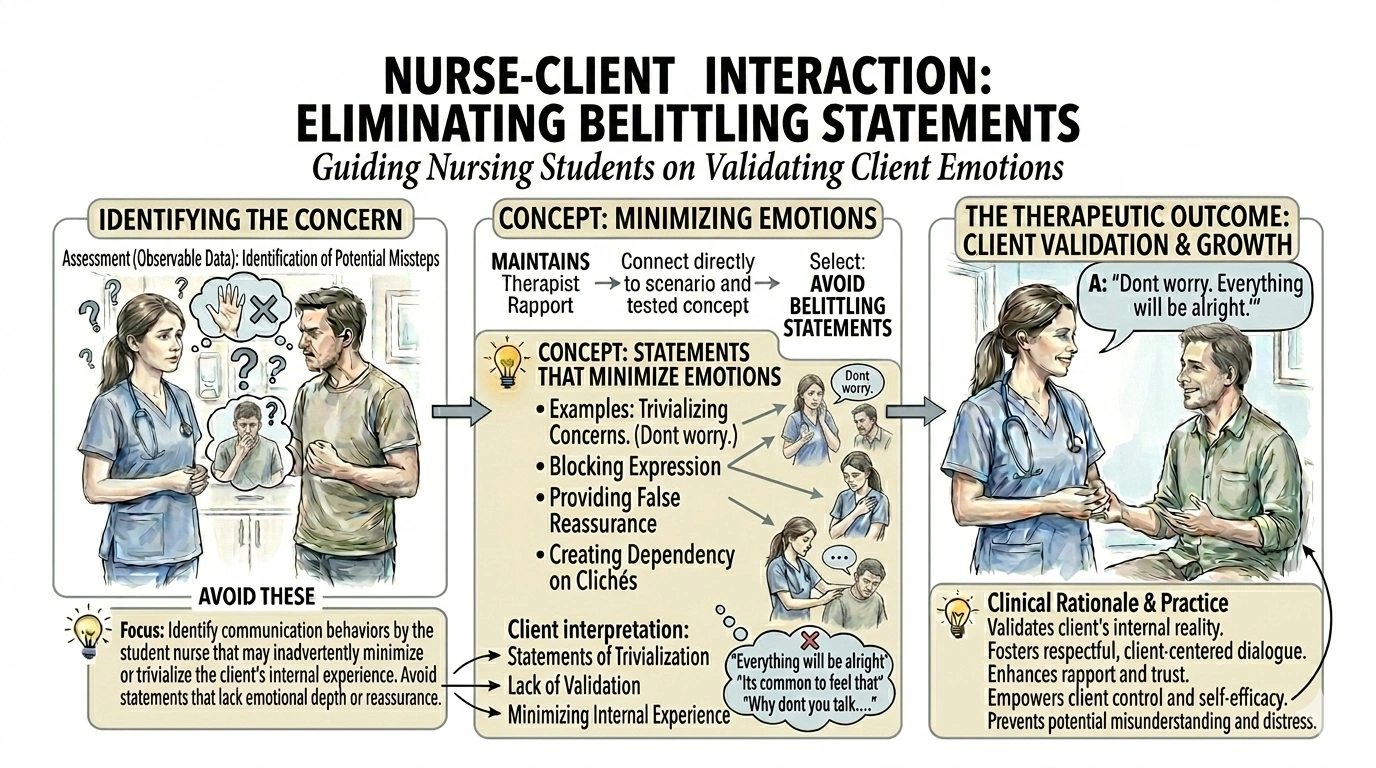
During a nurseclient interaction, which nursing statement may belittle the clients feelings and concerns?
A.
Dont worry. Everything will be alright.
B. You appear uptight.
C. I notice you have bitten your nails to the quick.
D. You are jumping to conclusions.
Rationale
For "During a nurseclient interaction, which nursing statement may belittle the clients feelings and concerns," the best answer is "Dont worry. Everything will be alright.".
A. Dont worry. Everything will be alright.
This choice fits because it stays grounded in the situation and avoids added assumptions. It addresses the stem's focus ("During a nurseclient interaction, which nursing statement may belittle the clients...") in a straightforward way. Clinically, it helps preserve rapport while interpreting behavior through context.
B. You appear uptight.
This answer does not address the stem's main point. It either answers a different question or adds meaning not provided in the situation. Here, "You appear uptight." pulls the nurse away from the stem's cue ("During a nurseclient interaction, which nursing statement may belittle the clients..."). Choose the option that answers the question directly without adding extra assumptions.
C. I notice you have bitten your nails to the quick.
This answer does not address the stem's main point. It either answers a different question or adds meaning not provided in the scenario. Compared with the stem ("During a nurseclient interaction, which nursing statement may belittle the clients..."), this choice introduces a different emphasis ("I notice you have bitten your nails to the quick."). A good elimination step is to remove choices that stereotype or drift away from the stem's priority.
D. You are jumping to conclusions.
This choice misses the focus of the question and would lead the nurse away from the best clinical judgment. This answer centers "You are jumping to conclusions.," but the stem highlights "During a nurseclient interaction, which nursing statement may belittle the clients...." A good elimination step is to remove choices that stereotype or drift away from the stem's priority.
**Conclusion**
This item centers on During a nurseclient interaction, which nursing statement may belittle the clients feelings and concerns? Dont worry. Everything will be alright.. The better reasoning here is the one that connects directly to the scenario details and the concept being tested. Clinically, this reasoning helps maintain rapport while guiding safe nursing decision-making.
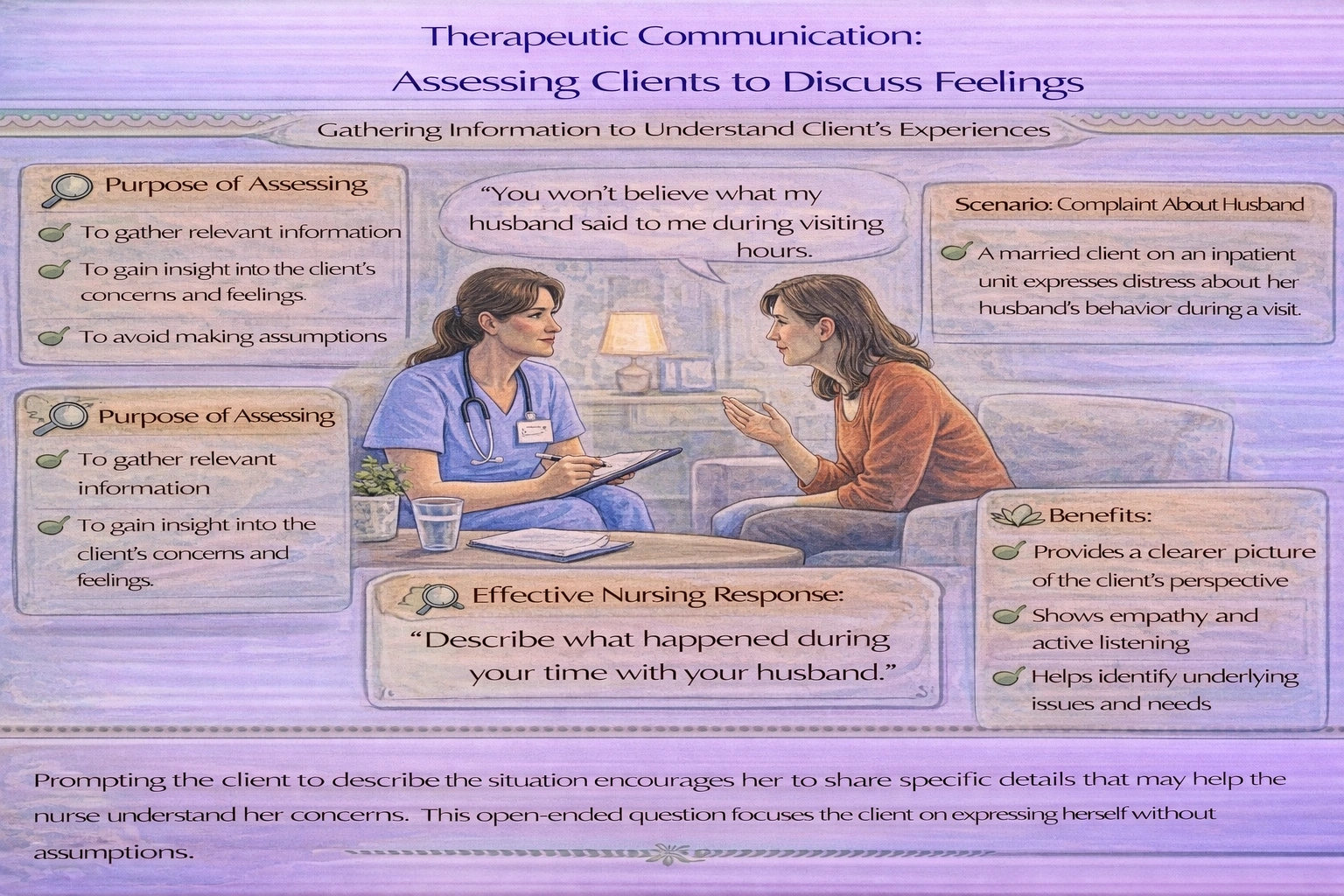
A client states, You wont believe what my husband said to me during visiting hours. He has no right treating me that way. Which nursing response would best assess the situation that occurred?
A.
Does your husband treat you like this very often?
B. What do you think is your role in this relationship?
C. Why do you think he behaved like that?
D. Describe what happened during your time with your husband.
Rationale
The statement that best answers "Which nursing response would best assess the situation that occurred" is "Describe what happened during your time with your husband.".
A. Does your husband treat you like this very often?
This option is off-target for what the stem is asking. It may be loosely connected, but it doesn't match the priority concept. The statement "Does your husband treat you like this very often?" is not supported by the scenario ("A client states, You wont believe what my husband said to me during visiting hours. He..."). Choose the choice that answers the question directly without adding extra assumptions.
B. What do you think is your role in this relationship?
This choice misses the focus of the question and would lead the nurse away from the best clinical judgment. This answer centers "What do you think is your role in this relationship?," but the stem highlights "A client states, You wont believe what my husband said to me during visiting hours. He...." Clinically, this would risk misinterpretation because it is not grounded in the presented data.
C. Why do you think he behaved like that?
This choice moves away from supportive communication. The nurse should avoid blame and instead use calm, client-centered language. Here, "Why do you think he behaved like that?" pulls the nurse away from the stem's cue ("A client states, You wont believe what my husband said to me during visiting hours. He..."). In practice, the nurse should stay with assessment cues and culturally safe interpretation.
D. Describe what happened during your time with your husband.
This answer is supported by the stem and aligns with safe, client-centered nursing care. It keeps attention on "A client states, You wont believe what my husband said to me during visiting hours. He...," which is what this item is testing. Clinically, it helps preserve rapport while interpreting behavior through context.
**Conclusion**
This item centers on A client states, You wont believe what my husband said to me during visiting hours. He has no right treating me that.... The most appropriate response is Describe what happened during your time with your husband., which aligns with the concept tested in the scenario. The better reasoning here is the one that connects directly to the scenario details and the concept being tested. Clinically, this reasoning helps maintain rapport while guiding safe nursing decision-making.
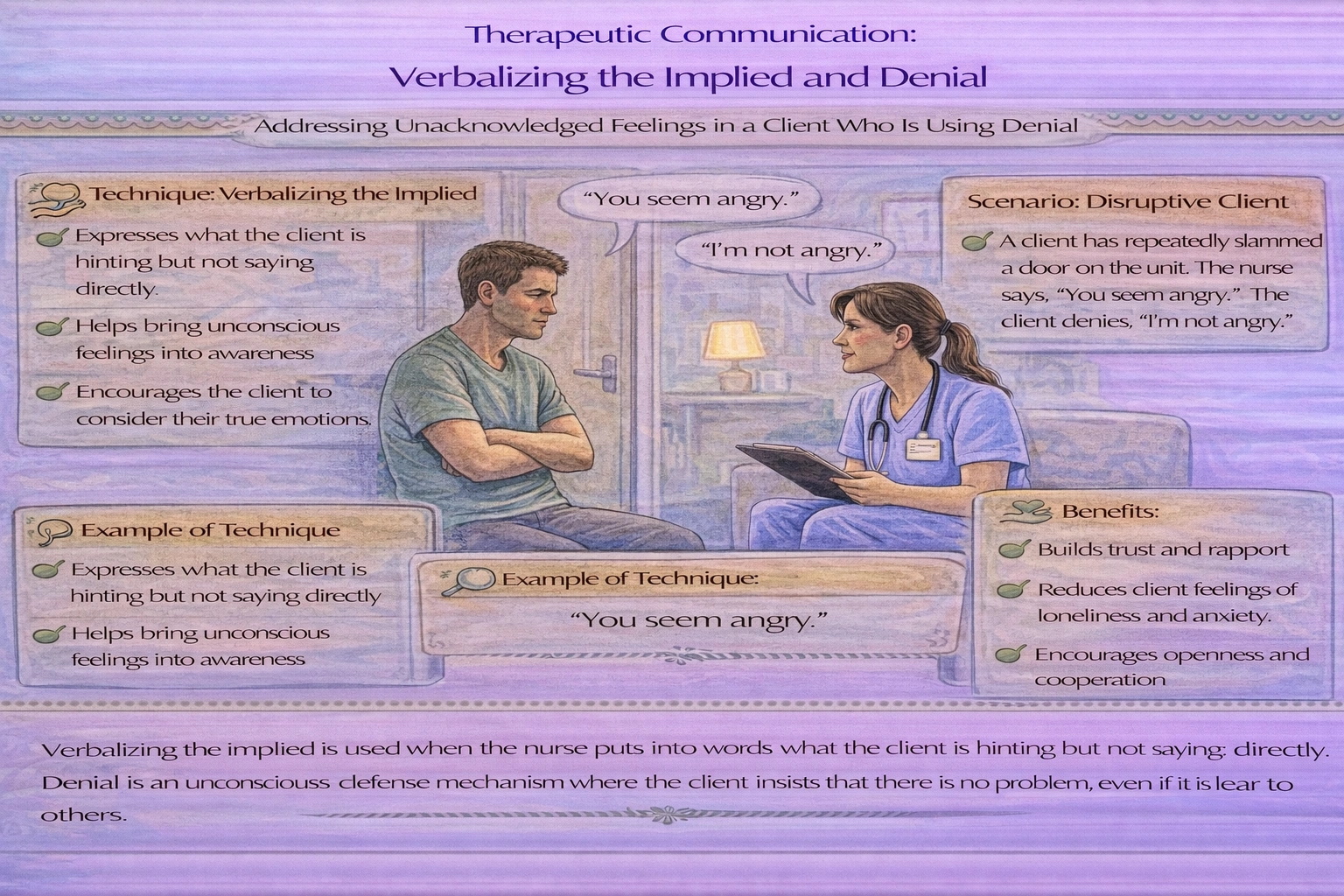
A client slammed a door on the unit several times. The nurse responds, You seem angry. The client states, Im not angry. What therapeutic communication technique has the nurse employed, and what defense mechanism is the client unconsciously demonstrating?
A.
Making observations and the defense mechanism of suppression
B. Verbalizing the implied and the defense mechanism of denial
C. Reflection and the defense mechanism of projection
D. Encouraging descriptions of perceptions and the defense mechanism of displacement
Rationale
The most appropriate selection for "What therapeutic communication technique has the nurse employed, and what defense mechanism is the client unconsciously demonstrating" is "Verbalizing the implied and the defense mechanism of denial".
A. Making observations and the defense mechanism of suppression
This choice is off-target for what the stem is asking. It may be loosely connected, but it doesn't match the priority concept. This answer centers "Making observations and the defense mechanism of suppression," but the stem highlights "A client slammed a door on the unit several times. The nurse responds, You seem angry....." In practice, the nurse should stay with assessment cues and culturally safe interpretation.
B. Verbalizing the implied and the defense mechanism of denial
This is the best answer because it directly reflects the key cue in the stem. It matches what the stem emphasizes ("A client slammed a door on the unit several times. The nurse responds, You seem angry....") and guides appropriate nursing judgment. From a nursing-process perspective, it prioritizes assessment and therapeutic effectiveness.
C. Reflection and the defense mechanism of projection
This choice misses the focus of the question and would lead the clinician away from the best clinical judgment. This answer centers "Reflection and the defense mechanism of projection," but the stem highlights "A client slammed a door on the unit several times. The nurse responds, You seem angry....." A good elimination step is to remove choices that stereotype or drift away from the stem's priority.
D. Encouraging descriptions of perceptions and the defense mechanism of displacement
This answer does not address the stem's main point. It either answers a different question or adds meaning not provided in the situation. Here, "Encouraging descriptions of perceptions and the defense mechanism of displacement" pulls the nurse away from the stem's cue ("A client slammed a door on the unit several times. The nurse responds, You seem angry...."). Choose the option that answers the question directly without adding extra assumptions.
**Conclusion**
The scenario emphasizes A client slammed a door on the unit several times. The nurse responds, You seem angry. The client states, Im not... Verbalizing the implied and the defense mechanism of denial. The strongest answers in this set stay closely tied to what is stated in the scenario and avoid adding extra meaning. This interpretation promotes culturally safe care and reduces the risk of misunderstanding client behavior.
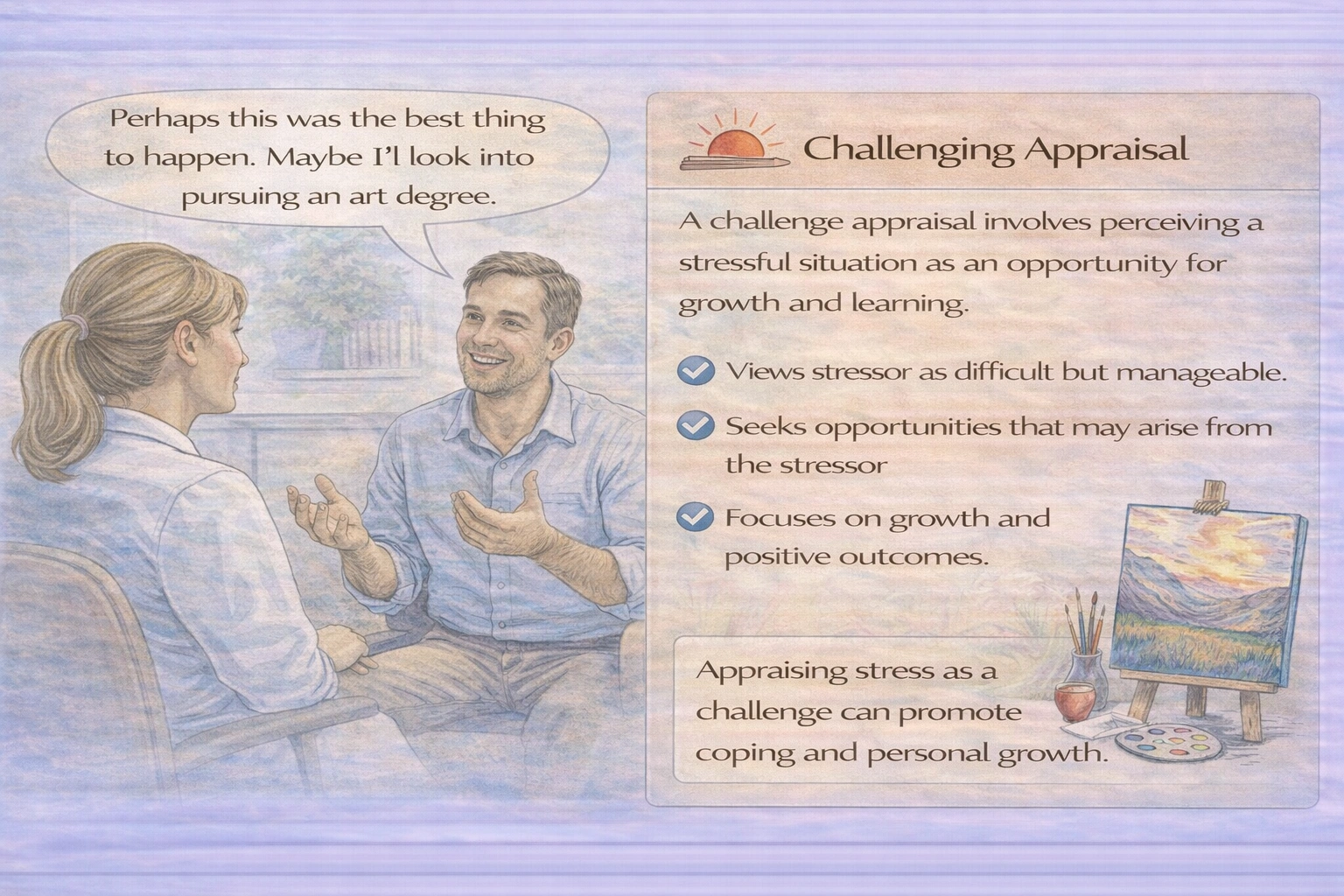
A physically and emotionally healthy client has just been fired. During a routine office visit he states to a nurse: Perhaps this was the best thing to happen. Maybe Ill look into pursuing an art degree. How should the nurse characterize the clients appraisal of the job loss stressor?
A.
Irrelevant
B. Harm/loss
C. Threatening
D. Challenging
Rationale
In this situation, the nurse characterize the clients appraisal of the job loss stressor as Challenging.
A. Irrelevant
This could seem tempting if the idea in “Irrelevant†addresses a different mechanism or priority than the one emphasized by the stem The wording does not track the stem’s main cue, so selecting it would shift the nurse away from the most precise interpretation or priority.
B. Harm/loss
This reflects a related idea, but it fits best when the idea in “Harm/loss†addresses a different mechanism or priority than the one emphasized by the stem The wording does not track the stem’s main cue, so selecting it would shift the nurse away from the most precise interpretation or priority.
C. Threatening
This could seem tempting if the idea in “Threatening†addresses a different mechanism or priority than the one emphasized by the stem The wording does not track the stem’s main cue, so selecting it would shift the nurse away from the most precise interpretation or priority.
D. Challenging
This matches the stem because The client perceives the situation of job loss as a challenge and an opportunity for growth. Need: Psychosocial Integrity A challenge appraisal frames the stressor as manageable and potentially growth-producing, which often reduces helplessness and increases problem-focused coping. From a nursing standpoint, this selection guides assessment and interventions toward what is most clinically meaningful in the moment—risk reduction, safety, accurate appraisal, and support for adaptive coping.
**Conclusion**
The scenario is best handled by identifying what the nurse must interpret or prioritize first and then choosing the statement that fits that requirement with the least distortion. The distractors have surface appeal, but they do not align as tightly with the clinical cue embedded in the stem.
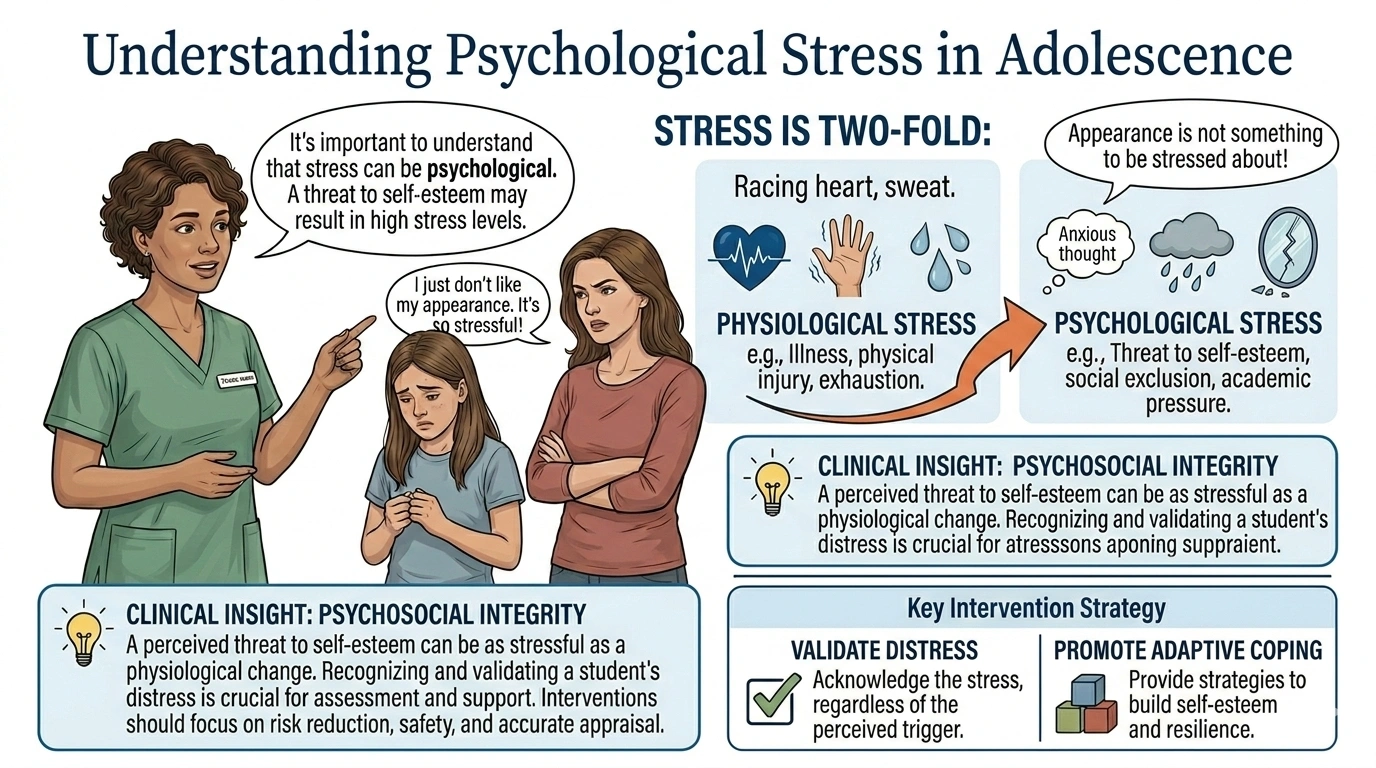
A school nurse is assessing a female high school student who is overly concerned about her appearance. The clients mother states, Thats not something to be stressed about! Which is the most appropriate nursing response?
A.
Teenagers! They dont know a thing about real stress.
B. Stress occurs only when there is a loss.
C. When you are in poor physical condition, you cant experience psychological well-being.
D. Stress can be psychological. A threat to self-esteem may result in high stress levels.
Rationale
The statement that matches what is being asked is Stress can be psychological. A threat to self-esteem may result in high stress levels..
A. Teenagers! They dont know a thing about real stress.
This could seem tempting if the idea in “Teenagers! They dont know a thing about real stress.†addresses a different mechanism or priority than the one emphasized by the stem The wording does not track the stem’s main cue, so selecting it would shift the nurse away from the most precise interpretation or priority.
B. Stress occurs only when there is a loss.
This might be chosen when the idea in “Stress occurs only when there is a loss.†addresses a different mechanism or priority than the one emphasized by the stem The wording does not track the stem’s main cue, so selecting it would shift the nurse away from the most precise interpretation or priority.
C. When you are in poor physical condition, you cant experience psychological well-being.
This could seem tempting if the idea in “When you are in poor physical condition, you cant experience psychological well-being.†addresses a different mechanism or priority than the one emphasized by the stem The wording does not track the stem’s main cue, so selecting it would shift the nurse away from the most precise interpretation or priority.
D. Stress can be psychological. A threat to self-esteem may result in high stress levels.
This is supported by the detail that Stress can be physical or psychological in nature. A perceived threat to self-esteem can be as stressful as a physiological change. Need: Psychosocial Integrity The underlying principle in the stem is best addressed by choosing the response that is both specific to the cue provided and consistent with evidence-informed psychiatric nursing practice. From a nursing standpoint, this selection guides assessment and interventions toward what is most clinically meaningful in the moment—risk reduction, safety, accurate appraisal, and support for adaptive coping.
**Conclusion**
The deciding factor is the stem’s priority signal; once that is identified, the best answer is the one that addresses it directly and stays within the given facts. Other choices either broaden the issue too far or assume details that were never provided.
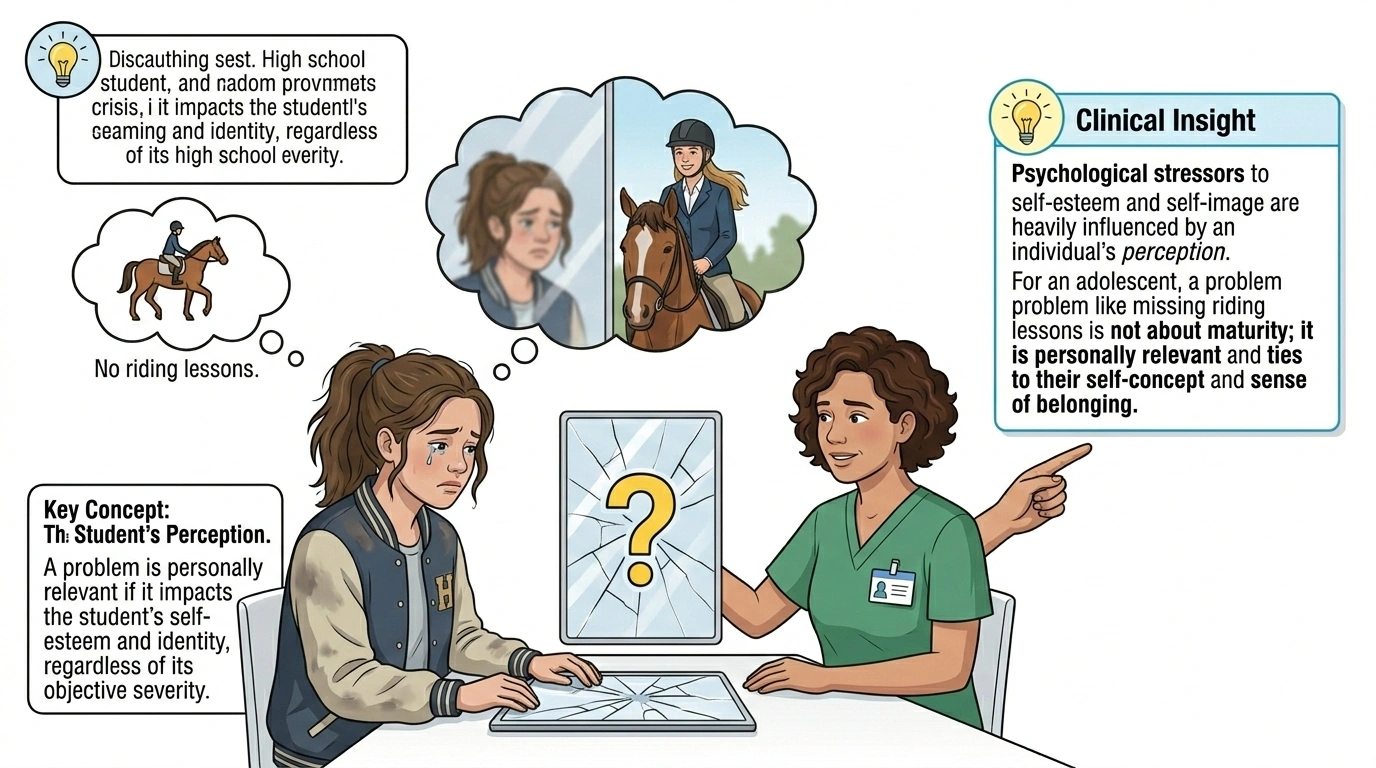
A school nurse is assessing a distraught female high school student who is overly concerned because her parents cant afford horseback riding lessons. How should the nurse interpret the students reaction to her perceived problem?
A.
The problem is endangering her well-being.
B. The problem is personally relevant to her.
C. The problem is based on immaturity.
D. The problem is exceeding her capacity to cope.
Rationale
In this situation, the nursing judgment that fits the stem is The problem is personally relevant to her..
A. The problem is endangering her well-being.
This reflects a related idea, but it fits best when the idea in “The problem is endangering her well-being.†addresses a different mechanism or priority than the one emphasized by the stem The wording does not track the stem’s main cue, so selecting it would shift the nurse away from the most precise interpretation or priority.
B. The problem is personally relevant to her.
This aligns with the concept that Psychological stressors to self-esteem and self-image are related to how the individual perceives the situation or event. Self-image is of particular importance to adolescents, who feel entitled to have all the advantages that other adolescents experience. Need: Psychosocial Integrity The underlying principle in the stem is best addressed by choosing the response that is both specific to the cue provided and consistent with evidence-informed psychiatric nursing practice. From a nursing standpoint, this selection guides assessment and interventions toward what is most clinically meaningful in the moment—risk reduction, safety, accurate appraisal, and support for adaptive coping.
C. The problem is based on immaturity.
This could seem tempting if the idea in “The problem is based on immaturity.†addresses a different mechanism or priority than the one emphasized by the stem The wording does not track the stem’s main cue, so selecting it would shift the nurse away from the most precise interpretation or priority.
D. The problem is exceeding her capacity to cope.
This might be chosen when the idea in “The problem is exceeding her capacity to cope.†addresses a different mechanism or priority than the one emphasized by the stem The wording does not track the stem’s main cue, so selecting it would shift the nurse away from the most precise interpretation or priority.
**Conclusion**
The stem provides enough information to select the most accurate interpretation without adding extra assumptions. The chosen answer reflects the correct framework, and the remaining choices drift toward incomplete, premature, or misdirected reasoning.
A nursing instructor is asking students about diseases of adaptation and when they are likely to occur. Which student response indicates that learning has occurred?
A.
When an individual has limited experience dealing with stress
B. When an individual inherits maladaptive genes
C. When an individual experiences existing conditions that exacerbate stress
D. When an individuals physiological and psychological resources have become depleted
Rationale
The statement that matches what is being asked is When an individuals physiological and psychological resources have become depleted.
A. When an individual has limited experience dealing with stress
This reflects a related idea, but it fits best when the idea in “When an individual has limited experience dealing with stress†addresses a different mechanism or priority than the one emphasized by the stem The wording does not track the stem’s main cue, so selecting it would shift the nurse away from the most precise interpretation or priority.
B. When an individual inherits maladaptive genes
This sounds reasonable when the idea in “When an individual inherits maladaptive genes†addresses a different mechanism or priority than the one emphasized by the stem The wording does not track the stem’s main cue, so selecting it would shift the nurse away from the most precise interpretation or priority.
C. When an individual experiences existing conditions that exacerbate stress
This reflects a related idea, but it fits best when the idea in “When an individual experiences existing conditions that exacerbate stress †addresses a different mechanism or priority than the one emphasized by the stem The wording does not track the stem’s main cue, so selecting it would shift the nurse away from the most precise interpretation or priority.
D. When an individuals physiological and psychological resources have become depleted
This works since During the stage of exhaustion of the general adaptation syndrome, the individual loses the capacity to adapt effectively because physiological and psychological resources have become depleted. This is the time when diseases of adaptation may occur. Need: Health Promotion and Maintenance The underlying principle in the stem is best addressed by choosing the response that is both specific to the cue provided and consistent with evidence-informed psychiatric nursing practice. From a nursing standpoint, this selection guides assessment and interventions toward what is most clinically meaningful in the moment—risk reduction, safety, accurate appraisal, and support for adaptive coping.
**Conclusion**
What separates the best choice from the rest is specificity: the correct option addresses the exact mechanism, stage, or principle described. The other answers relate to nearby ideas, yet they miss the question’s focal point or misapply the concept to the situation.
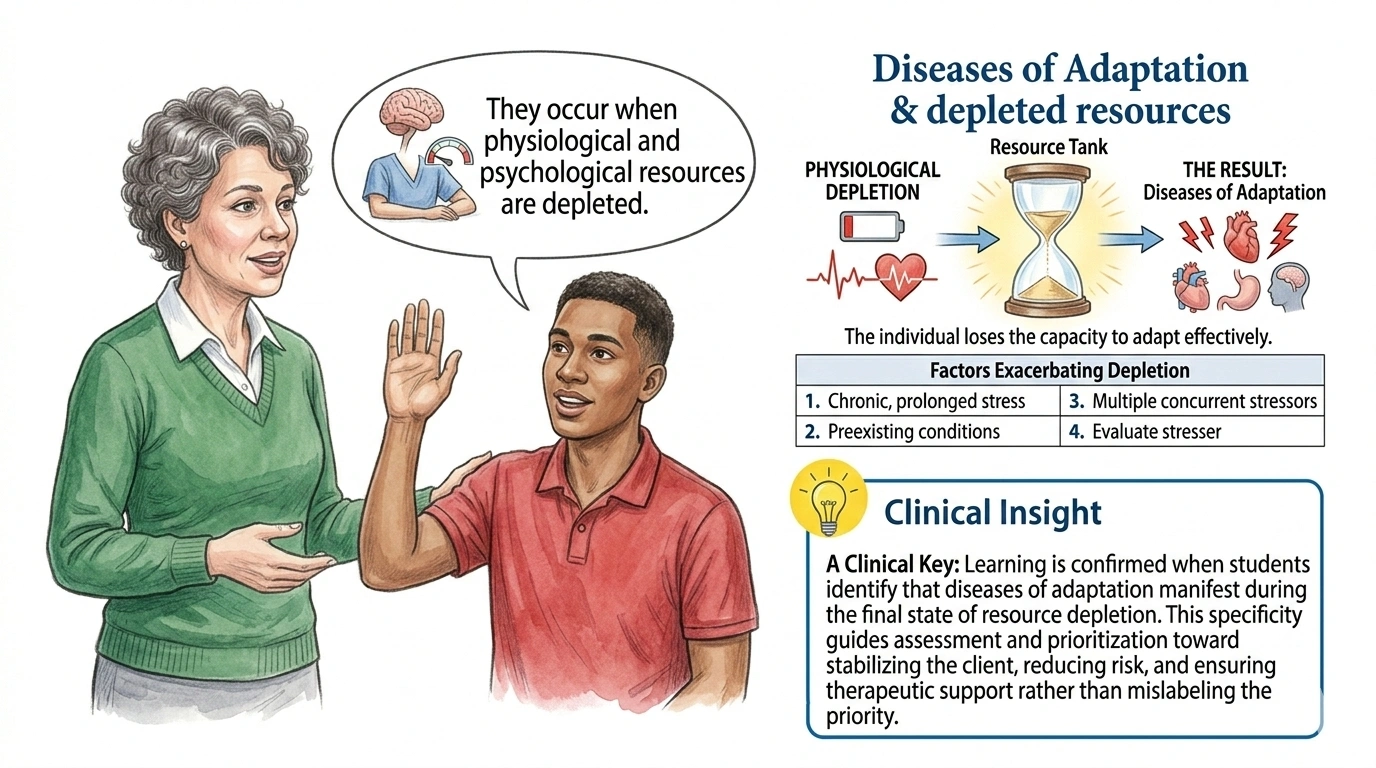
A nurse is evaluating a clients response to stress. What would indicate to the nurse that the client is experiencing a secondary appraisal of the stressful event?
A.
When the individual judges the event to be benign
B. When the individual judges the event to be irrelevant
C. When the individual judges the resources and skills needed to deal with the event
D. When the individual judges the event to be pleasurable
Rationale
In this situation, the nursing judgment that fits the stem is When the individual judges the resources and skills needed to deal with the event.
A. When the individual judges the event to be benign
This reflects a related idea, but it fits best when the idea in “When the individual judges the event to be benign †addresses a different mechanism or priority than the one emphasized by the stem The wording does not track the stem’s main cue, so selecting it would shift the nurse away from the most precise interpretation or priority.
B. When the individual judges the event to be irrelevant
This could seem tempting if the idea in “When the individual judges the event to be irrelevant†addresses a different mechanism or priority than the one emphasized by the stem The wording does not track the stem’s main cue, so selecting it would shift the nurse away from the most precise interpretation or priority.
C. When the individual judges the resources and skills needed to deal with the event
This is supported by the detail that When the individual judges the resources and skills needed to deal with the event, the individual is conducting a secondary appraisal. There are three types of primary appraisals: irrelevant, benignpositive, and stressful. Need: Psychosocial Integrity A challenge appraisal frames the stressor as manageable and potentially growth-producing, which often reduces helplessness and increases problem-focused coping. From a nursing standpoint, this selection guides assessment and interventions toward what is most clinically meaningful in the moment—risk reduction, safety, accurate appraisal, and support for adaptive coping.
D. When the individual judges the event to be pleasurable
This might be chosen when the idea in “When the individual judges the event to be pleasurable†addresses a different mechanism or priority than the one emphasized by the stem The wording does not track the stem’s main cue, so selecting it would shift the nurse away from the most precise interpretation or priority.
**Conclusion**
The scenario is best handled by identifying what the nurse must interpret or prioritize first and then choosing the statement that fits that requirement with the least distortion. The distractors have surface appeal, but they do not align as tightly with the clinical cue embedded in the stem.
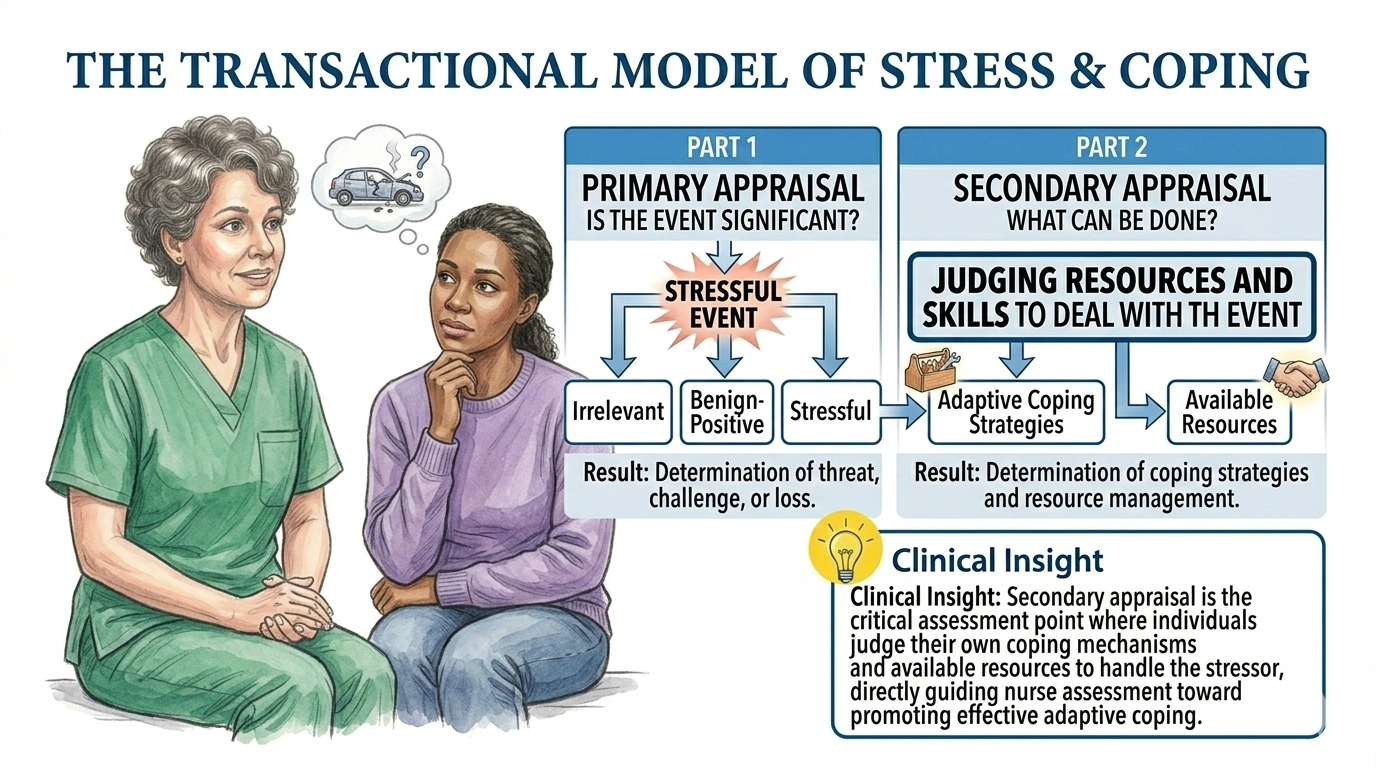
A nurse is interviewing a distressed client, who relates being fired after 15 years of loyal employment. Which of the following questions would best assist the nurse to determine the clients appraisal of the situation? Select all that apply.
A.
What resources have you used previously in stressful situations?
B. Have you ever experienced a similar stressful situation?
C. Who do you think is to blame for this situation?
D. Why do you think you were fired from your job?
Rationale
The statement that matches what is being asked is What resources have you used previously in stressful situations?; Have you ever experienced a similar stressful situation?; and What skills do you possess that might lead to gainful employment?.
A. What resources have you used previously in stressful situations?
This matches the stem because These questions specifically address the clients coping resources and encourage the client to apply learning from past experiences. These questions also encourage the client to consider alternative methods for dealing with stress. Asking who is to blame does not assess coping abilities but, rather, encourages maladaptive behavior. Requesting an explanation is a nontherapeutic block to communication. Need: Psychosocial Integrity A challenge appraisal frames the stressor as manageable and potentially growth-producing, which often reduces helplessness and increases problem-focused coping. From a nursing standpoint, this selection guides assessment and interventions toward what is most clinically meaningful in the moment—risk reduction, safety, accurate appraisal, and support for adaptive coping.
B. Have you ever experienced a similar stressful situation?
This works since These questions specifically address the clients coping resources and encourage the client to apply learning from past experiences. These questions also encourage the client to consider alternative methods for dealing with stress. Asking who is to blame does not assess coping abilities but, rather, encourages maladaptive behavior. Requesting an explanation is a nontherapeutic block to communication. Need: Psychosocial Integrity A challenge appraisal frames the stressor as manageable and potentially growth-producing, which often reduces helplessness and increases problem-focused coping. From a nursing standpoint, this selection guides assessment and interventions toward what is most clinically meaningful in the moment—risk reduction, safety, accurate appraisal, and support for adaptive coping.
C. Who do you think is to blame for this situation?
This might be chosen when the idea in “Who do you think is to blame for this situation?†addresses a different mechanism or priority than the one emphasized by the stem The wording does not track the stem’s main cue, so selecting it would shift the nurse away from the most precise interpretation or priority.
D. Why do you think you were fired from your job?
This might be chosen when the idea in “Why do you think you were fired from your job?†addresses a different mechanism or priority than the one emphasized by the stem The wording does not track the stem’s main cue, so selecting it would shift the nurse away from the most precise interpretation or priority.
E. What skills do you possess that might lead to gainful employment?
This fits because These questions specifically address the clients coping resources and encourage the client to apply learning from past experiences. These questions also encourage the client to consider alternative methods for dealing with stress. Asking who is to blame does not assess coping abilities but, rather, encourages maladaptive behavior. Requesting an explanation is a nontherapeutic block to communication. Need: Psychosocial Integrity A challenge appraisal frames the stressor as manageable and potentially growth-producing, which often reduces helplessness and increases problem-focused coping. From a nursing standpoint, this selection guides assessment and interventions toward what is most clinically meaningful in the moment—risk reduction, safety, accurate appraisal, and support for adaptive coping.
**Conclusion**
Clarity comes from reading the stem for what must be judged or done first, then selecting the choice that fits that requirement most precisely. The other options miss the target by generalizing or inserting information not found in the vignette.
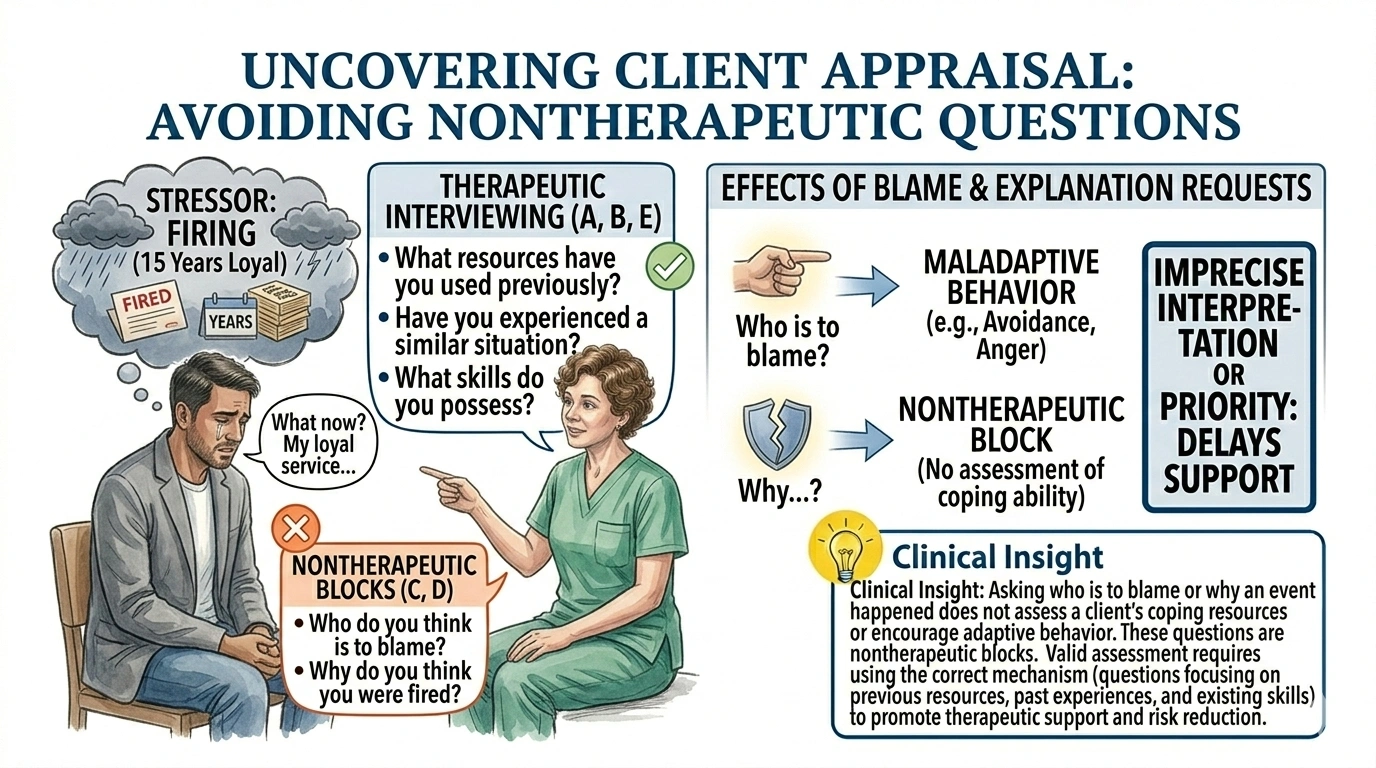
A patient presents in the Emergency Department immediately following a shooting incident in a school where she has been teaching. There is no evidence of physical injury, but she appears very hyperactive and talkative. Which of these symptoms manifested by the patient are common initial biological responses to stress? Select all that apply.
A.
Constricted pupils
B. Watery eyes
C. Unusual food cravings
D. Increased heart rate
Rationale
In this situation, the nursing judgment that fits the stem is Watery eyes; Increased heart rate; and Increased respirations.
A. Constricted pupils
This could seem tempting if the idea in “Constricted pupils†addresses a different mechanism or priority than the one emphasized by the stem The wording does not track the stem’s main cue, so selecting it would shift the nurse away from the most precise interpretation or priority.
B. Watery eyes
This is supported by the detail that Increased lacrimal secretions, increased heart rate, and increased respirations are identified as initial biological responses to stress. Since dilated pupils rather than constricted pupils are related to Fight or Flight syndrome, this symptom should be assessed for other potential causes. Unusual food cravings have not been identified as a typical biological response to stress. Need: Physiological Integrity The underlying principle in the stem is best addressed by choosing the response that is both specific to the cue provided and consistent with evidence-informed psychiatric nursing practice. From a nursing standpoint, this selection guides assessment and interventions toward what is most clinically meaningful in the moment—risk reduction, safety, accurate appraisal, and support for adaptive coping.
C. Unusual food cravings
This would apply in a different scenario where the idea in “Unusual food cravings†addresses a different mechanism or priority than the one emphasized by the stem The wording does not track the stem’s main cue, so selecting it would shift the nurse away from the most precise interpretation or priority.
D. Increased heart rate
This works since Increased lacrimal secretions, increased heart rate, and increased respirations are identified as initial biological responses to stress. Since dilated pupils rather than constricted pupils are related to Fight or Flight syndrome, this symptom should be assessed for other potential causes. Unusual food cravings have not been identified as a typical biological response to stress. Need: Physiological Integrity The underlying principle in the stem is best addressed by choosing the response that is both specific to the cue provided and consistent with evidence-informed psychiatric nursing practice. From a nursing standpoint, this selection guides assessment and interventions toward what is most clinically meaningful in the moment—risk reduction, safety, accurate appraisal, and support for adaptive coping.
E. Increased respirations
This matches the stem because Increased lacrimal secretions, increased heart rate, and increased respirations are identified as initial biological responses to stress. Since dilated pupils rather than constricted pupils are related to Fight or Flight syndrome, this symptom should be assessed for other potential causes. Unusual food cravings have not been identified as a typical biological response to stress. Need: Physiological Integrity The underlying principle in the stem is best addressed by choosing the response that is both specific to the cue provided and consistent with evidence-informed psychiatric nursing practice. From a nursing standpoint, this selection guides assessment and interventions toward what is most clinically meaningful in the moment—risk reduction, safety, accurate appraisal, and support for adaptive coping.
**Conclusion**
The stem provides enough information to select the most accurate interpretation without adding extra assumptions. The chosen answer reflects the correct framework, and the remaining choices drift toward incomplete, premature, or misdirected reasoning.
Chapter 2. Mental Health/Mental Illness: Historical and Theoretical Concepts
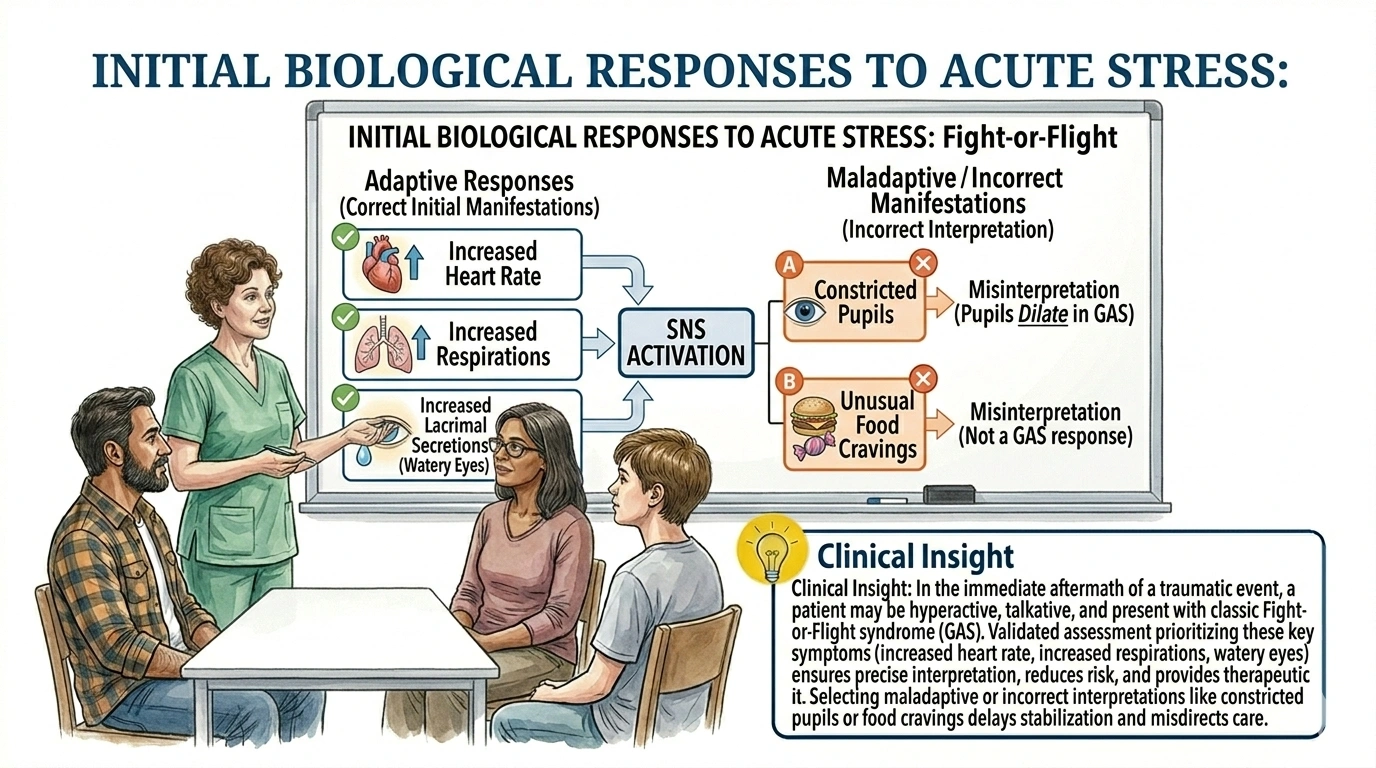
RN Exams
ATI Quizzes
3 Practice Tests
ATI Quizzes
3 Practice Tests
ATI Quizzes
3 Practice Tests
ATI Quizzes
3 Practice Tests