PSYCHIATRIC MENTAL HEALTH NURSING PRACTICE QUESTIONS
00:00
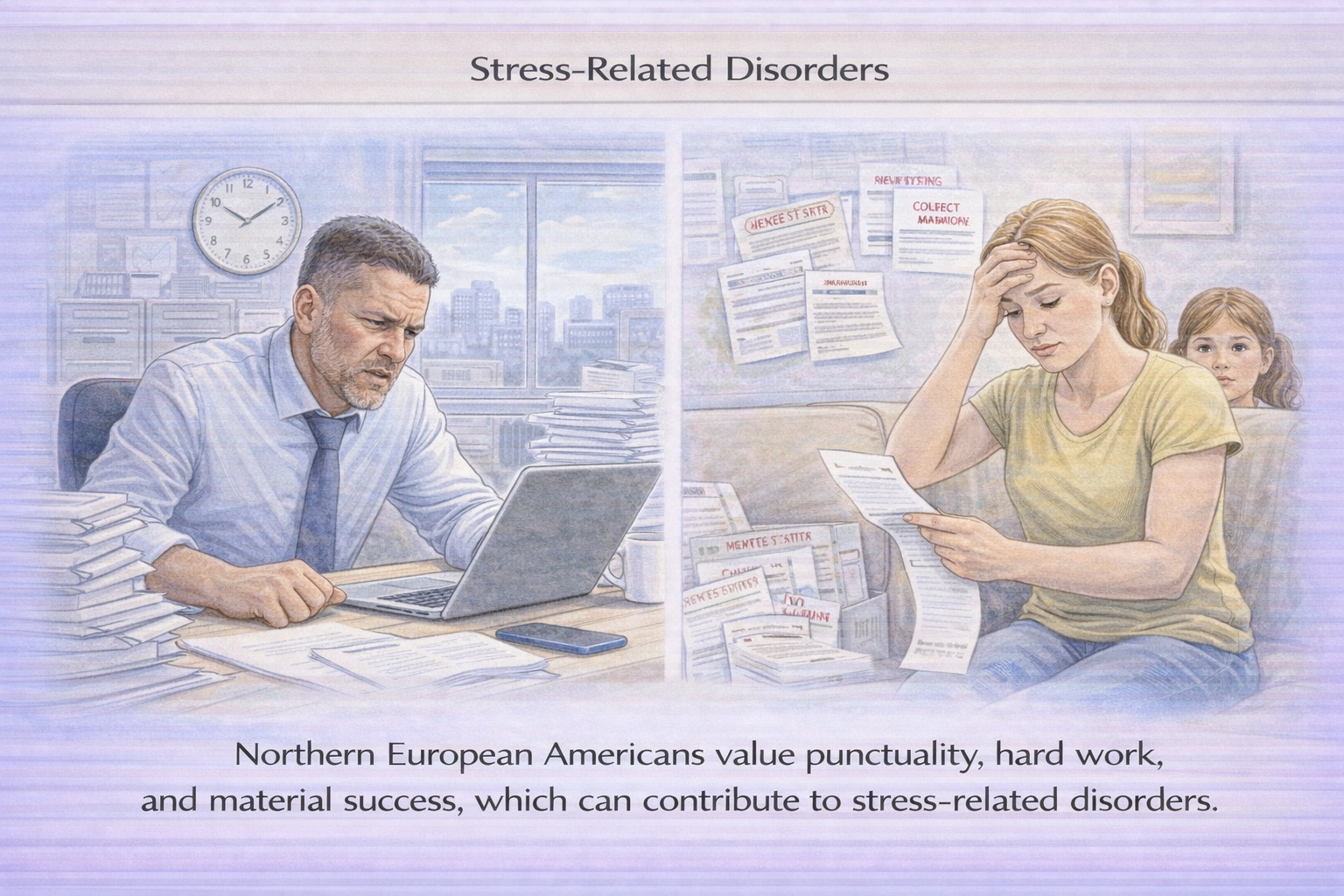
Northern European Americans value punctuality, hard work, and the acquisition of material possessions and status. A nurse should recognize that these values may contribute to which form of mental disorders?
A.
Dissociative disorders
B. Neurocognitive disorders
C. Stress-related disorders
D. Schizophrenia spectrum disorders
Rationale
The most appropriate selection for "Northern European Americans value punctuality, hard work, and the acquisition of material possessions and status. A nurse should recognize that these values may contribute to which form of mental disorders" is "Stress-related disorders".
A. Dissociative disorders
This selection belongs to another content area. The stem is testing culturally informed nursing care, not this condition. The statement "Dissociative disorders" is not supported by the scenario ("Northern European Americans value punctuality, hard work, and the acquisition of..."). In practice, the nurse should stay with assessment cues and culturally safe interpretation.
B. Neurocognitive disorders
This option shifts to a different clinical concept than the stem is testing. The question is focusing on cultural/communication judgment, not this clinical category. Compared with the stem ("Northern European Americans value punctuality, hard work, and the acquisition of..."), this choice introduces a different emphasis ("Neurocognitive disorders"). Clinically, this would risk misinterpretation because it is not grounded in the presented data.
C. Stress-related disorders
This answer is supported by the stem and aligns with safe, client-centered nursing care. It keeps attention on "Northern European Americans value punctuality, hard work, and the acquisition of...," which is what this item is testing. It promotes safe decision-making by basing interpretation on observable data.
D. Schizophrenia spectrum disorders
This selection belongs to another content area. The stem is testing culturally informed nursing care, not this condition. This answer centers "Schizophrenia spectrum disorders," but the stem highlights "Northern European Americans value punctuality, hard work, and the acquisition of...." Choose the option that answers the question directly without adding extra assumptions.
**Conclusion**
This item centers on Northern European Americans value punctuality, hard work, and the acquisition of material possessions and status. A... Stress-related disorders. A few answers pull in unrelated diagnoses or medical conditions that are not required by the question, which shifts attention away from the intended concept. In practice, this approach supports accurate assessment and respectful, client-centered care.
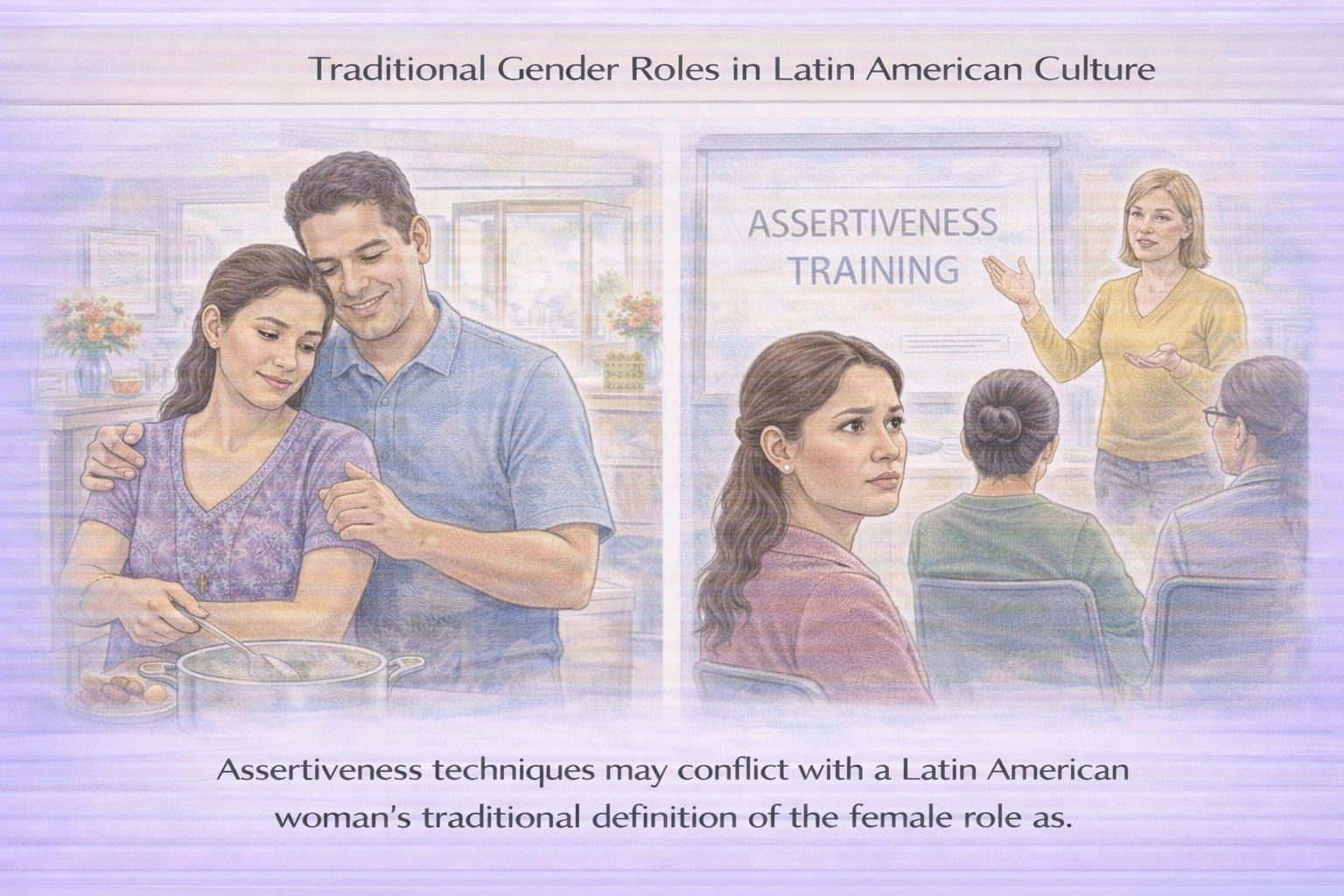
A Latin American woman refuses to participate in an assertiveness training group. Which cultural belief should a nurse identify as most likely to have influenced this clients decision?
A.
Future orientation causes the client to devalue assertiveness skills.
B. Decreased emotional expression makes it difficult to be assertive.
C. Assertiveness techniques may not be aligned with the clients definition of the female role.
D. Religious prohibitions prevent the clients participation in assertiveness training.
Rationale
For "Which cultural belief should a nurse identify as most likely to have influenced this clients decision," the best answer is "Assertiveness techniques may not be aligned with the clients definition of the female role.".
A. Future orientation causes the client to devalue assertiveness skills.
The reasoning here depends on speculation. Nursing judgment should stay anchored to the information presented. This answer centers "Future orientation causes the client to devalue assertiveness skills.," but the stem highlights "A Latin American woman refuses to participate in an assertiveness training group....." Clinically, this would risk misinterpretation because it is not grounded in the presented data.
B. Decreased emotional expression makes it difficult to be assertive.
This option is off-target for what the stem is asking. It may be loosely connected, but it doesn't match the priority concept. Compared with the stem ("A Latin American woman refuses to participate in an assertiveness training group...."), this choice introduces a different emphasis ("Decreased emotional expression makes it difficult to be assertive."). In practice, the nurse should stay with assessment cues and culturally safe interpretation.
C. Assertiveness techniques may not be aligned with the clients definition of the female role.
This is the strongest choice because it applies culturally informed, nonjudgmental nursing interpretation. It keeps attention on "A Latin American woman refuses to participate in an assertiveness training group....," which is what this item is testing. In practice, this supports respectful communication and accurate assessment.
D. Religious prohibitions prevent the clients participation in assertiveness training.
This choice explains the situation using assumptions rather than assessment findings. Here, "Religious prohibitions prevent the clients participation in assertiveness training." pulls the nurse away from the stem's cue ("A Latin American woman refuses to participate in an assertiveness training group...."). In practice, the nurse should stay with assessment cues and culturally safe interpretation.
**Conclusion**
The scenario emphasizes A Latin American woman refuses to participate in an assertiveness training group. Which cultural belief should a nurse.... The best-supported answer is Assertiveness techniques may not be aligned with the clients definition of the female..., because it matches the situation described. Some alternatives explain the situation with speculation rather than evidence from the scenario. Clinically, this reasoning helps maintain rapport while guiding safe nursing decision-making.
To effectively care for Asian American clients, a nurse should be aware of which cultural norm?
A.
Obesity and alcoholism are common problems.
B. Older people maintain positions of authority within the culture.
C. Milk is a staple in the Asian American diet.
D. Asian Americans are likely to seek psychiatric help.
Rationale
The statement that best answers "To effectively care for Asian American clients, a nurse should be aware of which cultural norm" is "Older people maintain positions of authority within the culture.".
A. Obesity and alcoholism are common problems.
This choice is off-target for what the stem is asking. It may be loosely connected, but it doesn't match the priority concept. This answer centers "Obesity and alcoholism are common problems.," but the stem highlights "To effectively care for Asian American clients, a nurse should be aware of which...." In practice, the nurse should stay with assessment cues and culturally safe interpretation.
B. Older people maintain positions of authority within the culture.
This choice fits because it stays grounded in the scenario and avoids added assumptions. It addresses the stem's focus ("To effectively care for Asian American clients, a nurse should be aware of which...") in a straightforward way. It promotes safe decision-making by basing interpretation on observable data.
C. Milk is a staple in the Asian American diet.
This choice misses the priority of the question and would lead the nurse away from the best clinical judgment. Compared with the stem ("To effectively care for Asian American clients, a nurse should be aware of which..."), this choice introduces a different emphasis ("Milk is a staple in the Asian American diet."). In practice, the clinician should stay with assessment cues and culturally safe interpretation.
D. Asian Americans are likely to seek psychiatric help.
The wording here is sweeping and risks stereotyping. The item is asking for an interpretation grounded in the scenario, not a blanket statement. Here, "Asian Americans are likely to seek psychiatric help." pulls the nurse away from the stem's cue ("To effectively care for Asian American clients, a nurse should be aware of which..."). In practice, the clinician should stay with assessment cues and culturally safe interpretation.
**Conclusion**
In this situation, the main issue is To effectively care for Asian American clients, a nurse should be aware of which cultural norm?. The most appropriate response is Older people maintain positions of authority within the culture., which aligns with the concept tested in the scenario. Several alternatives rely on broad, absolute statements that can turn cultural knowledge into stereotyping, which is unsafe for clinical judgment. In practice, this approach supports accurate assessment and respectful, client-centered care.

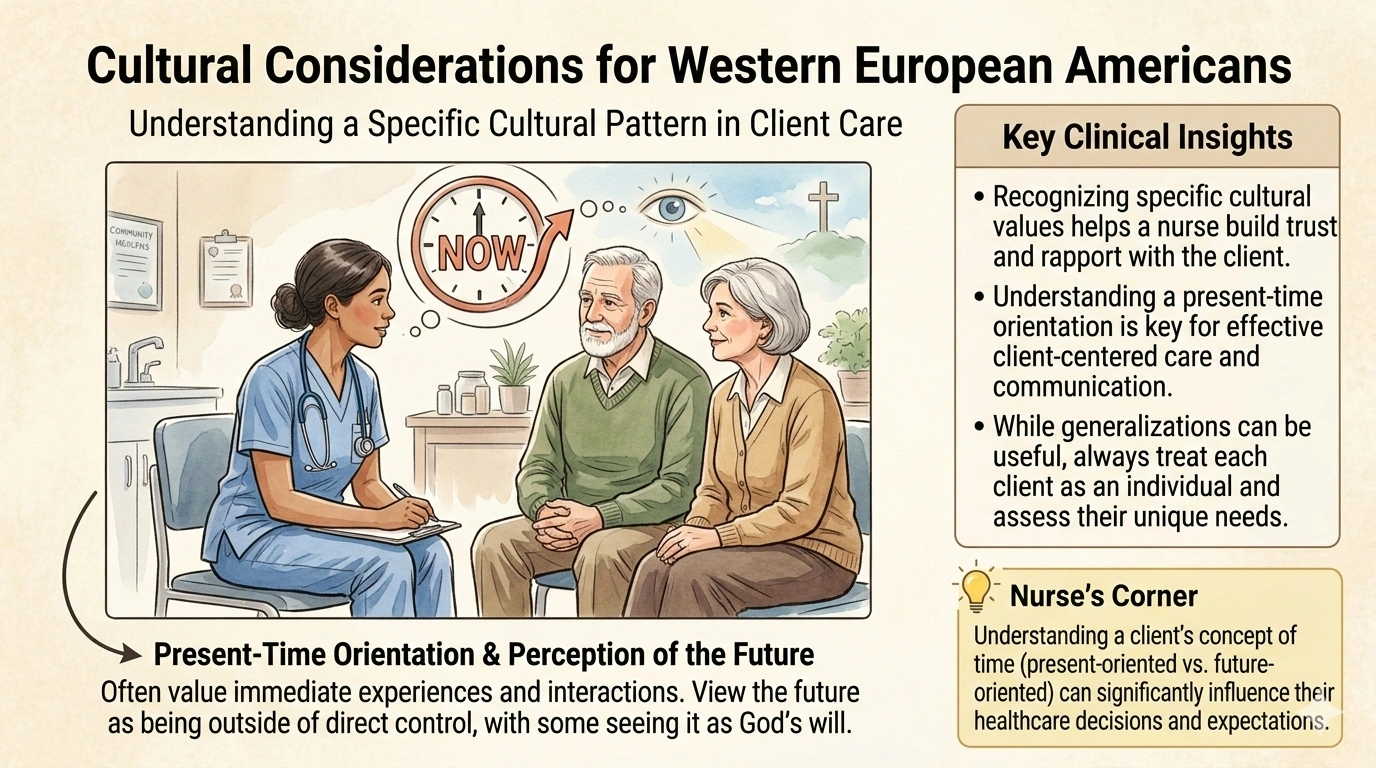
Which cultural considerations should a nurse identify with Western European Americans?
A.
They are present-time oriented and perceive the future as Gods will.
B. They value youth, and older adults are commonly placed in nursing homes.
C. They are at high risk for alcoholism due to a genetic predisposition.
D. They are future oriented and practice preventive health care.
Rationale
The cultural consideration the nurse should identify is "They are present-time oriented and perceive the future as Gods will.".
A. They are present-time oriented and perceive the future as Gods will.
This answer is supported by the stem and aligns with safe, client-centered nursing care. It addresses the stem's priority ("Which cultural considerations should a nurse identify with Western European Americans?") in a straightforward way. Clinically, it helps preserve rapport while interpreting behavior through context.
B. They value youth, and older adults are commonly placed in nursing homes.
This choice misses the focus of the question and would lead the nurse away from the best clinical judgment. Compared with the stem ("Which cultural considerations should a nurse identify with Western European Americans?"), this choice introduces a different emphasis ("They value youth, and older adults are commonly placed in nursing homes."). In practice, the nurse should stay with assessment cues and culturally safe interpretation.
C. They are at high risk for alcoholism due to a genetic predisposition.
This choice relies on an overly broad stereotype instead of the specific assessment cues in the stem. Cultural patterns can inform care, but they are not universal. Here, "They are at high risk for alcoholism due to a genetic predisposition." pulls the nurse away from the stem's cue ("Which cultural considerations should a nurse identify with Western European Americans?"). Choose the option that answers the question directly without adding extra assumptions.
D. They are future oriented and practice preventive health care.
This choice explains the situation using assumptions rather than assessment findings. The statement "They are future oriented and practice preventive health care." is not supported by the scenario ("Which cultural considerations should a nurse identify with Western European Americans?"). Choose the option that answers the question directly without adding extra assumptions.
**Conclusion**
The focus of this question is Which cultural considerations should a nurse identify with Western European Americans? They are present-time oriented and perceive the future as Gods will.. A number of choices depend on conclusions the scenario does not provide enough data to support, creating avoidable leaps in reasoning. Clinically, this reasoning helps maintain rapport while guiding safe nursing decision-making.
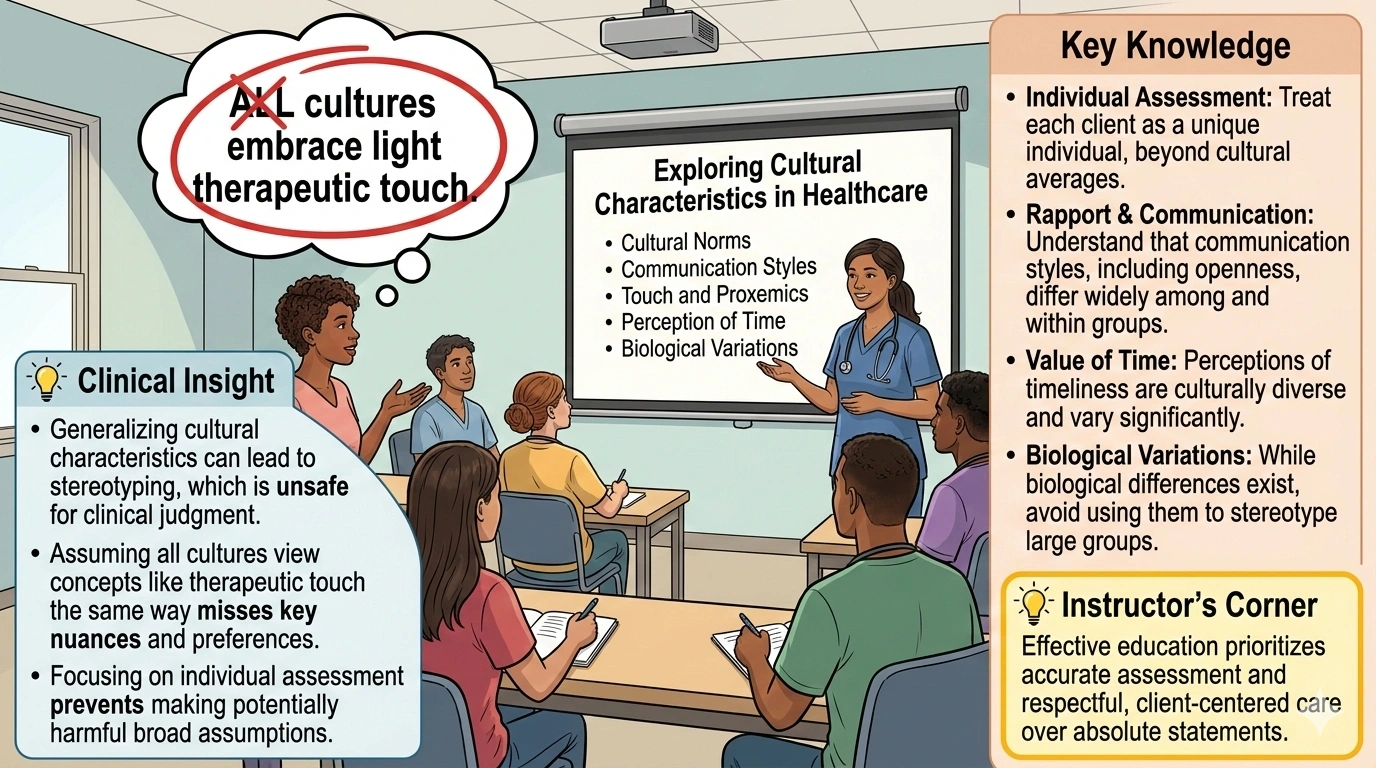
A nursing instructor is teaching about cultural characteristics. Which statement by the student indicates the need for further instruction?
A.
All cultures communicate freely within their group.
B. All cultures embrace light therapeutic touch.
C. All cultures view the importance of timeliness differently.
D. All cultures display biological variations.
Rationale
The most appropriate selection for "Which statement by the student indicates the need for further instruction" is "All cultures embrace light therapeutic touch.".
A. All cultures communicate freely within their group.
This choice relies on an overly broad stereotype instead of the specific assessment cues in the stem. Cultural patterns can inform care, but they are not universal. This answer centers "All cultures communicate freely within their group.," but the stem highlights "A nursing instructor is teaching about cultural characteristics. Which statement by...." In practice, the clinician should stay with assessment cues and culturally safe interpretation.
B. All cultures embrace light therapeutic touch.
This is the best answer because it directly reflects the key cue in the stem. It addresses the stem's priority ("A nursing instructor is teaching about cultural characteristics. Which statement by...") in a straightforward way. It promotes safe decision-making by basing interpretation on observable data.
C. All cultures view the importance of timeliness differently.
This choice relies on an overly broad stereotype instead of the specific assessment cues in the stem. Cultural patterns can inform care, but they are not universal. Compared with the stem ("A nursing instructor is teaching about cultural characteristics. Which statement by..."), this choice introduces a different emphasis ("All cultures view the importance of timeliness differently."). In practice, the clinician should stay with assessment cues and culturally safe interpretation.
D. All cultures display biological variations.
The wording here is sweeping and risks stereotyping. The item is asking for an interpretation grounded in the scenario, not a blanket statement. Here, "All cultures display biological variations." pulls the nurse away from the stem's cue ("A nursing instructor is teaching about cultural characteristics. Which statement by..."). A good elimination step is to remove choices that stereotype or drift away from the stem's priority.
**Conclusion**
This item centers on A nursing instructor is teaching about cultural characteristics. Which statement by the student indicates the need for... All cultures embrace light therapeutic touch.. Several alternatives rely on broad, absolute statements that can turn cultural knowledge into stereotyping, which is unsafe for clinical judgment. In practice, this approach supports accurate assessment and respectful, client-centered care.
When interviewing a client of a different culture, which of the following questions should a nurse consider asking? Select all that apply.
A.
Would using perfume products be acceptable?
B. Who may be expected to be present during the client interview?
C. Should communication patterns be modified to accommodate this client?
D. How much eye contact should be made with the client?
Rationale
For "When interviewing a client of a different culture, which of the following questions should a nurse consider asking? Select all that apply.," the best answer is "Who may be expected to be present during the client interview?, Should communication patterns be modified to accommodate this client?, How much eye contact should be made with the client?, Would hand shaking be acceptable?".
A. Would using perfume products be acceptable?
This choice misses the focus of the question and would lead the nurse away from the best clinical judgment. This answer centers "Would using perfume products be acceptable?," but the stem highlights "When interviewing a client of a different culture, which of the following questions...." Choose the option that answers the question directly without adding extra assumptions.
B. Who may be expected to be present during the client interview?
This answer is supported by the stem and aligns with safe, client-centered nursing care. It matches what the stem emphasizes ("When interviewing a client of a different culture, which of the following questions...") and guides appropriate nursing judgment. In practice, this supports respectful communication and accurate assessment.
C. Should communication patterns be modified to accommodate this client?
This answer does not address the stem's main point. It either answers a different question or adds meaning not provided in the scenario. Here, "Should communication patterns be modified to accommodate this client?" pulls the nurse away from the stem's cue ("When interviewing a client of a different culture, which of the following questions..."). In practice, the nurse should stay with assessment cues and culturally safe interpretation.
D. How much eye contact should be made with the client?
This choice misses the focus of the question and would lead the nurse away from the best clinical judgment. This answer centers "How much eye contact should be made with the client?," but the stem highlights "When interviewing a client of a different culture, which of the following questions...." In practice, the clinician should stay with assessment cues and culturally safe interpretation.
E. Would hand shaking be acceptable?
This answer does not address the stem's main point. It either answers a different question or adds meaning not provided in the scenario. Compared with the stem ("When interviewing a client of a different culture, which of the following questions..."), this choice introduces a different emphasis ("Would hand shaking be acceptable?"). Clinically, this would risk misinterpretation because it is not grounded in the presented data.
**Conclusion**
The focus of this question is When interviewing a client of a different culture, which of the following questions should a nurse consider asking?.... The best-supported answer is Who may be expected to be present during the client interview?; Should communication patterns be modified to accommodate this client?; How much eye contact should be made with the client?; Would hand shaking be acceptable?, because it matches the situation described. The better reasoning here is the one that connects directly to the scenario details and the concept being tested. Clinically, this reasoning helps maintain rapport while guiding safe nursing decision-making.
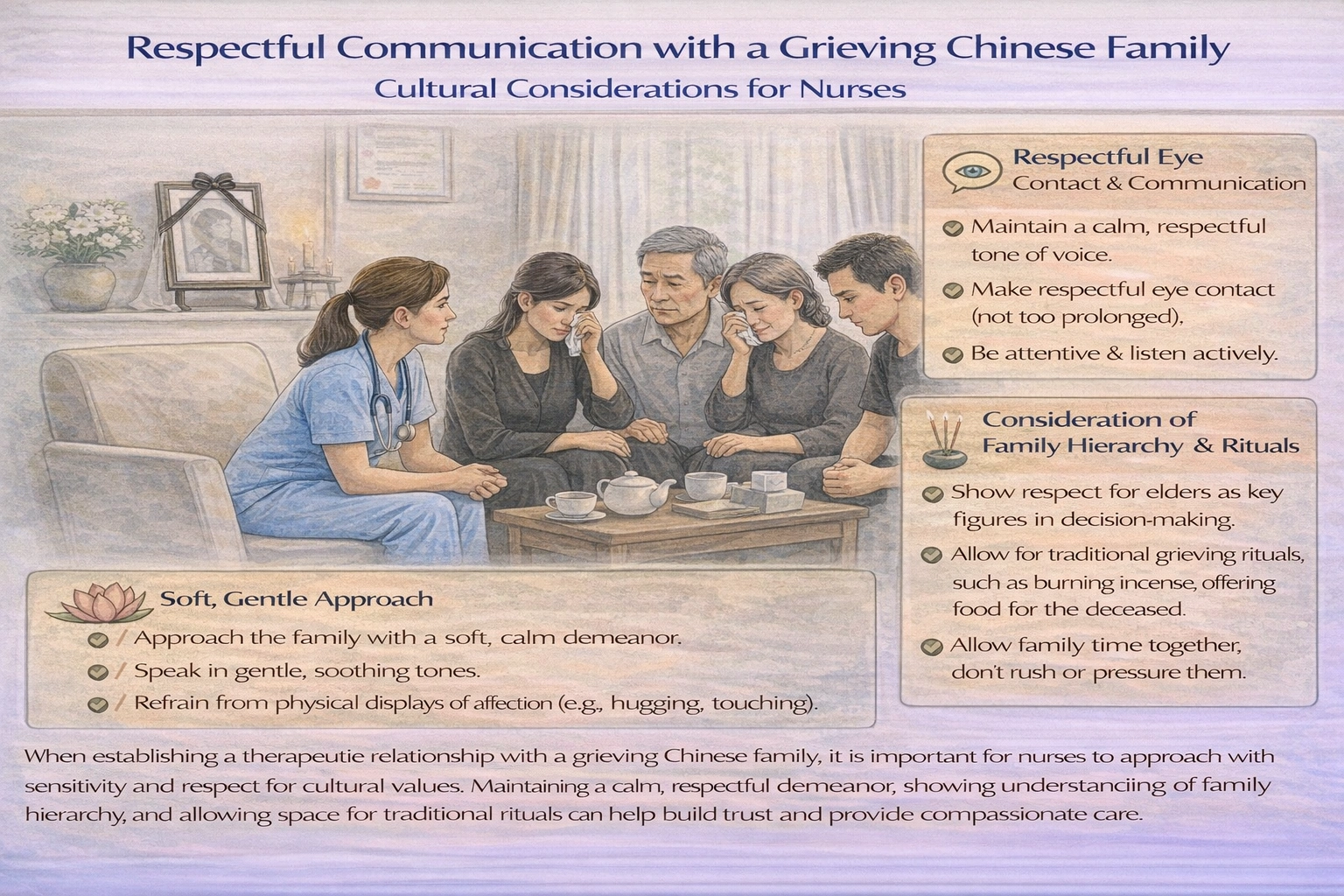
What is the most essential task for a nurse to accomplish prior to forming a therapeutic relationship with a client?
A.
To clarify personal attitudes, values, and beliefs
B. To obtain thorough assessment data
C. To determine the clients length of stay
D. To establish personal goals for the interaction
Rationale
The most essential task is "To clarify personal attitudes, values, and beliefs".
A. To clarify personal attitudes, values, and beliefs
This is the strongest option because it applies culturally informed, nonjudgmental nursing interpretation. It addresses the stem's focus ("What is the most essential task for a nurse to accomplish prior to forming a...") in a straightforward way. It promotes safe decision-making by basing interpretation on observable data.
B. To obtain thorough assessment data
This choice is off-target for what the stem is asking. It may be loosely connected, but it doesn't match the priority concept. Compared with the stem ("What is the most essential task for a nurse to accomplish prior to forming a..."), this choice introduces a different emphasis ("To obtain thorough assessment data"). Clinically, this would risk misinterpretation because it is not grounded in the presented data.
C. To determine the clients length of stay
This choice misses the focus of the question and would lead the nurse away from the best clinical judgment. This answer centers "To determine the clients length of stay," but the stem highlights "What is the most essential task for a nurse to accomplish prior to forming a...." In practice, the nurse should stay with assessment cues and culturally safe interpretation.
D. To establish personal goals for the interaction
This choice is off-target for what the stem is asking. It may be loosely connected, but it doesn't match the priority concept. Here, "To establish personal goals for the interaction" pulls the nurse away from the stem's cue ("What is the most essential task for a nurse to accomplish prior to forming a..."). Clinically, this would risk misinterpretation because it is not grounded in the presented data.
**Conclusion**
In this situation, the main issue is What is the most essential task for a nurse to accomplish prior to forming a therapeutic relationship with a client?. The most appropriate response is To clarify personal attitudes, values, and beliefs, which aligns with the concept tested in the scenario. The strongest answers in this set stay closely tied to what is stated in the scenario and avoid adding extra meaning. In practice, this approach supports accurate assessment and respectful, client-centered care.

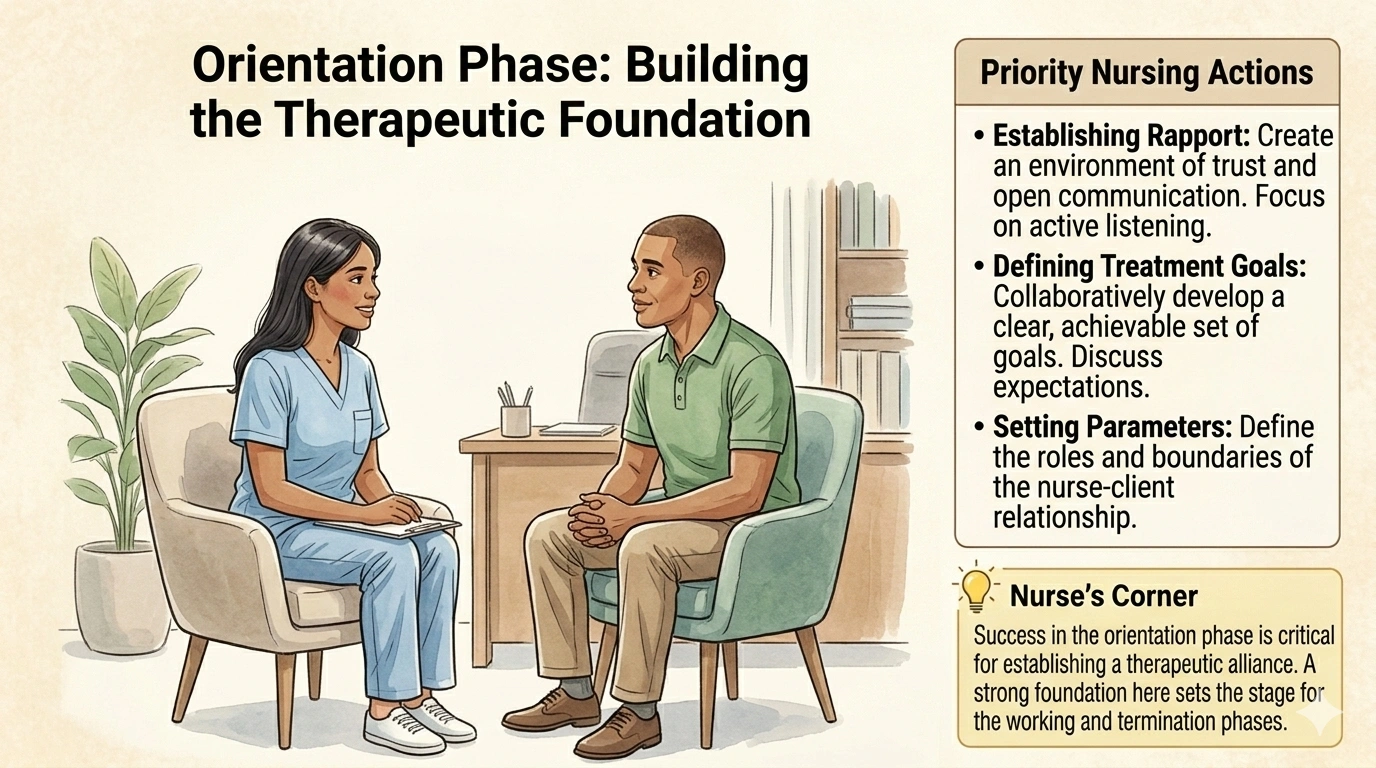
What is the priority nursing action during the orientation (introductory) phase of the nurseclient relationship?
A.
Acknowledge the clients actions and generate alternative behaviors.
B. Establish rapport and develop treatment goals.
C. Attempt to find alternative placement.
D. Explore how thoughts and feelings about this client may adversely impact care.
Rationale
The answer to "What is the priority nursing action during the orientation (introductory) phase of the nurseclient relationship" is "Establish rapport and develop treatment goals.".
A. Acknowledge the clients actions and generate alternative behaviors.
This option is off-target for what the stem is asking. It may be loosely connected, but it doesn't match the priority concept. This answer centers "Acknowledge the clients actions and generate alternative behaviors.," but the stem highlights "What is the priority nursing action during the orientation (introductory) phase of the...." A good elimination step is to remove choices that stereotype or drift away from the stem's priority.
B. Establish rapport and develop treatment goals.
This choice fits because it stays grounded in the situation and avoids added assumptions. It keeps attention on "What is the priority nursing action during the orientation (introductory) phase of the...," which is what this item is testing. It promotes safe decision-making by basing interpretation on observable data.
C. Attempt to find alternative placement.
This option is off-target for what the stem is asking. It may be loosely connected, but it doesn't match the priority concept. The statement "Attempt to find alternative placement." is not supported by the scenario ("What is the priority nursing action during the orientation (introductory) phase of the..."). A good elimination step is to remove choices that stereotype or drift away from the stem's priority.
D. Explore how thoughts and feelings about this client may adversely impact care.
This answer does not address the stem's main point. It either answers a different question or adds meaning not provided in the scenario. The statement "Explore how thoughts and feelings about this client may adversely impact care." is not supported by the scenario ("What is the priority nursing action during the orientation (introductory) phase of the..."). In practice, the nurse should stay with assessment cues and culturally safe interpretation.
**Conclusion**
This item centers on What is the priority nursing action during the orientation (introductory) phase of the nurseclient relationship?. The most appropriate response is Establish rapport and develop treatment goals., which aligns with the concept tested in the scenario. The strongest answers in this set stay closely tied to what is stated in the scenario and avoid adding extra meaning. This interpretation promotes culturally safe care and reduces the risk of misunderstanding client behavior.
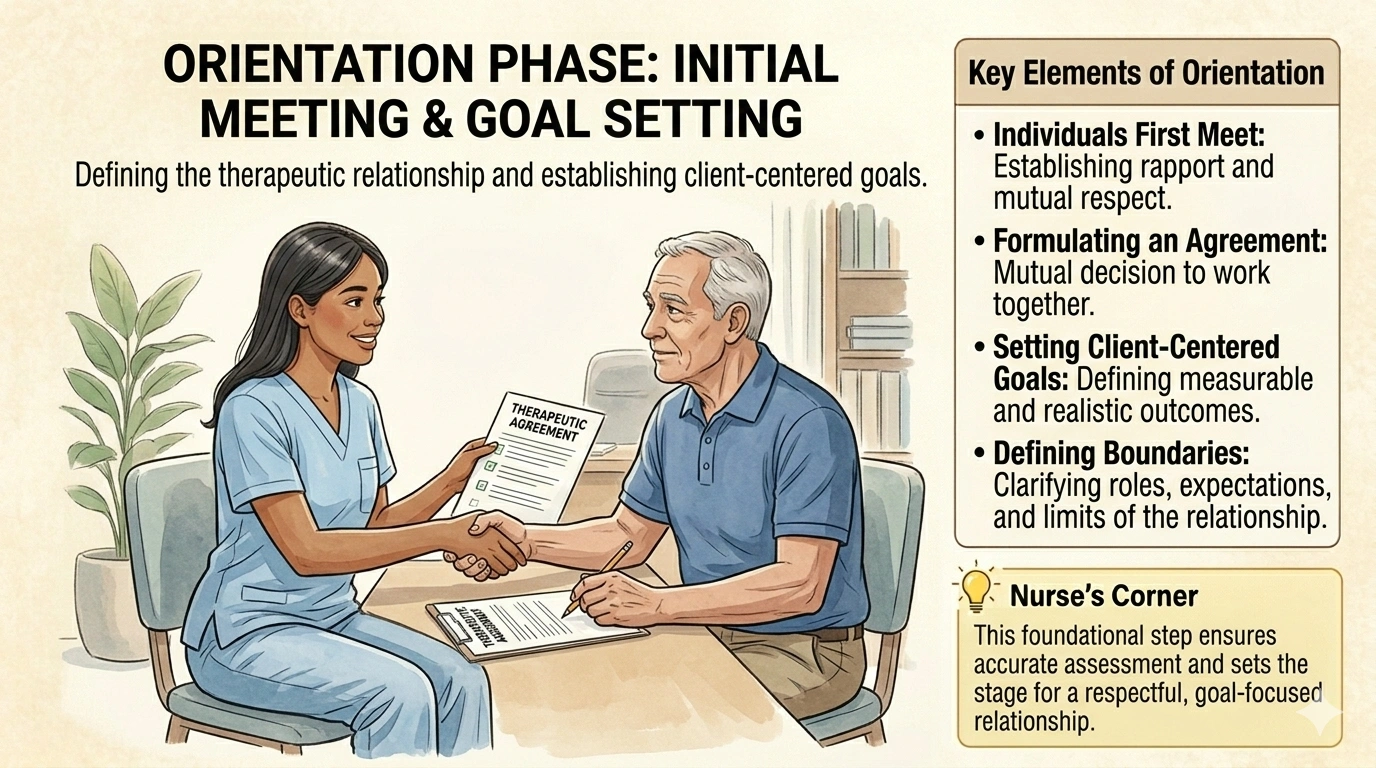
Which phase of the nurseclient relationship begins when the individuals first meet and is characterized by an agreement to continue to meet and work on setting client-centered goals?
A.
Preinteraction
B. Orientation
C. Working
D. Termination
Rationale
The phase being described is "Orientation".
A. Preinteraction
This choice is off-target for what the stem is asking. It may be loosely connected, but it doesn't match the priority concept. Compared with the stem ("Which phase of the nurseclient relationship begins when the individuals first meet and..."), this choice introduces a different emphasis ("Preinteraction"). Clinically, this would risk misinterpretation because it is not grounded in the presented data.
B. Orientation
This choice fits because it stays grounded in the scenario and avoids added assumptions. It addresses the stem's focus ("Which phase of the nurseclient relationship begins when the individuals first meet and...") in a straightforward way. It promotes safe decision-making by basing interpretation on observable data.
C. Working
This answer does not address the stem's main point. It either answers a different question or adds meaning not provided in the situation. The statement "Working" is not supported by the scenario ("Which phase of the nurseclient relationship begins when the individuals first meet and..."). Clinically, this would risk misinterpretation because it is not grounded in the presented data.
D. Termination
This option is off-target for what the stem is asking. It may be loosely connected, but it doesn't match the priority concept. Here, "Termination" pulls the nurse away from the stem's cue ("Which phase of the nurseclient relationship begins when the individuals first meet and..."). Clinically, this would risk misinterpretation because it is not grounded in the presented data.
**Conclusion**
In this situation, the main issue is Which phase of the nurseclient relationship begins when the individuals first meet and is characterized by an.... The most appropriate response is Orientation, which aligns with the concept tested in the scenario. The better reasoning here is the one that connects directly to the scenario details and the concept being tested. In practice, this approach supports accurate assessment and respectful, client-centered care.
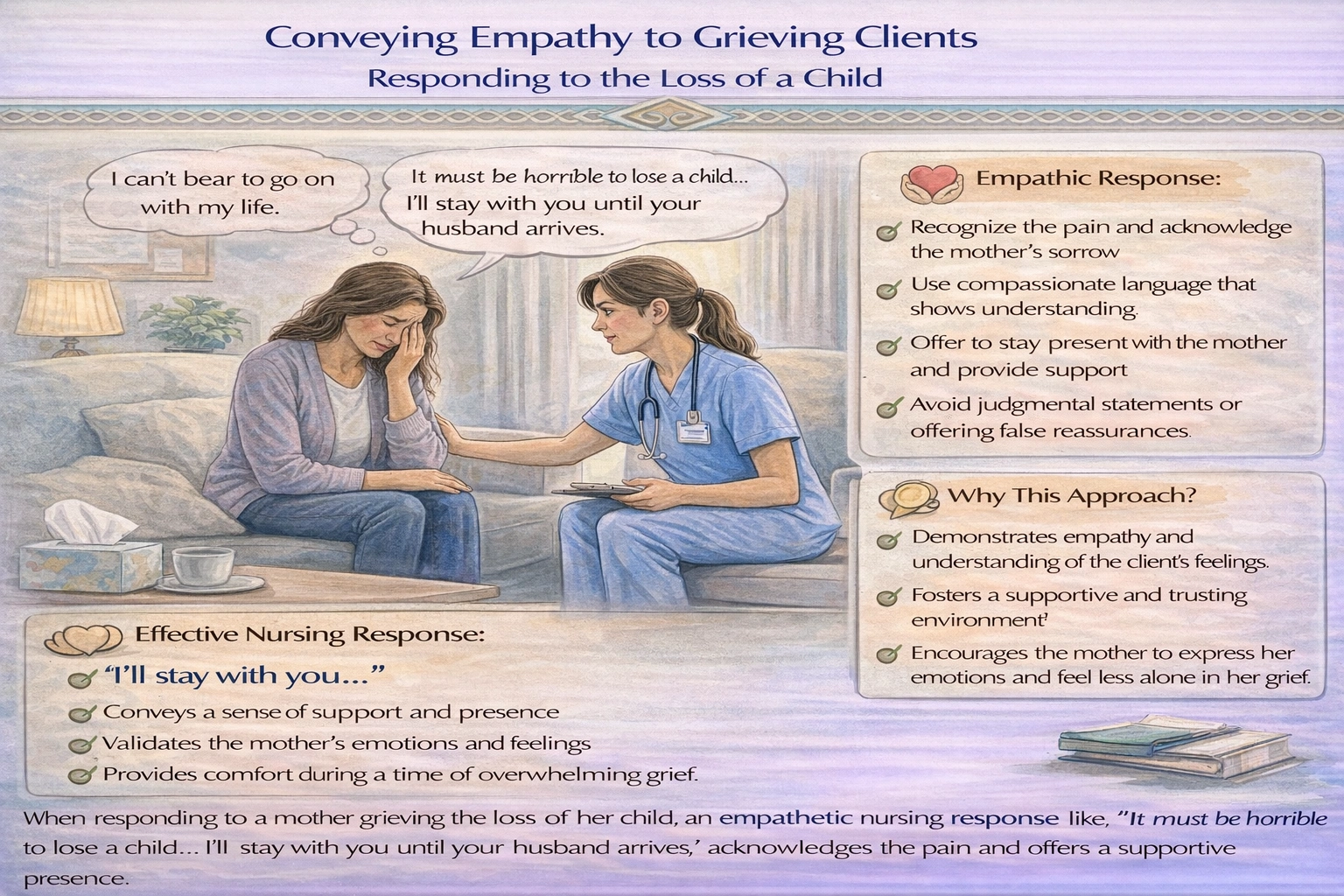
A mother who has learned that her child was killed in a tragic car accident states, I cant bear to go on with my life. Which nursing statement conveys empathy?
A.
This situation is very sad, but time is a great healer.
B. You are sad, but you must be strong for your other children.
C. Once you cry it all out, things will seem so much better.
D. It must be horrible to lose a child; Ill stay with you until your husband arrives.
Rationale
The nursing statement that answers the question is "It must be horrible to lose a child; Ill stay with you until your husband arrives.".
A. This situation is very sad, but time is a great healer.
This choice moves away from supportive communication. The nurse should avoid blame and instead use calm, client-centered language. This answer centers "This situation is very sad, but time is a great healer.," but the stem highlights "A mother who has learned that her child was killed in a tragic car accident states, I...." A good elimination step is to remove choices that stereotype or drift away from the stem's priority.
B. You are sad, but you must be strong for your other children.
This response is nontherapeutic because it is judgmental or dismissive. It would likely shut down communication rather than support assessment and rapport. This answer centers "You are sad, but you must be strong for your other children.," but the stem highlights "A mother who has learned that her child was killed in a tragic car accident states, I...." In practice, the nurse should stay with assessment cues and culturally safe interpretation.
C. Once you cry it all out, things will seem so much better.
This option generalizes about an entire group. The nurse should individualize assessment rather than accept absolutes. Compared with the stem ("A mother who has learned that her child was killed in a tragic car accident states, I..."), this choice introduces a different emphasis ("Once you cry it all out, things will seem so much better."). Clinically, this would risk misinterpretation because it is not grounded in the presented data.
D. It must be horrible to lose a child; Ill stay with you until your husband arrives.
This choice fits because it stays grounded in the scenario and avoids added assumptions. It addresses the stem's focus ("A mother who has learned that her child was killed in a tragic car accident states, I...") in a straightforward way. It promotes safe decision-making by basing interpretation on observable data.
**Conclusion**
The focus of this question is A mother who has learned that her child was killed in a tragic car accident states, I cant bear to go on with my life.... It must be horrible to lose a child; Ill stay with you until your husband arrives.. Some responses sound dismissive or judgmental, which can shut down disclosure and reduce therapeutic trust. Options written in sweeping terms tend to replace individualized assessment with assumptions; that approach weakens accuracy and rapport. In practice, this approach supports accurate assessment and respectful, client-centered care.
A client diagnosed with paranoid schizophrenia becomes agitated when asked to play a game. The client responds, Do you want to be my girlfriend? Which nursing response is most appropriate?
A.
You are upset now. It would be best if you go to your room until you feel better.
B. Remember, we have a professional relationship. Are you feeling uncomfortable?
C. We have discussed this before. I am not allowed to date clients.
D. I think you should discuss your fantasies with your therapist.
Rationale
The correct response to "Which nursing response is most appropriate" is "Remember, we have a professional relationship. Are you feeling uncomfortable?".
A. You are upset now. It would be best if you go to your room until you feel better.
This answer does not address the stem's main point. It either answers a different question or adds meaning not provided in the scenario. This answer centers "You are upset now. It would be best if you go to your room until you feel better.," but the stem highlights "A client diagnosed with paranoid schizophrenia becomes agitated when asked to play a...." Choose the option that answers the question directly without adding extra assumptions.
B. Remember, we have a professional relationship. Are you feeling uncomfortable?
This is the strongest option because it applies culturally informed, nonjudgmental nursing interpretation. It matches what the stem emphasizes ("A client diagnosed with paranoid schizophrenia becomes agitated when asked to play a...") and guides appropriate nursing judgment. It promotes safe decision-making by basing interpretation on observable data.
C. We have discussed this before. I am not allowed to date clients.
This choice is off-target for what the stem is asking. It may be loosely connected, but it doesn't match the priority concept. This answer centers "We have discussed this before. I am not allowed to date clients.," but the stem highlights "A client diagnosed with paranoid schizophrenia becomes agitated when asked to play a...." A good elimination step is to remove choices that stereotype or drift away from the stem's priority.
D. I think you should discuss your fantasies with your therapist.
This option is off-target for what the stem is asking. It may be loosely connected, but it doesn't match the priority concept. Compared with the stem ("A client diagnosed with paranoid schizophrenia becomes agitated when asked to play a..."), this choice introduces a different emphasis ("I think you should discuss your fantasies with your therapist."). Choose the option that answers the question directly without adding extra assumptions.
**Conclusion**
This item centers on A client diagnosed with paranoid schizophrenia becomes agitated when asked to play a game. The client responds, Do you.... The best-supported answer is Remember, we have a professional relationship. Are you feeling uncomfortable?, because it matches the situation described. Several alternatives rely on broad, absolute statements that can turn cultural knowledge into stereotyping, which is unsafe for clinical judgment. This interpretation promotes culturally safe care and reduces the risk of misunderstanding client behavior.
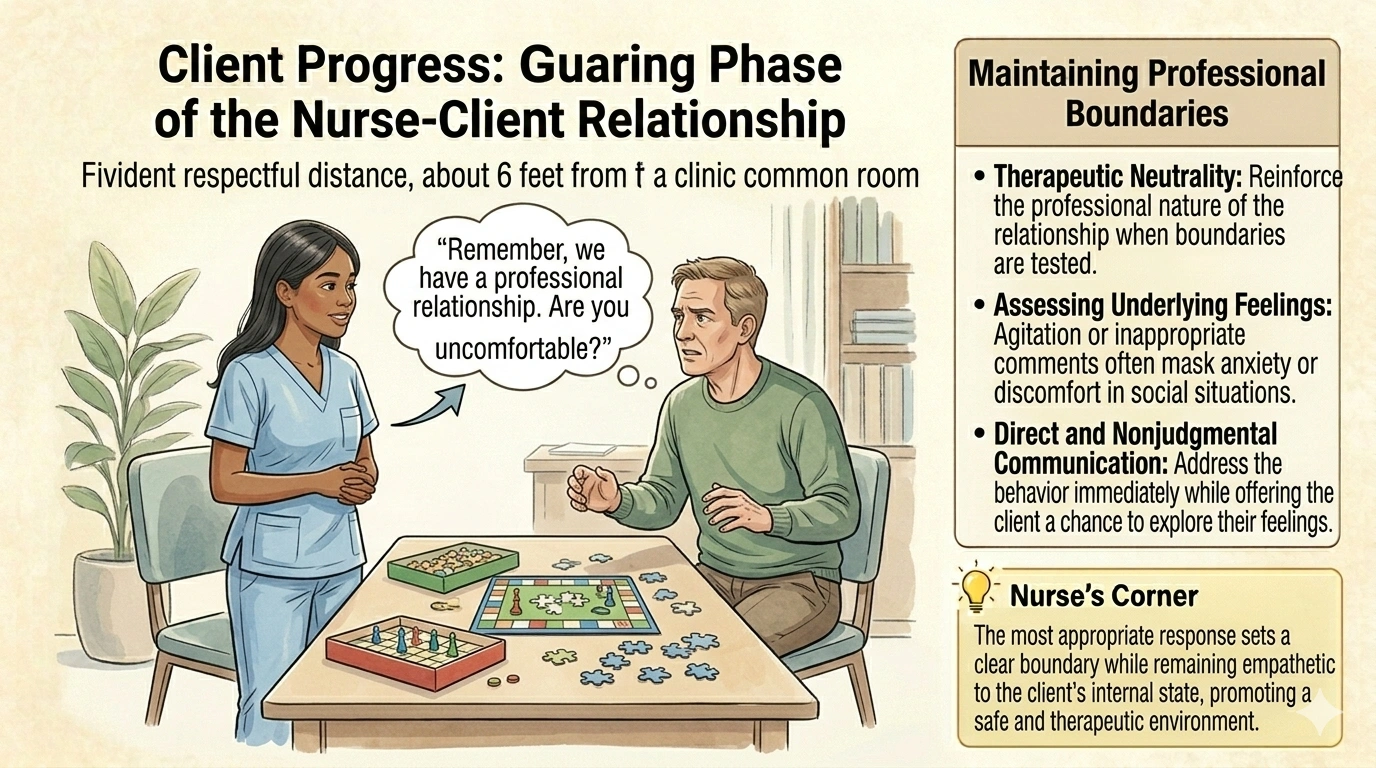
According to Peplau, which nursing intervention is most appropriate when the nurse is functioning in the role of a surrogate?
A.
The nurse functions as a nurturing parent in order to build a trusting relationship.
B. The nurse plays cards with a small group of clients.
C. The nurse discusses childhood events that may affect personality development.
D. The nurse provides a safe social environment.
Rationale
For "According to Peplau, which nursing intervention is most appropriate when the nurse is functioning in the role of a surrogate," the best answer is "The nurse functions as a nurturing parent in order to build a trusting relationship.".
A. The nurse functions as a nurturing parent in order to build a trusting relationship.
This is the best answer because it directly reflects the key cue in the stem. It addresses the stem's priority ("According to Peplau, which nursing intervention is most appropriate when the nurse is...") in a straightforward way. From a nursing-process perspective, it prioritizes assessment and therapeutic effectiveness.
B. The nurse plays cards with a small group of clients.
This choice relies on an overly broad stereotype instead of the specific assessment cues in the stem. Cultural patterns can inform care, but they are not universal. Here, "The nurse plays cards with a small group of clients." pulls the nurse away from the stem's cue ("According to Peplau, which nursing intervention is most appropriate when the nurse is..."). Choose the choice that answers the question directly without adding extra assumptions.
C. The nurse discusses childhood events that may affect personality development.
This answer does not address the stem's main point. It either answers a different question or adds meaning not provided in the situation. Here, "The nurse discusses childhood events that may affect personality development." pulls the nurse away from the stem's cue ("According to Peplau, which nursing intervention is most appropriate when the nurse is..."). Clinically, this would risk misinterpretation because it is not grounded in the presented data.
D. The nurse provides a safe social environment.
This choice is off-target for what the stem is asking. It may be loosely connected, but it doesn't match the priority concept. Compared with the stem ("According to Peplau, which nursing intervention is most appropriate when the nurse is..."), this choice introduces a different emphasis ("The nurse provides a safe social environment."). Clinically, this would risk misinterpretation because it is not grounded in the presented data.
**Conclusion**
This item centers on According to Peplau, which nursing intervention is most appropriate when the nurse is functioning in the role of a... The nurse functions as a nurturing parent in order to build a trusting relationship.. Several alternatives rely on broad, absolute statements that can turn cultural knowledge into stereotyping, which is unsafe for clinical judgment. This interpretation promotes culturally safe care and reduces the risk of misunderstanding client behavior.
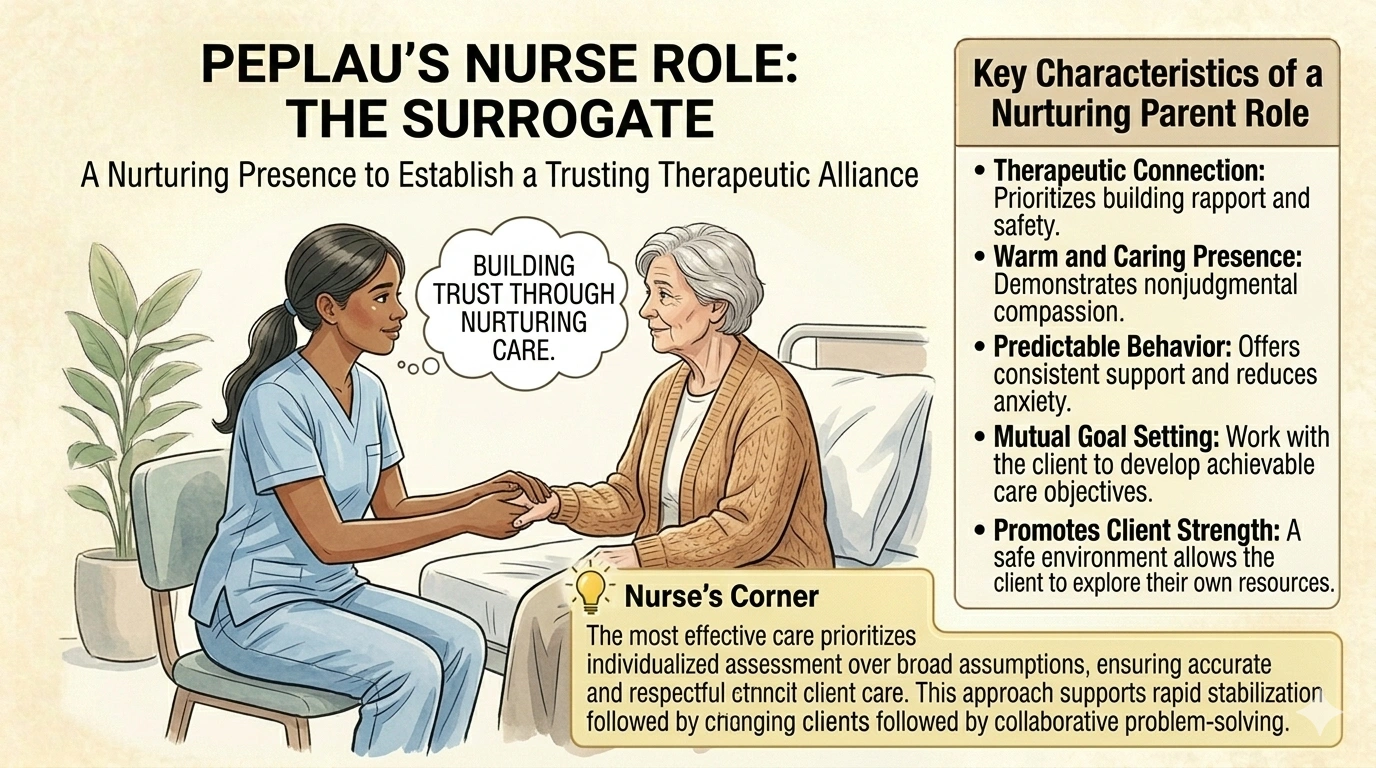
Which client statement may indicate a transference reaction?
A.
I need a real nurse. You are young enough to be my daughter and I dont want to tell you about my personal life.
B. I deserve more than I am getting here. Do you know who I am and what I do? Let me talk to your supervisor.
C. I dont seem to be able to relate to people. I would rather stay in my room and be by myself.
D. My mother is the source of my problems. She has always told me what to do and what to say.
Rationale
The correct response to "Which client statement may indicate a transference reaction" is "I need a real nurse. You are young enough to be my daughter and I dont want to tell you about my personal life.".
A. I need a real nurse. You are young enough to be my daughter and I dont want to tell you about my personal life.
This is the best answer because it directly reflects the key cue in the stem. It matches what the stem emphasizes ("Which client statement may indicate a transference reaction?") and guides appropriate nursing judgment. In practice, this supports respectful communication and accurate assessment.
B. I deserve more than I am getting here. Do you know who I am and what I do? Let me talk to your supervisor.
This answer does not address the stem's main point. It either answers a different question or adds meaning not provided in the scenario. Here, "I deserve more than I am getting here. Do you know who I am and what I do? Let me talk to your supervisor." pulls the nurse away from the stem's cue ("Which client statement may indicate a transference reaction?"). A good elimination step is to remove choices that stereotype or drift away from the stem's priority.
C. I dont seem to be able to relate to people. I would rather stay in my room and be by myself.
This option is off-target for what the stem is asking. It may be loosely connected, but it doesn't match the priority concept. Compared with the stem ("Which client statement may indicate a transference reaction?"), this choice introduces a different emphasis ("I dont seem to be able to relate to people. I would rather stay in my room and be by myself."). Clinically, this would risk misinterpretation because it is not grounded in the presented data.
D. My mother is the source of my problems. She has always told me what to do and what to say.
This answer does not address the stem's main point. It either answers a different question or adds meaning not provided in the scenario. Here, "My mother is the source of my problems. She has always told me what to do and what to say." pulls the nurse away from the stem's cue ("Which client statement may indicate a transference reaction?"). A good elimination step is to remove choices that stereotype or drift away from the stem's priority.
**Conclusion**
The scenario emphasizes Which client statement may indicate a transference reaction?. The most appropriate response is I need a real nurse. You are young enough to be my daughter and I dont want to tell you..., which aligns with the concept tested in the scenario. The strongest answers in this set stay closely tied to what is stated in the scenario and avoid adding extra meaning. In practice, this approach supports accurate assessment and respectful, client-centered care.
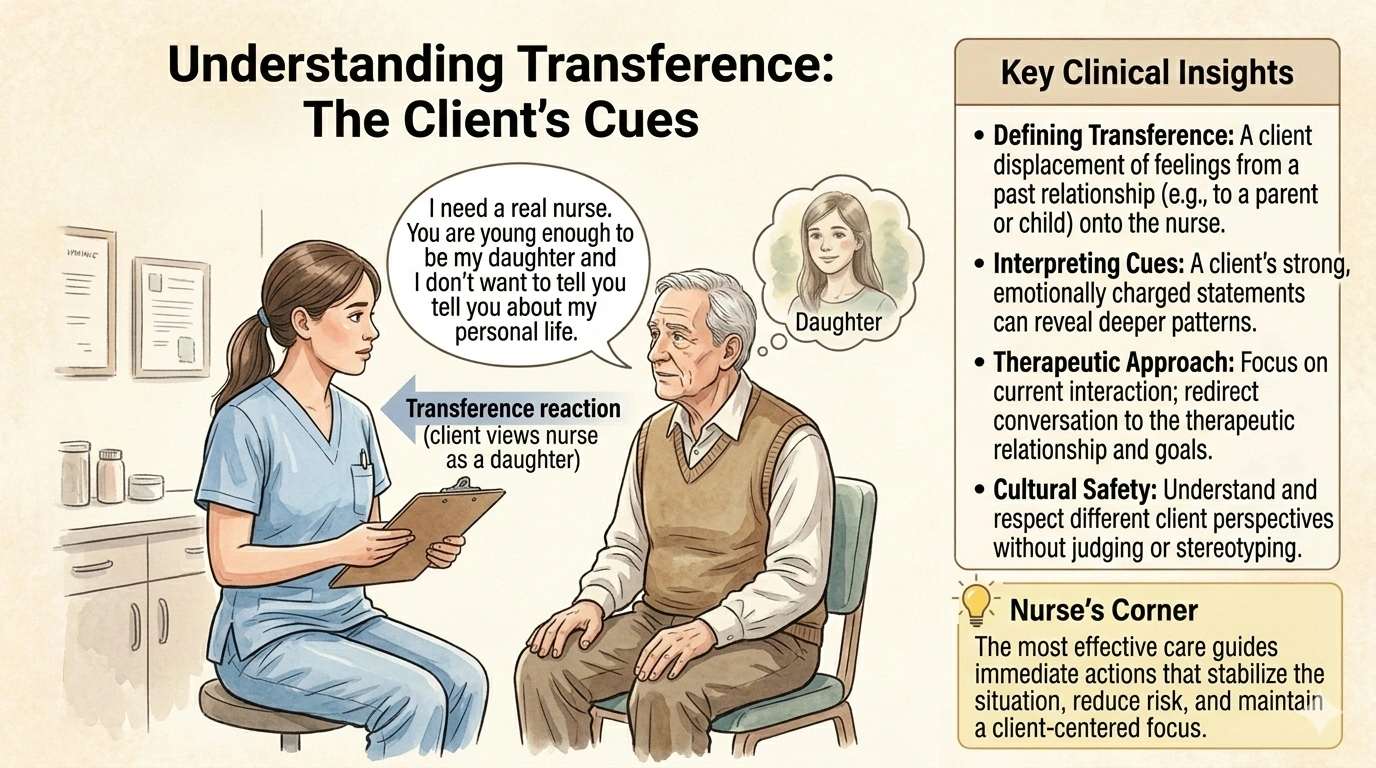
When is self-disclosure by the nurse appropriate in a therapeutic nurseclient relationship?
A.
When it is judged that the information may benefit the nurse and client
B. When the nurse has a duty to warn
C. When the nurse feels emotionally indebted toward the client
D. When it is judged that the information may benefit the client
Rationale
Self-disclosure is appropriate "When it is judged that the information may benefit the client".
A. When it is judged that the information may benefit the nurse and client
This option is off-target for what the stem is asking. It may be loosely connected, but it doesn't match the priority concept. Compared with the stem ("When is self-disclosure by the nurse appropriate in a therapeutic nurseclient..."), this choice introduces a different emphasis ("When it is judged that the information may benefit the nurse and client"). Clinically, this would risk misinterpretation because it is not grounded in the presented data.
B. When the nurse has a duty to warn
This option is off-target for what the stem is asking. It may be loosely connected, but it doesn't match the priority concept. This answer centers "When the nurse has a duty to warn," but the stem highlights "When is self-disclosure by the nurse appropriate in a therapeutic nurseclient...." In practice, the nurse should stay with assessment cues and culturally safe interpretation.
C. When the nurse feels emotionally indebted toward the client
This choice misses the focus of the question and would lead the nurse away from the best clinical judgment. This answer centers "When the nurse feels emotionally indebted toward the client," but the stem highlights "When is self-disclosure by the nurse appropriate in a therapeutic nurseclient...." In practice, the clinician should stay with assessment cues and culturally safe interpretation.
D. When it is judged that the information may benefit the client
This choice fits because it stays grounded in the scenario and avoids added assumptions. It keeps attention on "When is self-disclosure by the nurse appropriate in a therapeutic nurseclient...," which is what this item is testing. Clinically, it helps preserve rapport while interpreting behavior through context.
**Conclusion**
The focus of this question is When is self-disclosure by the nurse appropriate in a therapeutic nurseclient relationship? When it is judged that the information may benefit the client. Several alternatives rely on broad, absolute statements that can turn cultural knowledge into stereotyping, which is unsafe for clinical judgment. This interpretation promotes culturally safe care and reduces the risk of misunderstanding client behavior.
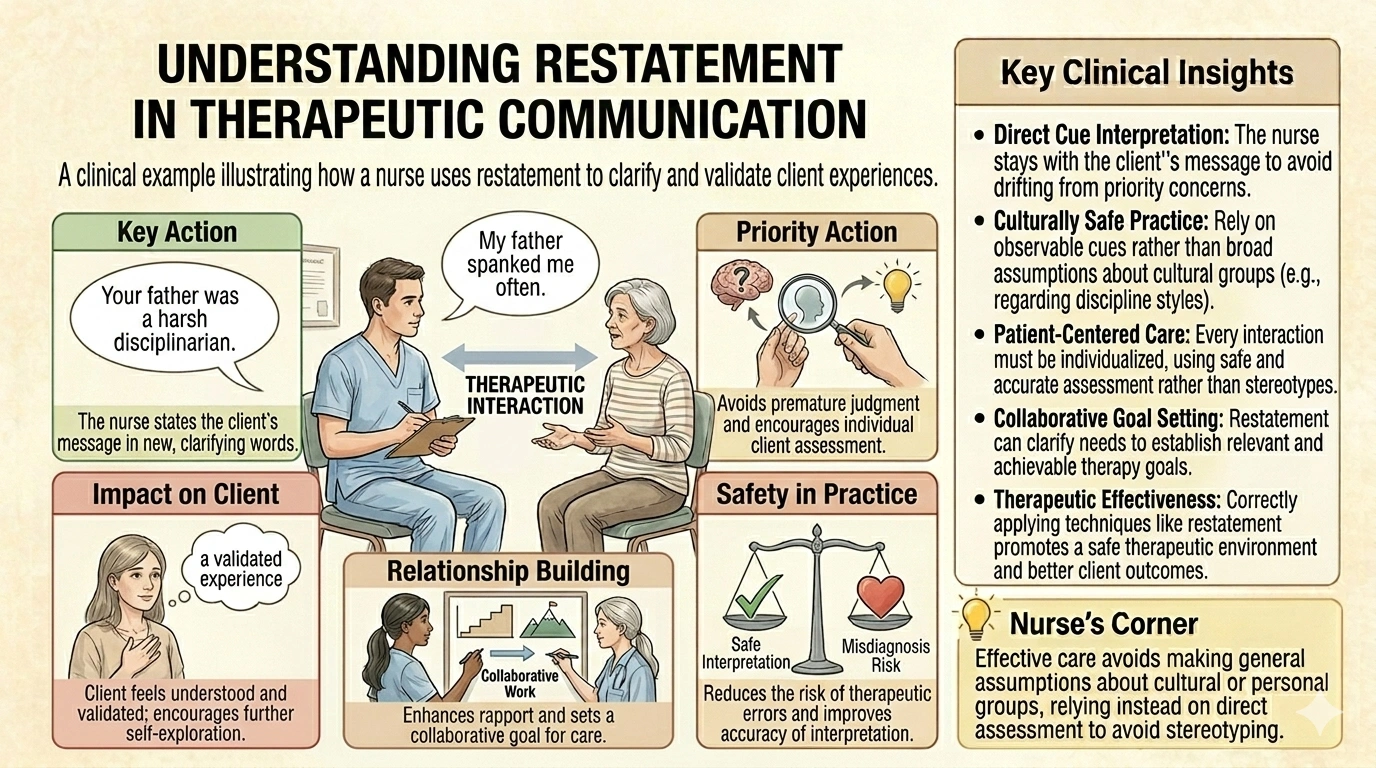
Which therapeutic communication technique is being used in this nurseclient interaction? Client: My father spanked me often. Nurse: Your father was a harsh disciplinarian.
A.
Restatement
B. Offering general leads
C. Focusing
D. Accepting
Rationale
The therapeutic communication technique being used is "Restatement".
A. Restatement
This is the best answer because it directly reflects the key cue in the stem. It responds to "Which therapeutic communication technique is being used in this clinicianclient..." without stereotyping the client or shifting to a different concept. From a nursing-process perspective, it prioritizes assessment and therapeutic effectiveness.
B. Offering general leads
This choice misses the focus of the question and would lead the nurse away from the best clinical judgment. Here, "Offering general leads" pulls the nurse away from the stem's cue ("Which therapeutic communication technique is being used in this nurseclient..."). A good elimination step is to remove choices that stereotype or drift away from the stem's priority.
C. Focusing
This choice misses the focus of the question and would lead the nurse away from the best clinical judgment. This answer centers "Focusing," but the stem highlights "Which therapeutic communication technique is being used in this nurseclient...." Choose the option that answers the question directly without adding extra assumptions.
D. Accepting
This choice is off-target for what the stem is asking. It may be loosely connected, but it doesn't match the priority concept. This answer centers "Accepting," but the stem highlights "Which therapeutic communication technique is being used in this nurseclient...." Clinically, this would risk misinterpretation because it is not grounded in the presented data.
**Conclusion**
The focus of this question is Which therapeutic communication technique is being used in this nurseclient interaction? Client: My father spanked me.... The best-supported answer is Restatement, because it matches the situation described. The strongest answers in this set stay closely tied to what is stated in the scenario and avoid adding extra meaning. Clinically, this reasoning helps maintain rapport while guiding safe nursing decision-making.
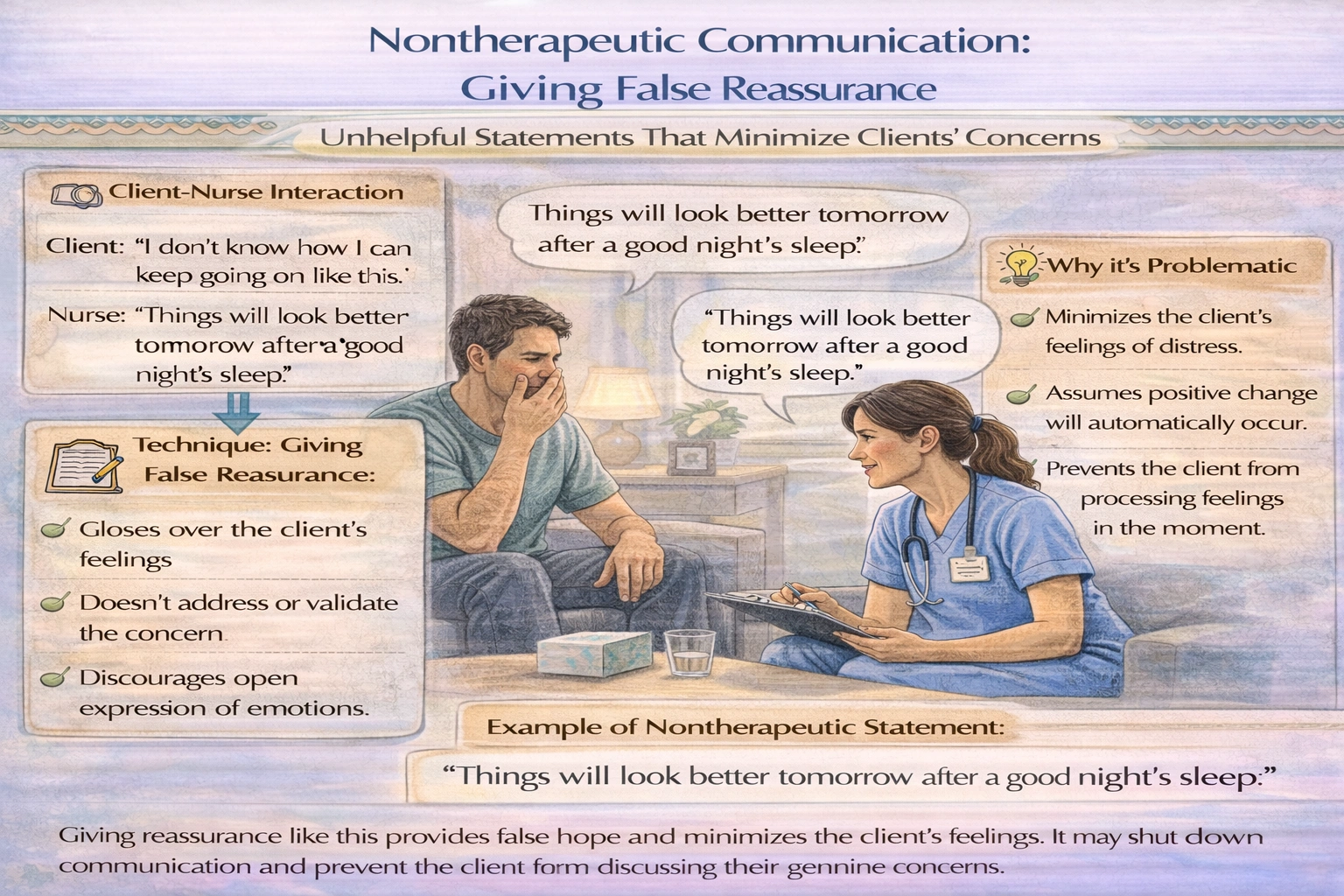
A nurse states to a client, Things will look better tomorrow after a good nights sleep. This is an example of which communication technique?
A.
The therapeutic technique of giving advice
B. The therapeutic technique of defending
C. The nontherapeutic technique of presenting reality
D. The nontherapeutic technique of giving false reassurance
Rationale
The answer to "A nurse states to a client, Things will look better tomorrow after a good nights sleep. This is an example of which communication technique" is "The nontherapeutic technique of giving false reassurance".
A. The therapeutic technique of giving advice
This answer does not address the stem's main point. It either answers a different question or adds meaning not provided in the scenario. Here, "The therapeutic technique of giving advice" pulls the nurse away from the stem's cue ("A nurse states to a client, Things will look better tomorrow after a good nights..."). Clinically, this would risk misinterpretation because it is not grounded in the presented data.
B. The therapeutic technique of defending
This choice misses the focus of the question and would lead the nurse away from the best clinical judgment. This answer centers "The therapeutic technique of defending," but the stem highlights "A nurse states to a client, Things will look better tomorrow after a good nights...." Choose the choice that answers the question directly without adding extra assumptions.
C. The nontherapeutic technique of presenting reality
This choice is off-target for what the stem is asking. It may be loosely connected, but it doesn't match the priority concept. Here, "The nontherapeutic technique of presenting reality" pulls the nurse away from the stem's cue ("A nurse states to a client, Things will look better tomorrow after a good nights..."). In practice, the clinician should stay with assessment cues and culturally safe interpretation.
D. The nontherapeutic technique of giving false reassurance
This is the strongest option because it applies culturally informed, nonjudgmental nursing interpretation. It responds to "A nurse states to a client, Things will look better tomorrow after a good nights..." without stereotyping the client or shifting to a different concept. In practice, this supports respectful communication and accurate assessment.
**Conclusion**
The scenario emphasizes A nurse states to a client, Things will look better tomorrow after a good nights sleep. This is an example of which... The nontherapeutic technique of giving false reassurance. The strongest answers in this set stay closely tied to what is stated in the scenario and avoid adding extra meaning. This interpretation promotes culturally safe care and reduces the risk of misunderstanding client behavior.
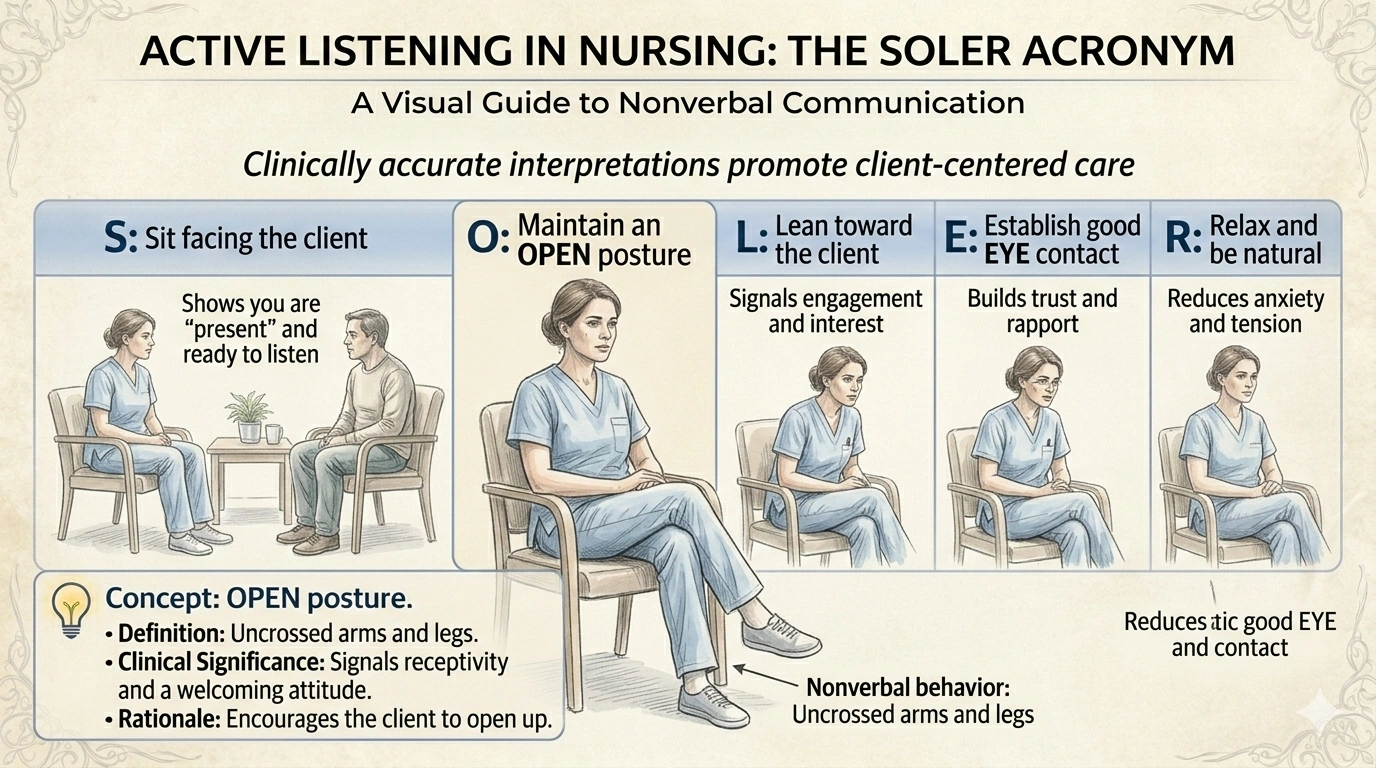
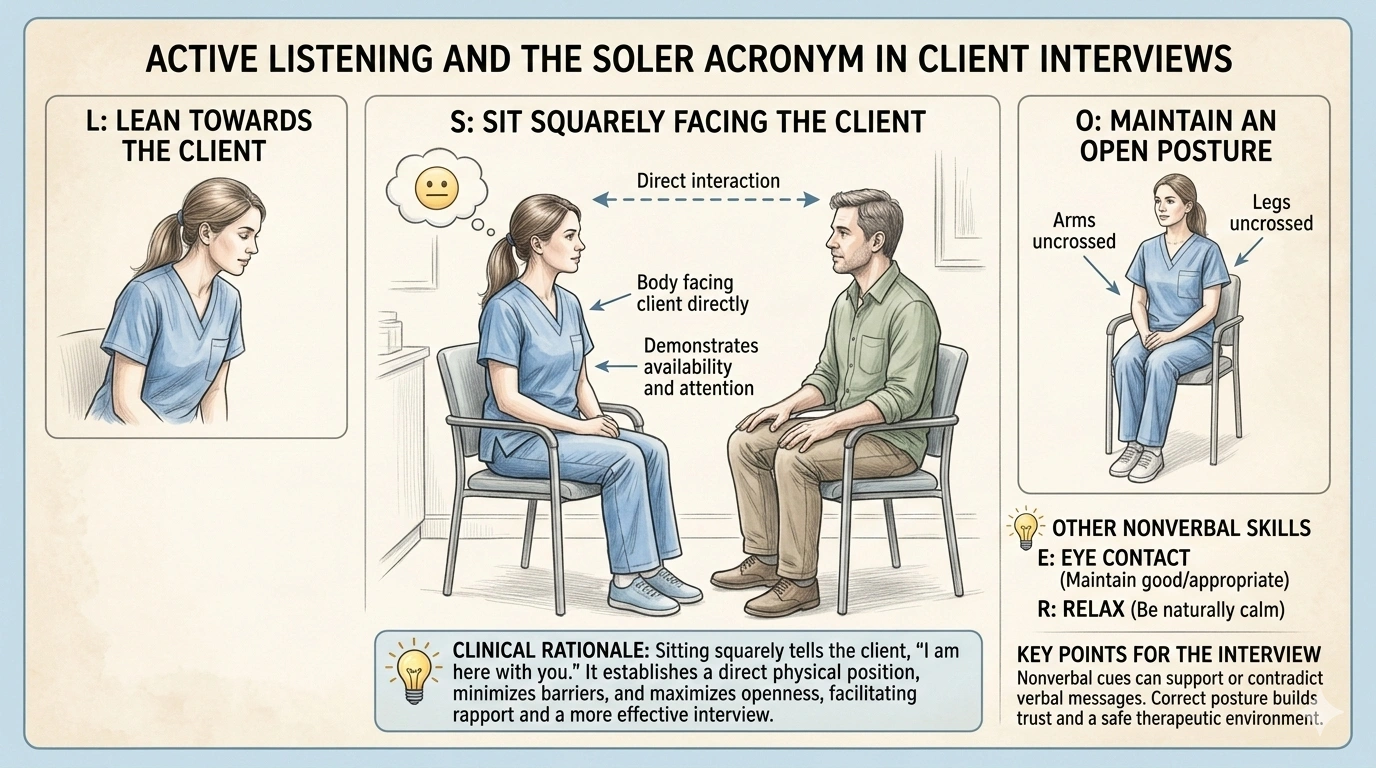
A nurse maintains an uncrossed arm and leg posture. This nonverbal behavior is reflective of which letter of the SOLER acronym for active listening?
A.
S
B. O
C. L
D. E
Rationale
For "A nurse maintains an uncrossed arm and leg posture. This nonverbal behavior is reflective of which letter of the SOLER acronym for active listening," the best answer is "O".
A. S
This answer does not address the stem's main point. It either answers a different question or adds meaning not provided in the situation. Compared with the stem ("A nurse maintains an uncrossed arm and leg posture. This nonverbal behavior is..."), this choice introduces a different emphasis ("S"). Choose the choice that answers the question directly without adding extra assumptions.
B. O
This is the best answer because it directly reflects the key cue in the stem. It responds to "A nurse maintains an uncrossed arm and leg posture. This nonverbal behavior is..." without stereotyping the client or shifting to a different concept. It promotes safe decision-making by basing interpretation on observable data.
C. L
This answer does not address the stem's main point. It either answers a different question or adds meaning not provided in the scenario. The statement "L" is not supported by the scenario ("A nurse maintains an uncrossed arm and leg posture. This nonverbal behavior is..."). In practice, the clinician should stay with assessment cues and culturally safe interpretation.
D. E
This choice is off-target for what the stem is asking. It may be loosely connected, but it doesn't match the priority concept. This answer centers "E," but the stem highlights "A nurse maintains an uncrossed arm and leg posture. This nonverbal behavior is...." A good elimination step is to remove choices that stereotype or drift away from the stem's priority.
E. R
This answer does not address the stem's main point. It either answers a different question or adds meaning not provided in the scenario. The statement "R" is not supported by the scenario ("A nurse maintains an uncrossed arm and leg posture. This nonverbal behavior is..."). In practice, the nurse should stay with assessment cues and culturally safe interpretation.
**Conclusion**
In this situation, the main issue is A nurse maintains an uncrossed arm and leg posture. This nonverbal behavior is reflective of which letter of the SOLER.... The best-supported answer is O, because it matches the situation described. The better reasoning here is the one that connects directly to the scenario details and the concept being tested. In practice, this approach supports accurate assessment and respectful, client-centered care.
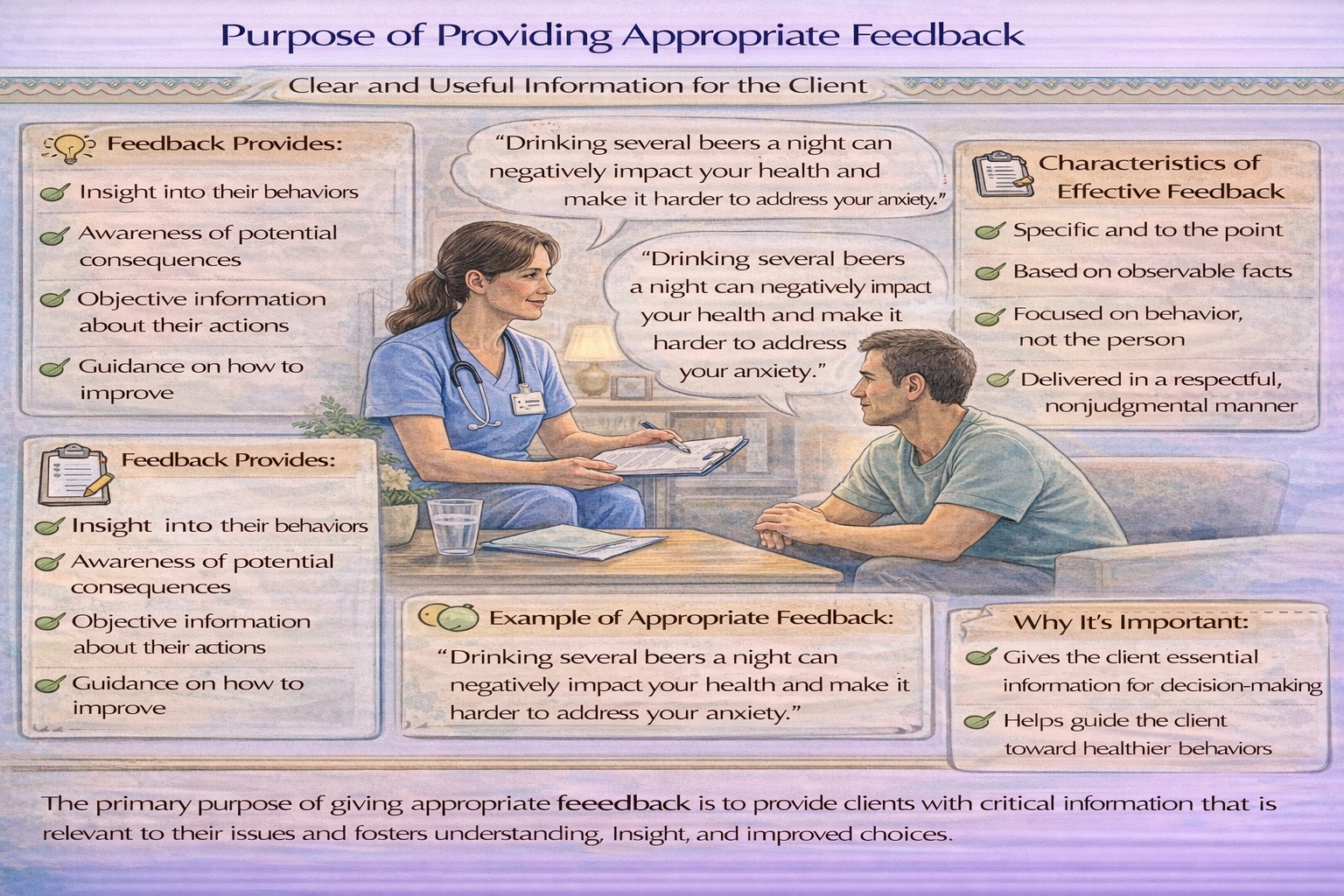
What is the purpose of a nurse providing appropriate feedback?
A.
To give the client good advice
B. To advise the client on appropriate behaviors
C. To evaluate the clients behavior
D. To give the client critical information
Rationale
The purpose being asked about is "To give the client critical information".
A. To give the client good advice
This answer does not address the stem's main point. It either answers a different question or adds meaning not provided in the situation. This answer centers "To give the client good advice," but the stem highlights "What is the purpose of a nurse providing appropriate feedback?." Choose the choice that answers the question directly without adding extra assumptions.
B. To advise the client on appropriate behaviors
This option is off-target for what the stem is asking. It may be loosely connected, but it doesn't match the priority concept. Here, "To advise the client on appropriate behaviors" pulls the nurse away from the stem's cue ("What is the purpose of a nurse providing appropriate feedback?"). Choose the option that answers the question directly without adding extra assumptions.
C. To evaluate the clients behavior
This option is off-target for what the stem is asking. It may be loosely connected, but it doesn't match the priority concept. This answer centers "To evaluate the clients behavior," but the stem highlights "What is the purpose of a nurse providing appropriate feedback?." Choose the option that answers the question directly without adding extra assumptions.
D. To give the client critical information
This choice fits because it stays grounded in the scenario and avoids added assumptions. It keeps attention on "What is the purpose of a clinician providing appropriate feedback?," which is what this item is testing. From a nursing-process perspective, it prioritizes assessment and therapeutic effectiveness.
**Conclusion**
The scenario emphasizes What is the purpose of a nurse providing appropriate feedback? To give the client critical information. The strongest answers in this set stay closely tied to what is stated in the scenario and avoid adding extra meaning. In practice, this approach supports accurate assessment and respectful, client-centered care.
When interviewing a client, which nonverbal behavior should a nurse employ?
A.
Maintaining indirect eye contact with the client
B. Providing space by leaning back away from the client
C. Sitting squarely, facing the client
D. Maintaining open posture with arms and legs crossed
Rationale
What the nurse should choose for "When interviewing a client, which nonverbal behavior should a nurse employ" is "Sitting squarely, facing the client".
A. Maintaining indirect eye contact with the client
This choice misses the priority of the question and would lead the nurse away from the best clinical judgment. Here, "Maintaining indirect eye contact with the client" pulls the nurse away from the stem's cue ("When interviewing a client, which nonverbal behavior should a nurse employ?"). Clinically, this would risk misinterpretation because it is not grounded in the presented data.
B. Providing space by leaning back away from the client
This answer does not address the stem's main point. It either answers a different question or adds meaning not provided in the situation. The statement "Providing space by leaning back away from the client" is not supported by the scenario ("When interviewing a client, which nonverbal behavior should a nurse employ?"). A good elimination step is to remove choices that stereotype or drift away from the stem's priority.
C. Sitting squarely, facing the client
This answer is supported by the stem and aligns with safe, client-centered nursing care. It keeps attention on "When interviewing a client, which nonverbal behavior should a nurse employ?," which is what this item is testing. From a nursing-process perspective, it prioritizes assessment and therapeutic effectiveness.
D. Maintaining open posture with arms and legs crossed
This answer does not address the stem's main point. It either answers a different question or adds meaning not provided in the scenario. The statement "Maintaining open posture with arms and legs crossed" is not supported by the scenario ("When interviewing a client, which nonverbal behavior should a nurse employ?"). Clinically, this would risk misinterpretation because it is not grounded in the presented data.
**Conclusion**
The focus of this question is When interviewing a client, which nonverbal behavior should a nurse employ? Sitting squarely, facing the client. The strongest answers in this set stay closely tied to what is stated in the scenario and avoid adding extra meaning. Clinically, this reasoning helps maintain rapport while guiding safe nursing decision-making.
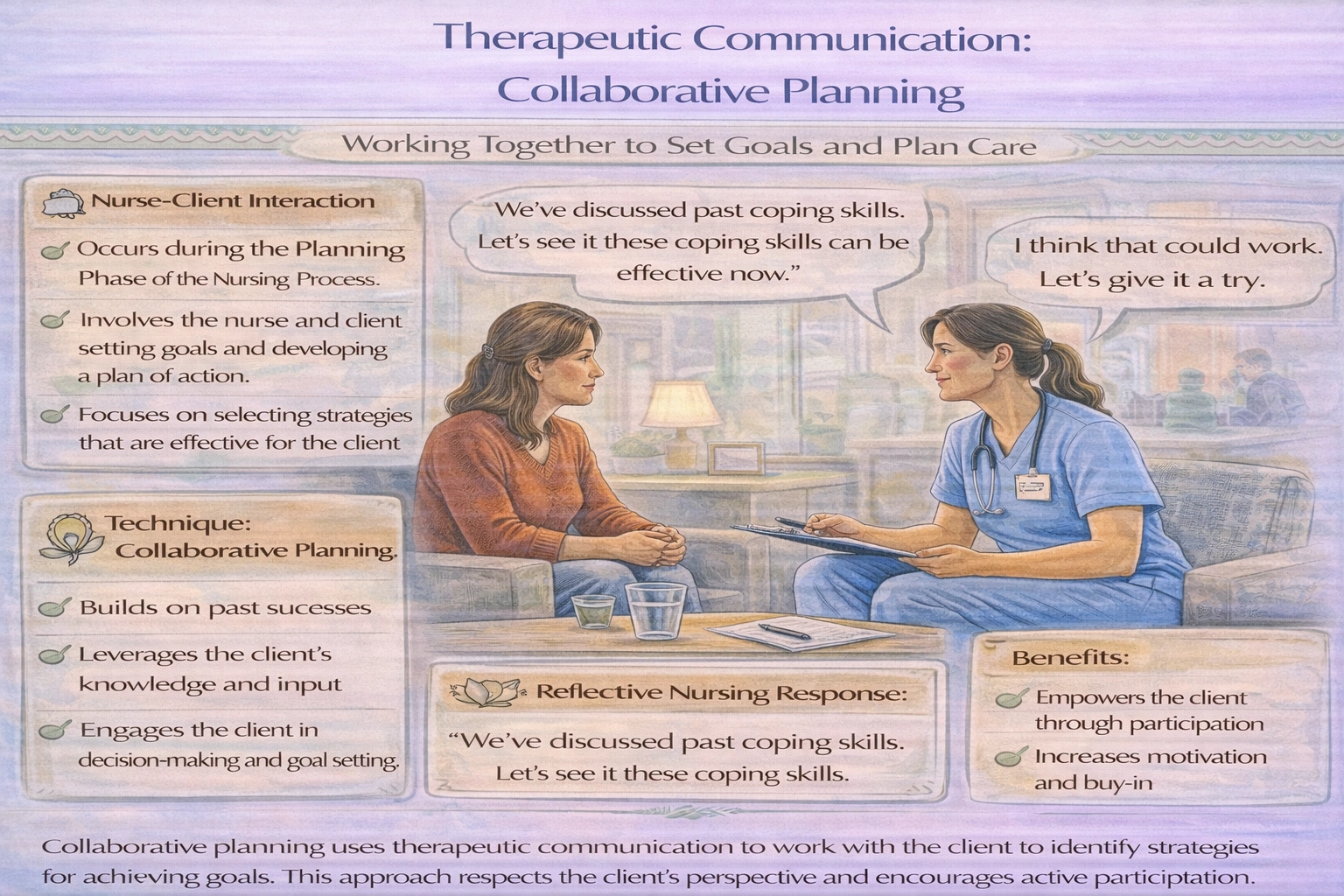
Which example of a therapeutic communication technique would be effective in the planning phase of the nursing process?
A.
Weve discussed past coping skills. Lets see if these coping skills can be effective now.
B. Please tell me in your own words what brought you to the hospital.
C. This new approach worked for you. Keep it up.
D. I notice that you seem to be responding to voices that I do not hear.
Rationale
The most appropriate selection for "Which example of a therapeutic communication technique would be effective in the planning phase of the nursing process" is "".
A. Weve discussed past coping skills. Lets see if these coping skills can be effective now.
This choice misses the focus of the question and would lead the nurse away from the best clinical judgment. Compared with the stem ("Which example of a therapeutic communication technique would be effective in the..."), this choice introduces a different emphasis ("Weve discussed past coping skills. Lets see if these coping skills can be effective now."). Choose the choice that answers the question directly without adding extra assumptions.
B. Please tell me in your own words what brought you to the hospital.
This option is off-target for what the stem is asking. It may be loosely connected, but it doesn't match the priority concept. Compared with the stem ("Which example of a therapeutic communication technique would be effective in the..."), this choice introduces a different emphasis ("Please tell me in your own words what brought you to the hospital."). Choose the option that answers the question directly without adding extra assumptions.
C. This new approach worked for you. Keep it up.
This choice moves away from supportive communication. The nurse should avoid blame and instead use calm, client-centered language. This answer centers "This new approach worked for you. Keep it up.," but the stem highlights "Which example of a therapeutic communication technique would be effective in the...." Choose the option that answers the question directly without adding extra assumptions.
D. I notice that you seem to be responding to voices that I do not hear.
This answer does not address the stem's main point. It either answers a different question or adds meaning not provided in the situation. The statement "I notice that you seem to be responding to voices that I do not hear." is not supported by the scenario ("Which example of a therapeutic communication technique would be effective in the..."). Clinically, this would risk misinterpretation because it is not grounded in the presented data.
**Conclusion**
The scenario emphasizes Which example of a therapeutic communication technique would be effective in the planning phase of the nursing process?. The correct response should be the one that addresses the concept being tested using only the information given. Some responses sound dismissive or judgmental, which can shut down disclosure and reduce therapeutic trust. In practice, this approach supports accurate assessment and respectful, client-centered care.
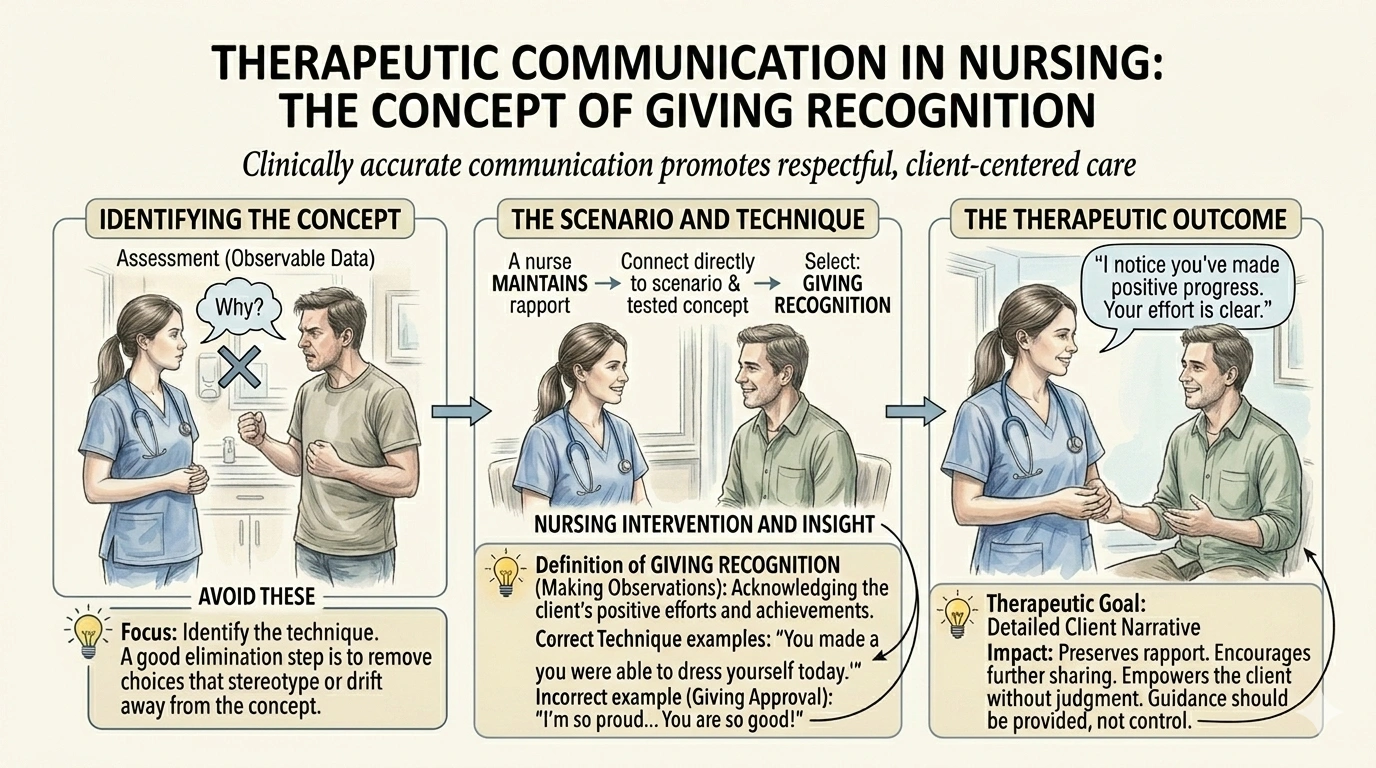
Which nursing statement is a good example of the therapeutic communication technique of giving recognition?
A.
You did not attend group today. Can we talk about that?
B.
C.
D.
Rationale
The nursing statement that answers the question is "".
A. You did not attend group today. Can we talk about that?
This answer does not address the stem's main point. It either answers a different question or adds meaning not provided in the scenario. The statement "You did not attend group today. Can we talk about that?" is not supported by the scenario ("Which nursing statement is a good example of the therapeutic communication technique..."). A good elimination step is to remove choices that stereotype or drift away from the stem's priority.
**Conclusion**
The focus of this question is Which nursing statement is a good example of the therapeutic communication technique of giving recognition?. The best answer will be the choice that directly matches the scenario and the concept being assessed. The better reasoning here is the one that connects directly to the scenario details and the concept being tested. This interpretation promotes culturally safe care and reduces the risk of misunderstanding client behavior.
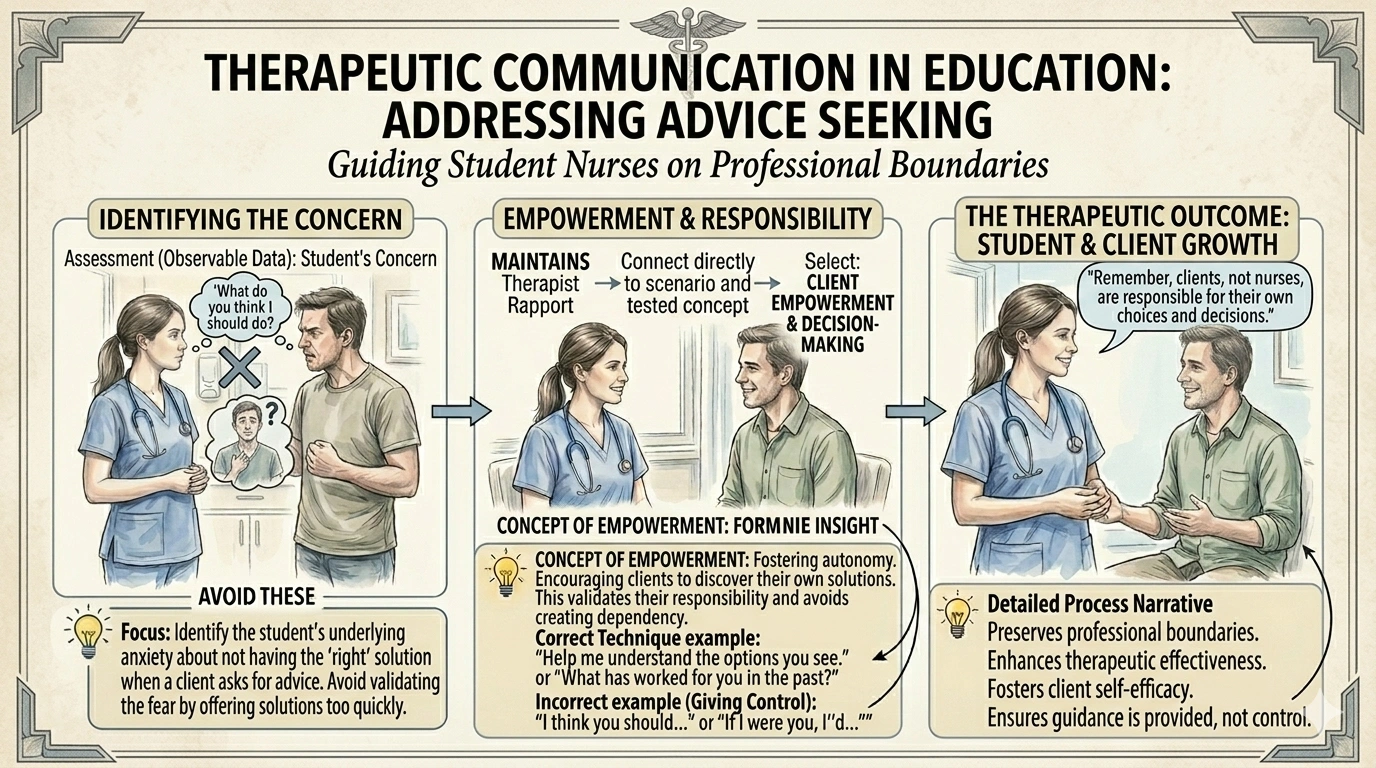
A student nurse tells the instructor, Im concerned that when a client asks me for advice I wont have a good solution. Which should be the nursing instructors best response?
A.
Its scary to feel put on the spot by a client. Nurses dont always have the answer.
B. Remember, clients, not nurses, are responsible for their own choices and decisions.
C. Just keep the clients best interests in mind and do the best that you can.
D. Set a goal to continue to work on this aspect of your practice.
Rationale
The most appropriate selection for "Which should be the nursing instructors best response" is "Remember, clients, not nurses, are responsible for their own choices and decisions.".
A. Its scary to feel put on the spot by a client. Nurses dont always have the answer.
This answer does not address the stem's main point. It either answers a different question or adds meaning not provided in the scenario. The statement "Its scary to feel put on the spot by a client. Nurses dont always have the answer." is not supported by the scenario ("A student nurse tells the instructor, Im concerned that when a client asks me for..."). Clinically, this would risk misinterpretation because it is not grounded in the presented data.
B. Remember, clients, not nurses, are responsible for their own choices and decisions.
This answer is supported by the stem and aligns with safe, client-centered nursing care. It keeps attention on "A student clinician tells the instructor, Im concerned that when a client requires me for...," which is what this item is testing. From a nursing-process perspective, it prioritizes assessment and therapeutic effectiveness.
C. Just keep the clients best interests in mind and do the best that you can.
This answer does not address the stem's main point. It either answers a different question or adds meaning not provided in the scenario. Here, "Just keep the clients best interests in mind and do the best that you can." pulls the nurse away from the stem's cue ("A student nurse tells the instructor, Im concerned that when a client asks me for..."). Clinically, this would risk misinterpretation because it is not grounded in the presented data.
D. Set a goal to continue to work on this aspect of your practice.
This answer does not address the stem's main point. It either answers a different question or adds meaning not provided in the scenario. The statement "Set a goal to continue to work on this aspect of your practice." is not supported by the scenario ("A student nurse tells the instructor, Im concerned that when a client asks me for..."). Choose the option that answers the question directly without adding extra assumptions.
**Conclusion**
In this situation, the main issue is A student nurse tells the instructor, Im concerned that when a client asks me for advice I wont have a good solution..... The most appropriate response is Remember, clients, not nurses, are responsible for their own choices and decisions., which aligns with the concept tested in the scenario. The strongest answers in this set stay closely tied to what is stated in the scenario and avoid adding extra meaning. In practice, this approach supports accurate assessment and respectful, client-centered care.
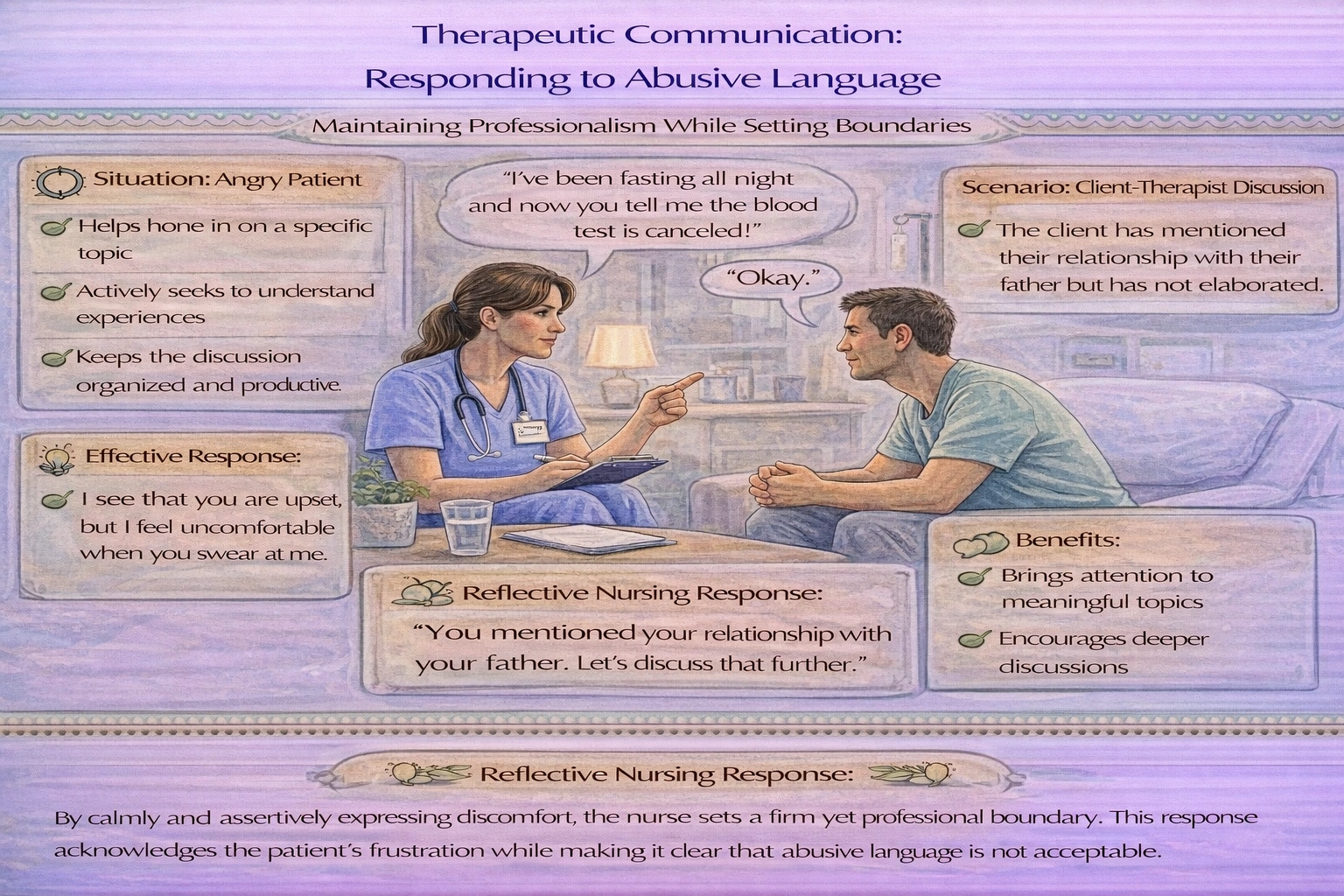
After fasting from 10 p.m. the previous evening, a client finds out that the blood test has been canceled. The client swears at the nurse and states, You are incompetent! Which is the nurses best response?
A.
Do you believe that I was the cause of your blood test being canceled?
B. I see that you are upset, but I feel uncomfortable when you swear at me.
C. Have you ever thought about ways to express anger appropriately?
D. Ill give you some space. Let me know if you need anything.
Rationale
The correct response to "Which is the nurses best response" is "I see that you are upset, but I feel uncomfortable when you swear at me.".
A. Do you believe that I was the cause of your blood test being canceled?
This answer does not address the stem's main point. It either answers a different question or adds meaning not provided in the scenario. The statement "Do you believe that I was the cause of your blood test being canceled?" is not supported by the scenario ("After fasting from 10 p.m. the previous evening, a client finds out that the blood..."). Choose the option that answers the question directly without adding extra assumptions.
B. I see that you are upset, but I feel uncomfortable when you swear at me.
This is the strongest option because it applies culturally informed, nonjudgmental nursing interpretation. It responds to "After fasting from 10 p.m. the previous evening, a client finds out that the blood..." without stereotyping the client or shifting to a different concept. It promotes safe decision-making by basing interpretation on observable data.
C. Have you ever thought about ways to express anger appropriately?
This answer does not address the stem's main point. It either answers a different question or adds meaning not provided in the scenario. Compared with the stem ("After fasting from 10 p.m. the previous evening, a client finds out that the blood..."), this choice introduces a different emphasis ("Have you ever thought about ways to express anger appropriately?"). Choose the choice that answers the question directly without adding extra assumptions.
D. Ill give you some space. Let me know if you need anything.
This choice misses the focus of the question and would lead the nurse away from the best clinical judgment. This answer centers "Ill give you some space. Let me know if you need anything.," but the stem highlights "After fasting from 10 p.m. the previous evening, a client finds out that the blood...." A good elimination step is to remove choices that stereotype or drift away from the stem's priority.
**Conclusion**
In this situation, the main issue is After fasting from 10 p.m. the previous evening, a client finds out that the blood test has been canceled. The client... I see that you are upset, but I feel uncomfortable when you swear at me.. Some alternatives explain the situation with speculation rather than evidence from the scenario. In practice, this approach supports accurate assessment and respectful, client-centered care.
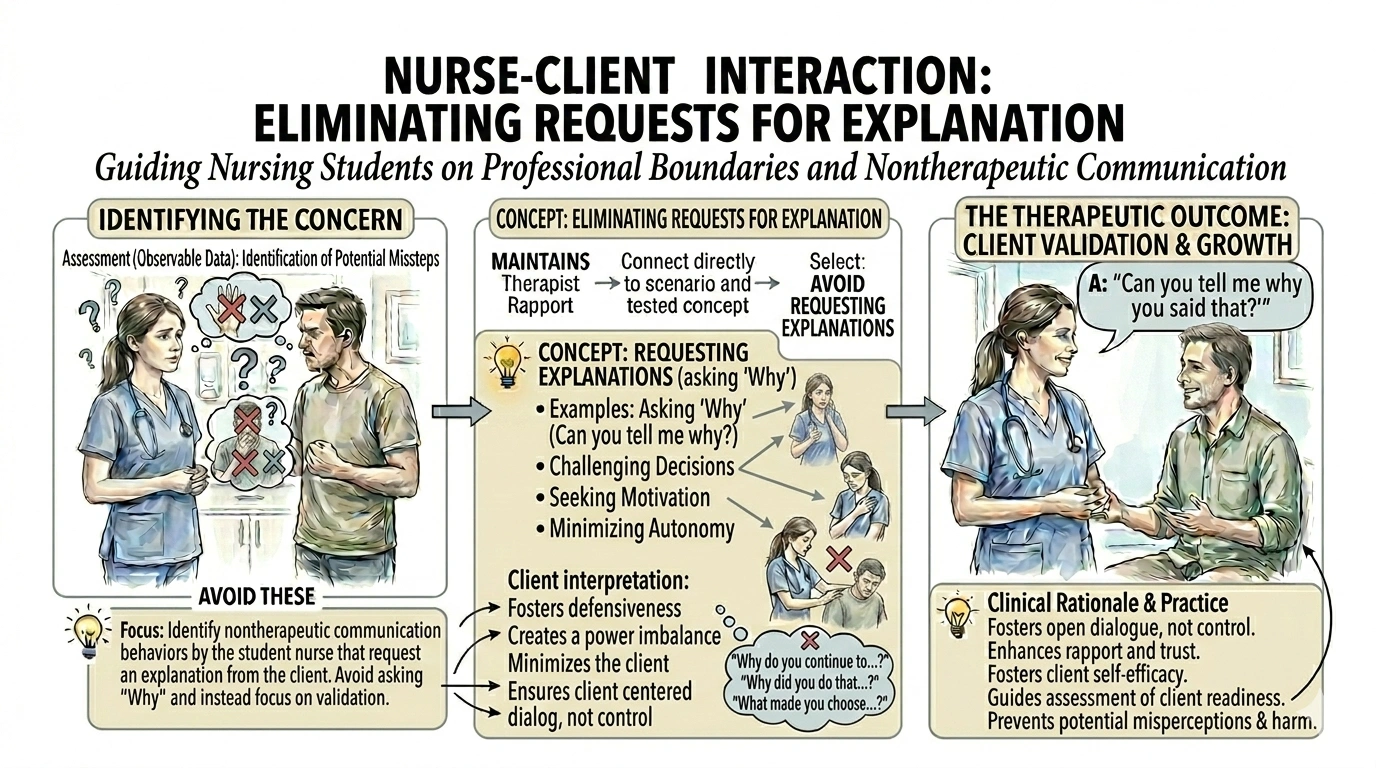
Which nursing response is an example of the nontherapeutic communication block of requesting an explanation?
A.
Can you tell me why you said that?
B. Keep your chin up. Ill explain the procedure to you.
C. There is always an explanation for both good and bad behaviors.
D. Are you not understanding the explanation I provided?
Rationale
What the nurse should choose for "Which nursing response is an example of the nontherapeutic communication block of requesting an explanation" is "Can you tell me why you said that?".
A. Can you tell me why you said that?
This choice fits because it stays grounded in the scenario and avoids added assumptions. It matches what the stem emphasizes ("Which nursing response is an example of the nontherapeutic communication block of...") and guides appropriate nursing judgment. It promotes safe decision-making by basing interpretation on observable data.
B. Keep your chin up. Ill explain the procedure to you.
This choice misses the focus of the question and would lead the nurse away from the best clinical judgment. This answer centers "Keep your chin up. Ill explain the procedure to you.," but the stem highlights "Which nursing response is an example of the nontherapeutic communication block of...." Choose the option that answers the question directly without adding extra assumptions.
C. There is always an explanation for both good and bad behaviors.
This choice misses the priority of the question and would lead the nurse away from the best clinical judgment. The statement "There is always an explanation for both good and bad behaviors." is not supported by the scenario ("Which nursing response is an example of the nontherapeutic communication block of..."). Clinically, this would risk misinterpretation because it is not grounded in the presented data.
D. Are you not understanding the explanation I provided?
This answer does not address the stem's main point. It either answers a different question or adds meaning not provided in the situation. Compared with the stem ("Which nursing response is an example of the nontherapeutic communication block of..."), this choice introduces a different emphasis ("Are you not understanding the explanation I provided?"). Clinically, this would risk misinterpretation because it is not grounded in the presented data.
**Conclusion**
In this situation, the main issue is Which nursing response is an example of the nontherapeutic communication block of requesting an explanation? Can you tell me why you said that?. The better reasoning here is the one that connects directly to the scenario details and the concept being tested. In practice, this approach supports accurate assessment and respectful, client-centered care.
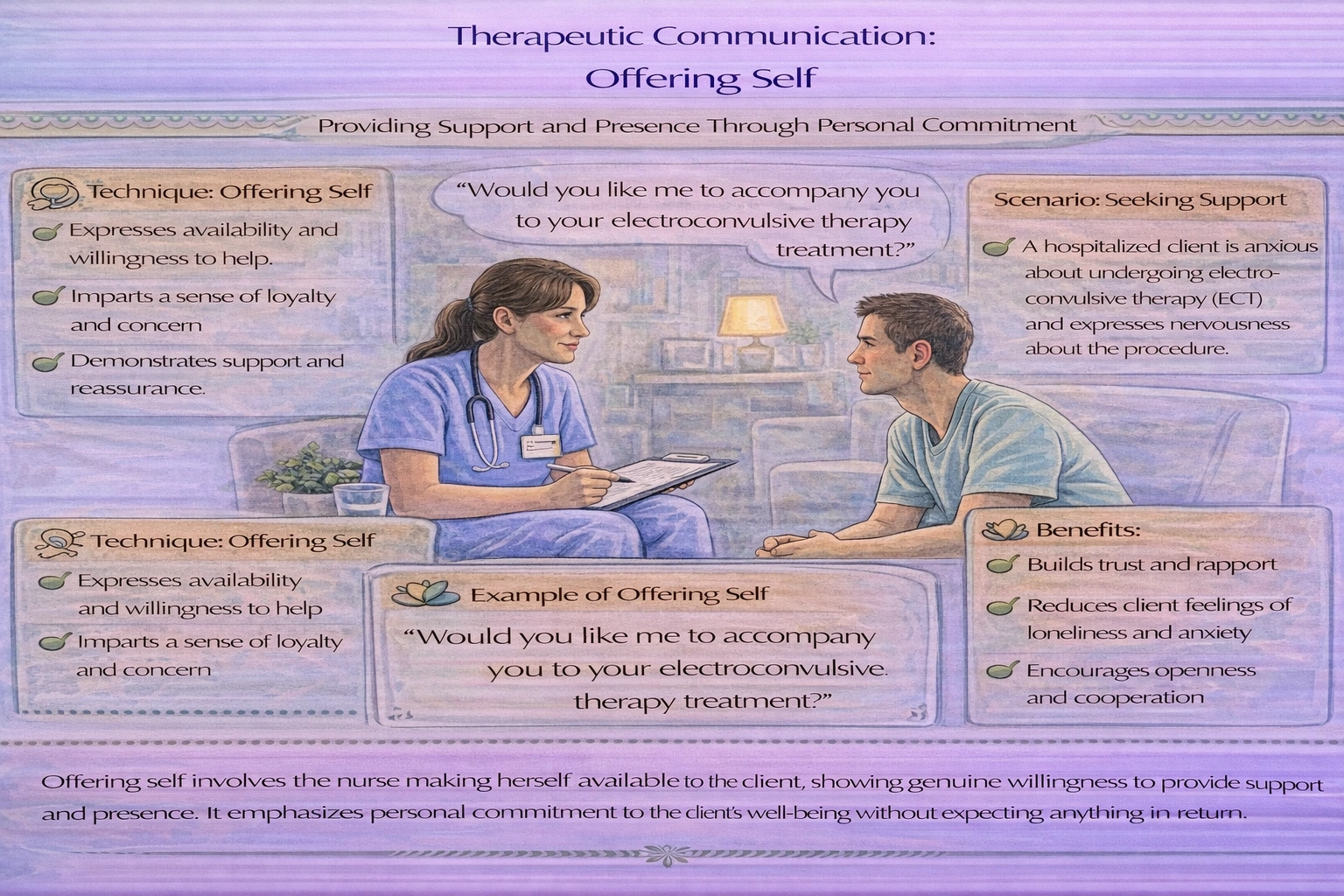
Which nursing statement is a good example of the therapeutic communication technique of offering self?
A.
I think it would be great if you talked about that problem during our next group session.
B. Would you like me to accompany you to your electroconvulsive therapy treatment?
C. I notice that you are offering help to other peers in the milieu.
D. After discharge, would you like to meet me for lunch to review your outpatient progress?
Rationale
The nursing statement that answers the question is "Would you like me to accompany you to your electroconvulsive therapy treatment?".
A. I think it would be great if you talked about that problem during our next group session.
This choice misses the focus of the question and would lead the nurse away from the best clinical judgment. This answer centers "I think it would be great if you talked about that problem during our next group session.," but the stem highlights "Which nursing statement is a good example of the therapeutic communication technique...." In practice, the nurse should stay with assessment cues and culturally safe interpretation.
B. Would you like me to accompany you to your electroconvulsive therapy treatment?
This answer is supported by the stem and aligns with safe, client-centered nursing care. It matches what the stem emphasizes ("Which nursing statement is a good example of the therapeutic communication technique...") and guides appropriate nursing judgment. Clinically, it helps preserve rapport while interpreting behavior through context.
C. I notice that you are offering help to other peers in the milieu.
This option is off-target for what the stem is asking. It may be loosely connected, but it doesn't match the priority concept. The statement "I notice that you are offering help to other peers in the milieu." is not supported by the scenario ("Which nursing statement is a good example of the therapeutic communication technique..."). In practice, the nurse should stay with assessment cues and culturally safe interpretation.
D. After discharge, would you like to meet me for lunch to review your outpatient progress?
This choice misses the priority of the question and would lead the clinician away from the best clinical judgment. Compared with the stem ("Which nursing statement is a good example of the therapeutic communication technique..."), this choice introduces a different emphasis ("After discharge, would you like to meet me for lunch to review your outpatient progress?"). A good elimination step is to remove choices that stereotype or drift away from the stem's priority.
**Conclusion**
The focus of this question is Which nursing statement is a good example of the therapeutic communication technique of offering self?. The most appropriate response is Would you like me to accompany you to your electroconvulsive therapy treatment?, which aligns with the concept tested in the scenario. The strongest answers in this set stay closely tied to what is stated in the scenario and avoid adding extra meaning. In practice, this approach supports accurate assessment and respectful, client-centered care.
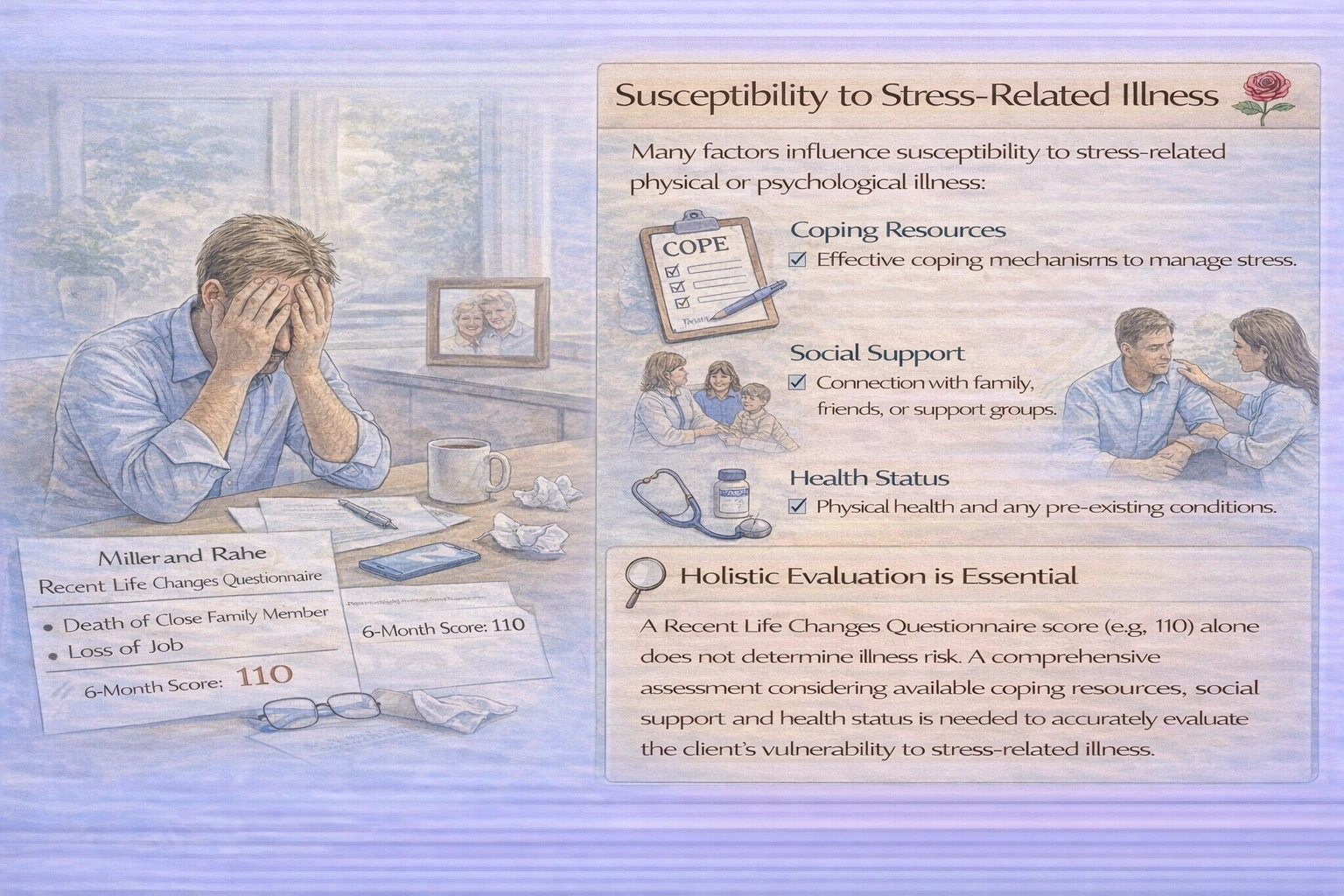
A client has experienced the death of a close family member and at the same time becomes unemployed. This situation has resulted in a 6-month score of 110 on the Recent Life Changes Questionnaire. How should the nurse evaluate this client data?
A.
The client is experiencing severe distress and is at risk for physical and psychological illness.
B. A score of 110 on the Miller and Rahe Recent Life Changes Questionnaire indicates no significant threat of stress-related illness.
C. Susceptibility to stress-related physical or psychological illness cannot be estimated without knowledge of coping resources and available supports.
D. The client may view these losses as challenges and perceive them as opportunities.
Rationale
The best way to evaluate this client data is Susceptibility to stress-related physical or psychological illness cannot be estimated without knowledge of coping resources and available supports..
A. The client is experiencing severe distress and is at risk for physical and psychological illness.
This sounds reasonable when the idea in “The client is experiencing severe distress and is at risk for physical and psychological illness.†addresses a different mechanism or priority than the one emphasized by the stem The wording does not track the stem’s main cue, so selecting it would shift the nurse away from the most precise interpretation or priority.
B. A score of 110 on the Miller and Rahe Recent Life Changes Questionnaire indicates no significant threat of stress-related illness.
This might be chosen when the idea in “A score of 110 on the Miller and Rahe Recent Life Changes Questionnaire indicates no significant threat of stress-related illness.†addresses a different mechanism or priority than the one emphasized by the stem The wording does not track the stem’s main cue, so selecting it would shift the nurse away from the most precise interpretation or priority.
C. Susceptibility to stress-related physical or psychological illness cannot be estimated without knowledge of coping resources and available supports.
This aligns with the concept that The Recent Life Changes Questionnaire is an expanded version of the Schedule of Recent Experiences and the Rahe-Holmes Social Readjustment Rating Scale. A 6-month score of 300 or more, or a year-score total of 500 or more, indicates high stress in a clients life. However, positive coping mechanisms and strong social support can limit susceptibility to stress-related illnesses. Need: Psychosocial Integrity Life-change scores offer a rough estimate of cumulative stress load, yet vulnerability is strongly shaped by coping style, resilience, health status, and the presence of practical and emotional supports. From a nursing standpoint, this selection guides assessment and interventions toward what is most clinically meaningful in the moment—risk reduction, safety, accurate appraisal, and support for adaptive coping.
D. The client may view these losses as challenges and perceive them as opportunities.
This could seem tempting if the idea in “The client may view these losses as challenges and perceive them as opportunities.†addresses a different mechanism or priority than the one emphasized by the stem The wording does not track the stem’s main cue, so selecting it would shift the nurse away from the most precise interpretation or priority.
**Conclusion**
Success on this item comes from focusing on the single clinical cue the stem emphasizes and selecting the option that responds to it without adding extra meaning. The distractors feel plausible, but they stretch beyond what the scenario actually supports.
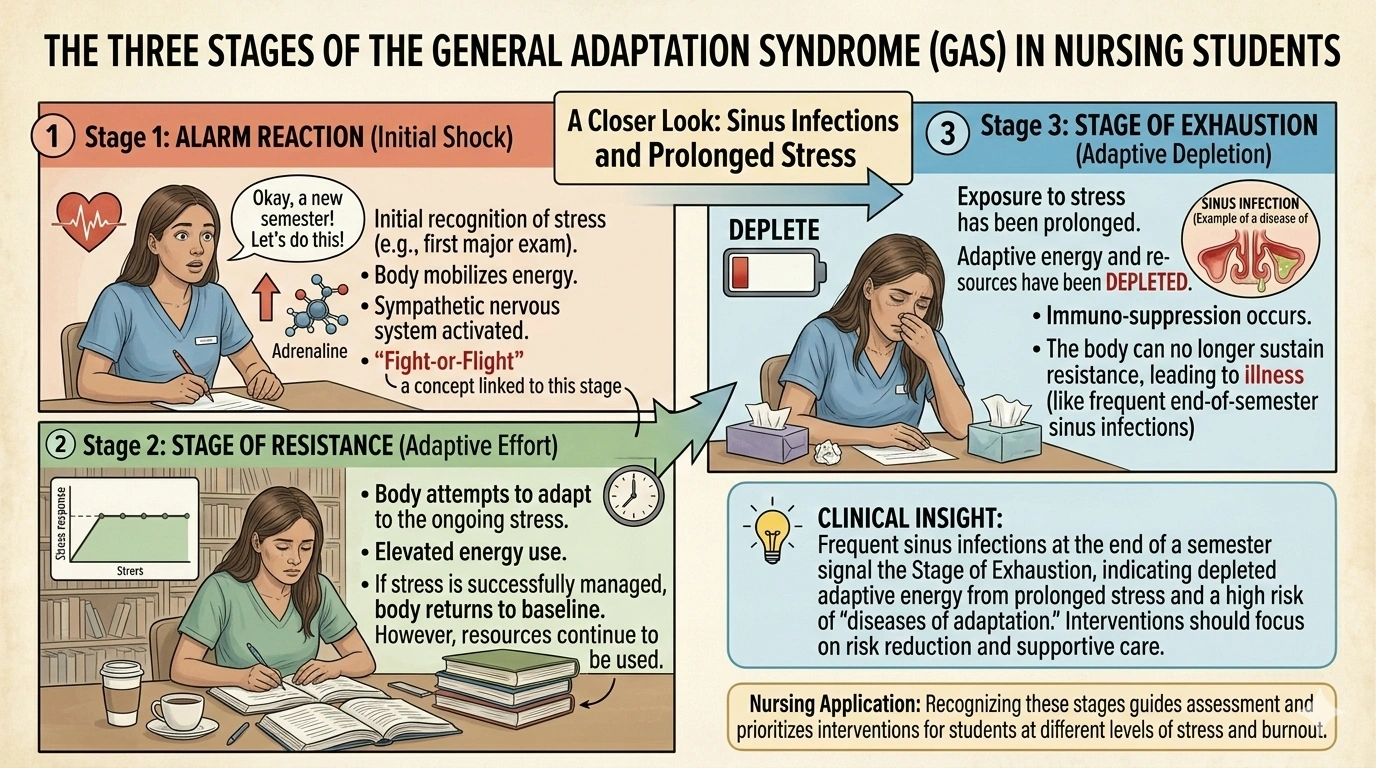
A nursing student finds that she comes down with a sinus infection toward the end of every semester. When this occurs, which stage of stress is the student most likely experiencing?
A.
Alarm reaction stage
B. Stage of resistance
C. Stage of exhaustion
D. Fight-or-flight stage
Rationale
The interpretation supported by the scenario is Stage of exhaustion.
A. Alarm reaction stage
This could seem tempting if the idea in “Alarm reaction stage†addresses a different mechanism or priority than the one emphasized by the stem The wording does not track the stem’s main cue, so selecting it would shift the nurse away from the most precise interpretation or priority.
B. Stage of resistance
This could seem tempting if the idea in “Stage of resistance†addresses a different mechanism or priority than the one emphasized by the stem The wording does not track the stem’s main cue, so selecting it would shift the nurse away from the most precise interpretation or priority.
C. Stage of exhaustion
This aligns with the concept that At the stage of exhaustion, the students exposure to stress has been prolonged and adaptive energy has been depleted. Diseases of adaptation occur more frequently in this stage. Need: Psychosocial Integrity The underlying principle in the stem is best addressed by choosing the response that is both specific to the cue provided and consistent with evidence-informed psychiatric nursing practice. From a nursing standpoint, this selection guides assessment and interventions toward what is most clinically meaningful in the moment—risk reduction, safety, accurate appraisal, and support for adaptive coping.
D. Fight-or-flight stage
This would apply in a different scenario where the idea in “Fight-or-flight stage†addresses a different mechanism or priority than the one emphasized by the stem The wording does not track the stem’s main cue, so selecting it would shift the nurse away from the most precise interpretation or priority.
**Conclusion**
The stem provides enough information to select the most accurate interpretation without adding extra assumptions. The chosen answer reflects the correct framework, and the remaining choices drift toward incomplete, premature, or misdirected reasoning.
An unemployed college graduate is experiencing severe anxiety over not finding a teaching position and has difficulty with independent problem-solving. During a routine physical examination, the graduate confides in the clinic nurse. Which is the most appropriate nursing intervention?
A.
Encourage the student to use the alternative coping mechanism of relaxation exercises.
B. Complete the problem-solving process for the client.
C. Work through the problem-solving process with the client.
D. Encourage the client to keep a journal.
Rationale
The best way to answer the question is Work through the problem-solving process with the client..
A. Encourage the student to use the alternative coping mechanism of relaxation exercises.
This might be chosen when the idea in “Encourage the student to use the alternative coping mechanism of relaxation exercises.†addresses a different mechanism or priority than the one emphasized by the stem The wording does not track the stem’s main cue, so selecting it would shift the nurse away from the most precise interpretation or priority.
B. Complete the problem-solving process for the client.
This reflects a related idea, but it fits best when the idea in “Complete the problem-solving process for the client.†addresses a different mechanism or priority than the one emphasized by the stem The wording does not track the stem’s main cue, so selecting it would shift the nurse away from the most precise interpretation or priority.
C. Work through the problem-solving process with the client.
This fits because During times of high anxiety and stress, clients will need more assistance in problem-solving and decision making. Need: Psychosocial Integrity The underlying principle in the stem is best addressed by choosing the response that is both specific to the cue provided and consistent with evidence-informed psychiatric nursing practice. From a nursing standpoint, this selection guides assessment and interventions toward what is most clinically meaningful in the moment—risk reduction, safety, accurate appraisal, and support for adaptive coping.
D. Encourage the client to keep a journal.
This reflects a related idea, but it fits best when the idea in “Encourage the client to keep a journal.†addresses a different mechanism or priority than the one emphasized by the stem The wording does not track the stem’s main cue, so selecting it would shift the nurse away from the most precise interpretation or priority.
**Conclusion**
What separates the best choice from the rest is specificity: the correct option addresses the exact mechanism, stage, or principle described. The other answers relate to nearby ideas, yet they miss the question’s focal point or misapply the concept to the situation.
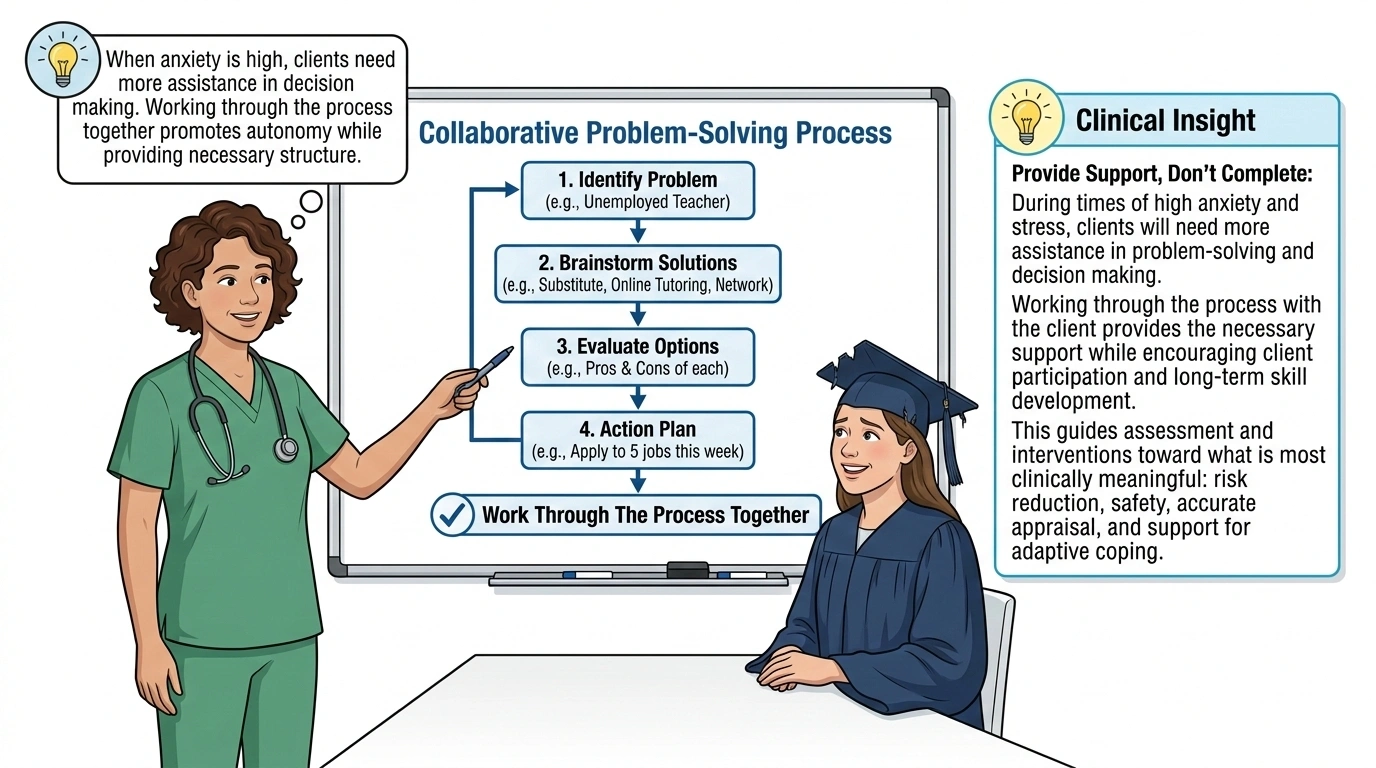
A distraught, single, first-time mother cries and asks a nurse, How can I go to work if I cant afford childcare? What is the nurses initial action in assisting the client with the problem-solving process?
A.
Determine the risks and benefits for each alternative.
B. Formulate goals for resolution of the problem.
C. Evaluate the outcome of the implemented alternative.
D. Assess the facts of the situation.
Rationale
The interpretation supported by the scenario is Assess the facts of the situation..
A. Determine the risks and benefits for each alternative.
This would apply in a different scenario where the idea in “Determine the risks and benefits for each alternative.†addresses a different mechanism or priority than the one emphasized by the stem The wording does not track the stem’s main cue, so selecting it would shift the nurse away from the most precise interpretation or priority.
B. Formulate goals for resolution of the problem.
This might be chosen when the idea in “Formulate goals for resolution of the problem.†addresses a different mechanism or priority than the one emphasized by the stem The wording does not track the stem’s main cue, so selecting it would shift the nurse away from the most precise interpretation or priority.
C. Evaluate the outcome of the implemented alternative.
This reflects a related idea, but it fits best when the idea in “Evaluate the outcome of the implemented alternative.†addresses a different mechanism or priority than the one emphasized by the stem The wording does not track the stem’s main cue, so selecting it would shift the nurse away from the most precise interpretation or priority.
D. Assess the facts of the situation.
This fits because Before any other steps can be taken, accurate information about the situation must be gathered and assessed. Need: Psychosocial Integrity The underlying principle in the stem is best addressed by choosing the response that is both specific to the cue provided and consistent with evidence-informed psychiatric nursing practice. From a nursing standpoint, this selection guides assessment and interventions toward what is most clinically meaningful in the moment—risk reduction, safety, accurate appraisal, and support for adaptive coping.
**Conclusion**
The scenario is best handled by identifying what the nurse must interpret or prioritize first and then choosing the statement that fits that requirement with the least distortion. The distractors have surface appeal, but they do not align as tightly with the clinical cue embedded in the stem.
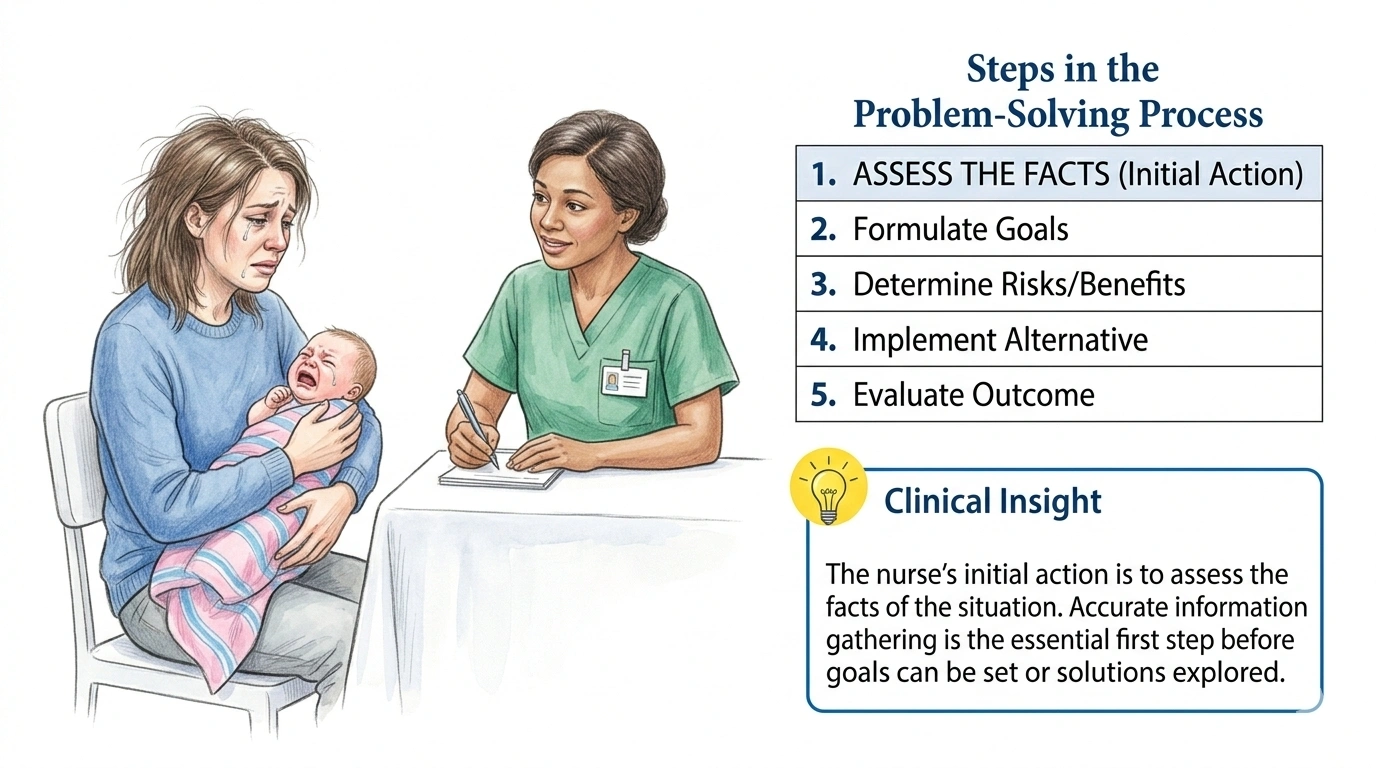
Which symptom should a nurse identify as typical of the fight-or-flight response?
A.
Pupil constriction
B. Increased heart rate
C. Increased salivation
D. Increased peristalsis
Rationale
The best way to answer the question is Increased heart rate.
A. Pupil constriction
This sounds reasonable when the idea in “Pupil constriction†addresses a different mechanism or priority than the one emphasized by the stem The wording does not track the stem’s main cue, so selecting it would shift the nurse away from the most precise interpretation or priority.
B. Increased heart rate
This fits because During the fight-or-flight response, the heart rate increases in response to the release of epinephrine. Pupils dilate to enhance vision. Salivation and peristalsis decrease as the body slows unessential functions. OK Need: Physiological Integrity The underlying principle in the stem is best addressed by choosing the response that is both specific to the cue provided and consistent with evidence-informed psychiatric nursing practice. From a nursing standpoint, this selection guides assessment and interventions toward what is most clinically meaningful in the moment—risk reduction, safety, accurate appraisal, and support for adaptive coping.
C. Increased salivation
This reflects a related idea, but it fits best when the idea in “Increased salivation†addresses a different mechanism or priority than the one emphasized by the stem The wording does not track the stem’s main cue, so selecting it would shift the nurse away from the most precise interpretation or priority.
D. Increased peristalsis
This could seem tempting if the idea in “Increased peristalsis†addresses a different mechanism or priority than the one emphasized by the stem The wording does not track the stem’s main cue, so selecting it would shift the nurse away from the most precise interpretation or priority.
**Conclusion**
The correct response is the one that matches the stem’s central assessment focus and reflects the intended principle without overreach. Alternatives may sound reasonable, but they rely on assumptions rather than the client data presented.
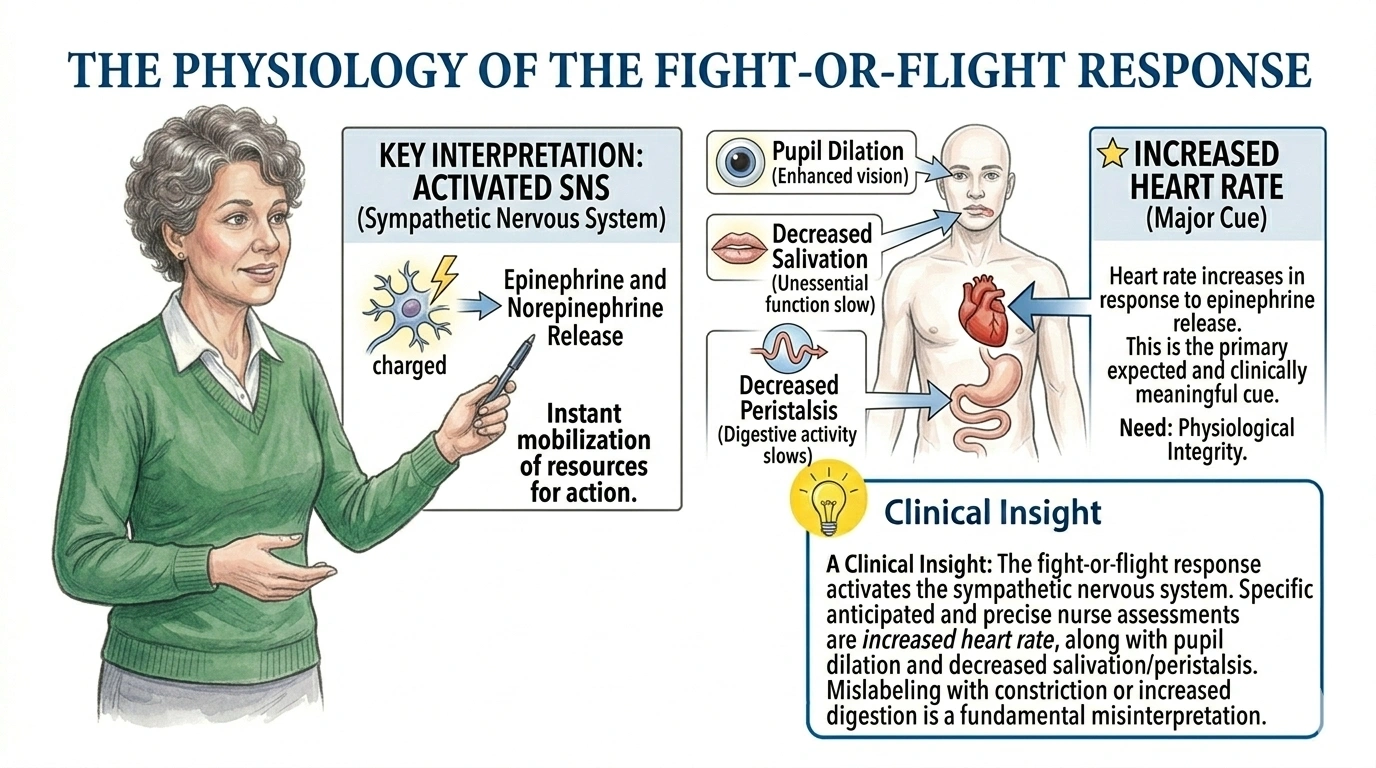
A client who experiences stress on a regular basis asks a nurse what causes these feelings. Which is the most appropriate nursing response?
A.
Genetics have nothing to do with your temperament.
B. How you reacted to past experiences influences how you feel now.
C. If youre in good physical health, your stress level will be low.
D. Stress can always be avoided if appropriate coping mechanisms are employed.
Rationale
The interpretation supported by the scenario is How you reacted to past experiences influences how you feel now..
A. Genetics have nothing to do with your temperament.
This would apply in a different scenario where the idea in “Genetics have nothing to do with your temperament.†addresses a different mechanism or priority than the one emphasized by the stem The wording does not track the stem’s main cue, so selecting it would shift the nurse away from the most precise interpretation or priority.
B. How you reacted to past experiences influences how you feel now.
This is supported by the detail that Past experiences are occurrences that result in learned patterns that can influence an individuals current adaptation response. They include previous exposure to the stressor or other stressors in general, learned coping responses, and degree of adaptation to previous stressors. Need: Psychosocial Integrity The underlying principle in the stem is best addressed by choosing the response that is both specific to the cue provided and consistent with evidence-informed psychiatric nursing practice. From a nursing standpoint, this selection guides assessment and interventions toward what is most clinically meaningful in the moment—risk reduction, safety, accurate appraisal, and support for adaptive coping.
C. If youre in good physical health, your stress level will be low.
This would apply in a different scenario where the idea in “If youre in good physical health, your stress level will be low.†addresses a different mechanism or priority than the one emphasized by the stem The wording does not track the stem’s main cue, so selecting it would shift the nurse away from the most precise interpretation or priority.
D. Stress can always be avoided if appropriate coping mechanisms are employed.
This sounds reasonable when the idea in “Stress can always be avoided if appropriate coping mechanisms are employed.†addresses a different mechanism or priority than the one emphasized by the stem The wording does not track the stem’s main cue, so selecting it would shift the nurse away from the most precise interpretation or priority.
**Conclusion**
The stem provides enough information to select the most accurate interpretation without adding extra assumptions. The chosen answer reflects the correct framework, and the remaining choices drift toward incomplete, premature, or misdirected reasoning.
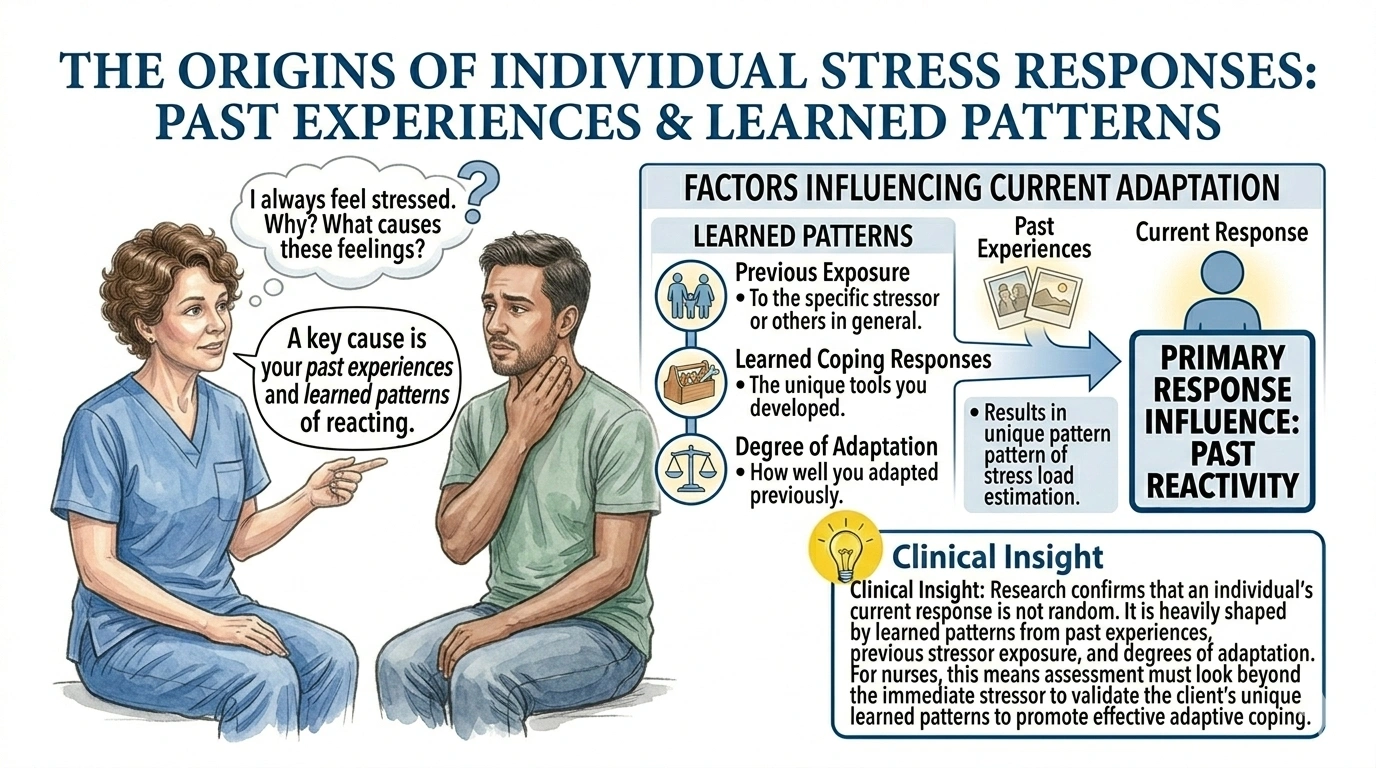
A nurse is conducting education on anxiety and stress management. Which of the following should be identified as the most important initial step in learning how to manage anxiety?
A.
Diagnostic blood tests
B. Awareness of factors creating stress
C. Relaxation exercises
D. Identifying support systems
Rationale
The best way to answer the question is Awareness of factors creating stress.
A. Diagnostic blood tests
This would apply in a different scenario where the idea in “Diagnostic blood tests †addresses a different mechanism or priority than the one emphasized by the stem The wording does not track the stem’s main cue, so selecting it would shift the nurse away from the most precise interpretation or priority.
B. Awareness of factors creating stress
This matches the stem because Although all of the above answers may be useful in the comprehensive management of stress, the initial step is awareness that stress is being experienced and awareness of factors that create stress. Integrity The underlying principle in the stem is best addressed by choosing the response that is both specific to the cue provided and consistent with evidence-informed psychiatric nursing practice. From a nursing standpoint, this selection guides assessment and interventions toward what is most clinically meaningful in the moment—risk reduction, safety, accurate appraisal, and support for adaptive coping.
C. Relaxation exercises
This reflects a related idea, but it fits best when the idea in “Relaxation exercises†addresses a different mechanism or priority than the one emphasized by the stem The wording does not track the stem’s main cue, so selecting it would shift the nurse away from the most precise interpretation or priority.
D. Identifying support systems
This could seem tempting if the idea in “Identifying support systems†addresses a different mechanism or priority than the one emphasized by the stem The wording does not track the stem’s main cue, so selecting it would shift the nurse away from the most precise interpretation or priority.
**Conclusion**
What separates the best choice from the rest is specificity: the correct option addresses the exact mechanism, stage, or principle described. The other answers relate to nearby ideas, yet they miss the question’s focal point or misapply the concept to the situation.
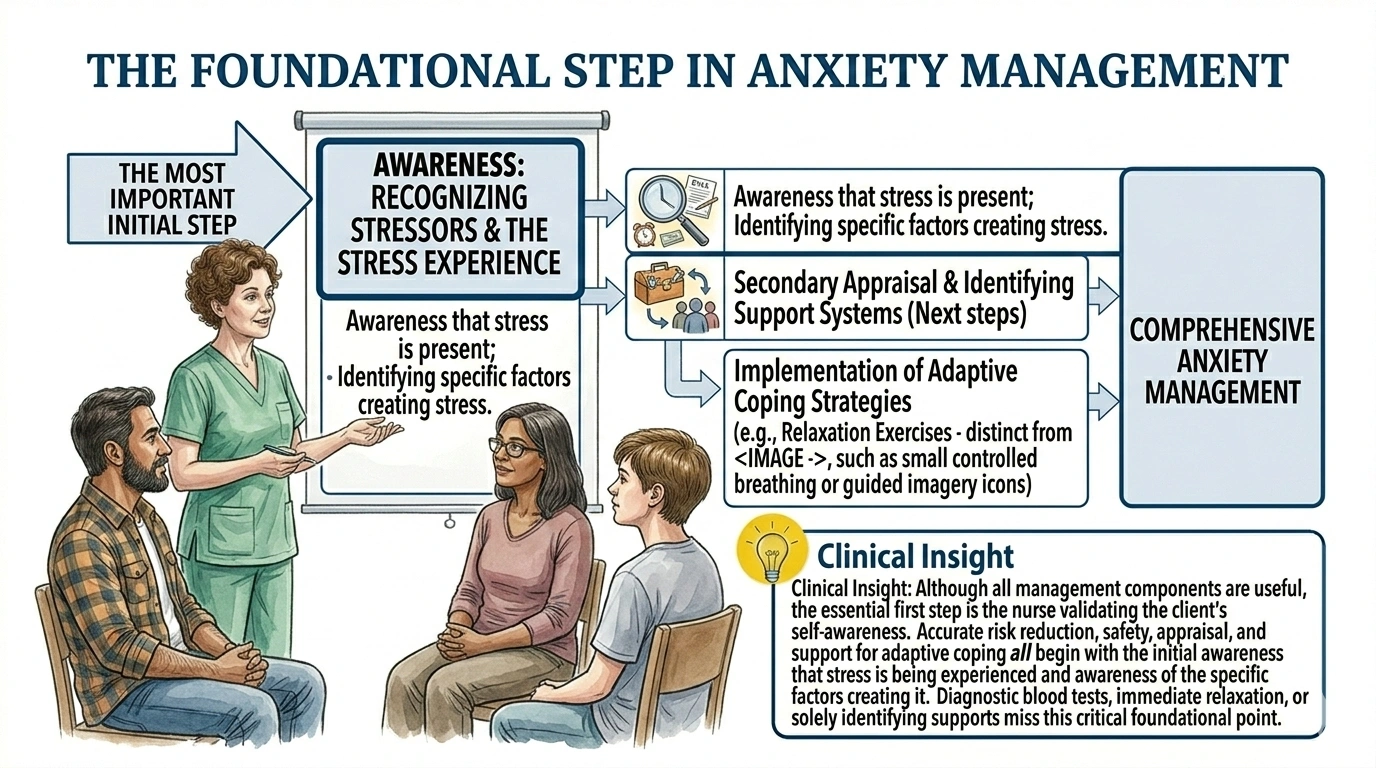
At what point should the nurse determine that a client is at risk for developing a mental disorder?
A.
When thoughts, feelings, and behaviors are not reflective of the DSM-5 criteria
B. When maladaptive responses to stress are coupled with interference in daily functioning
C. When the client communicates significant distress
D. When the client uses defense mechanisms as ego protection
Rationale
The interpretation supported by the scenario is When maladaptive responses to stress are coupled with interference in daily functioning.
A. When thoughts, feelings, and behaviors are not reflective of the DSM-5 criteria
This could seem tempting if the idea in “When thoughts, feelings, and behaviors are not reflective of the DSM-5 criteria†addresses a different mechanism or priority than the one emphasized by the stem The wording does not track the stem’s main cue, so selecting it would shift the nurse away from the most precise interpretation or priority.
B. When maladaptive responses to stress are coupled with interference in daily functioning
This is supported by the detail that The nurse should determine that the client is at risk for mental disorder when responses to stress are maladaptive and interfere with daily functioning. The DSM-5 indicates that in order to be diagnosed with a mental disorder, there must be significant disturbance in cognition, emotion, regulation, or behavior that reflects a dysfunction in the psychological, biological or developmental processes underlying mental functioning. These disorders are usually associated with significant distress or disability in social, occupational, or other important activities. The clients ability to communicate distress would be considered a positive attribute. Need: Psychosocial Integrity The underlying principle in the stem is best addressed by choosing the response that is both specific to the cue provided and consistent with evidence-informed psychiatric nursing practice. From a nursing standpoint, this selection guides assessment and interventions toward what is most clinically meaningful in the moment—risk reduction, safety, accurate appraisal, and support for adaptive coping.
C. When the client communicates significant distress
This reflects a related idea, but it fits best when the idea in “When the client communicates significant distress†addresses a different mechanism or priority than the one emphasized by the stem The wording does not track the stem’s main cue, so selecting it would shift the nurse away from the most precise interpretation or priority.
D. When the client uses defense mechanisms as ego protection
This sounds reasonable when the idea in “When the client uses defense mechanisms as ego protection†addresses a different mechanism or priority than the one emphasized by the stem The wording does not track the stem’s main cue, so selecting it would shift the nurse away from the most precise interpretation or priority.
**Conclusion**
The scenario is best handled by identifying what the nurse must interpret or prioritize first and then choosing the statement that fits that requirement with the least distortion. The distractors have surface appeal, but they do not align as tightly with the clinical cue embedded in the stem.
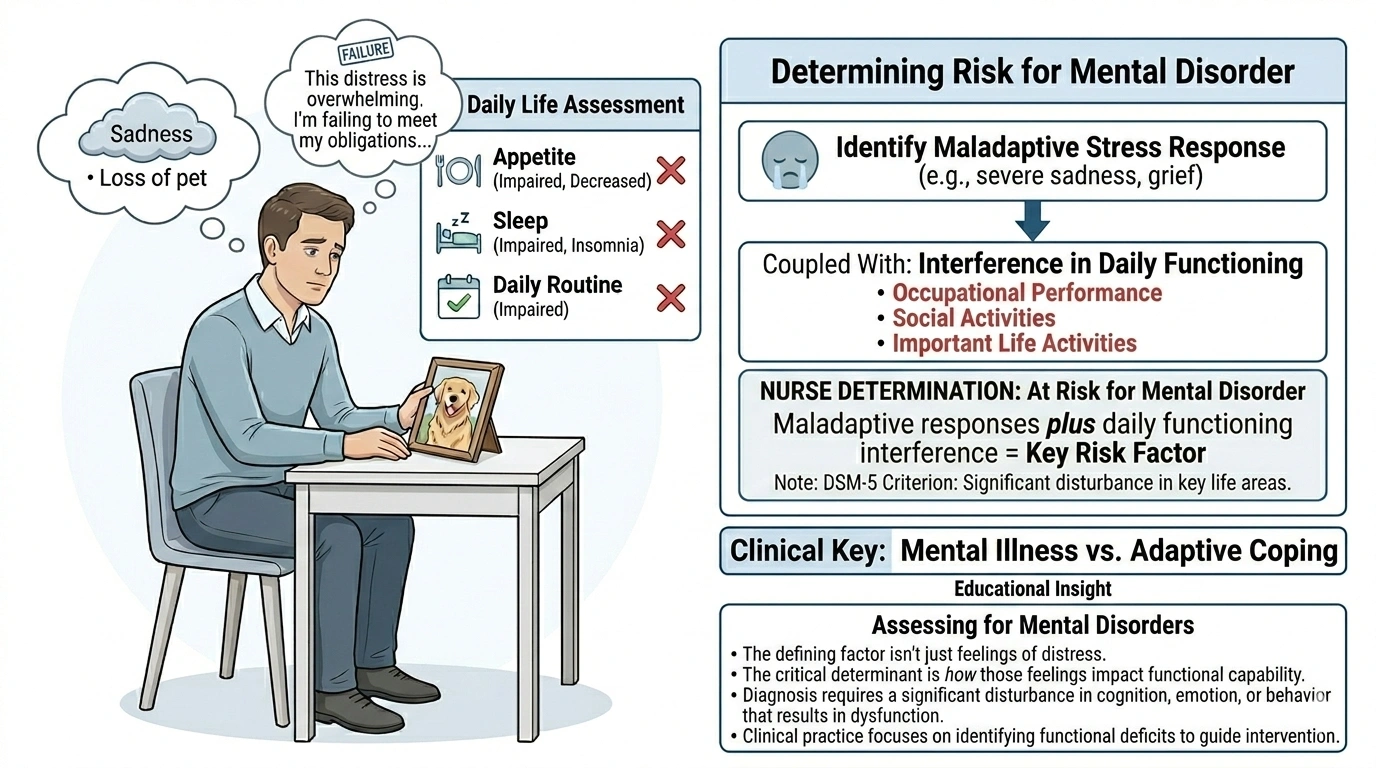
RN Exams
ATI Quizzes
3 Practice Tests
ATI Quizzes
3 Practice Tests
ATI Quizzes
3 Practice Tests
ATI Quizzes
3 Practice Tests