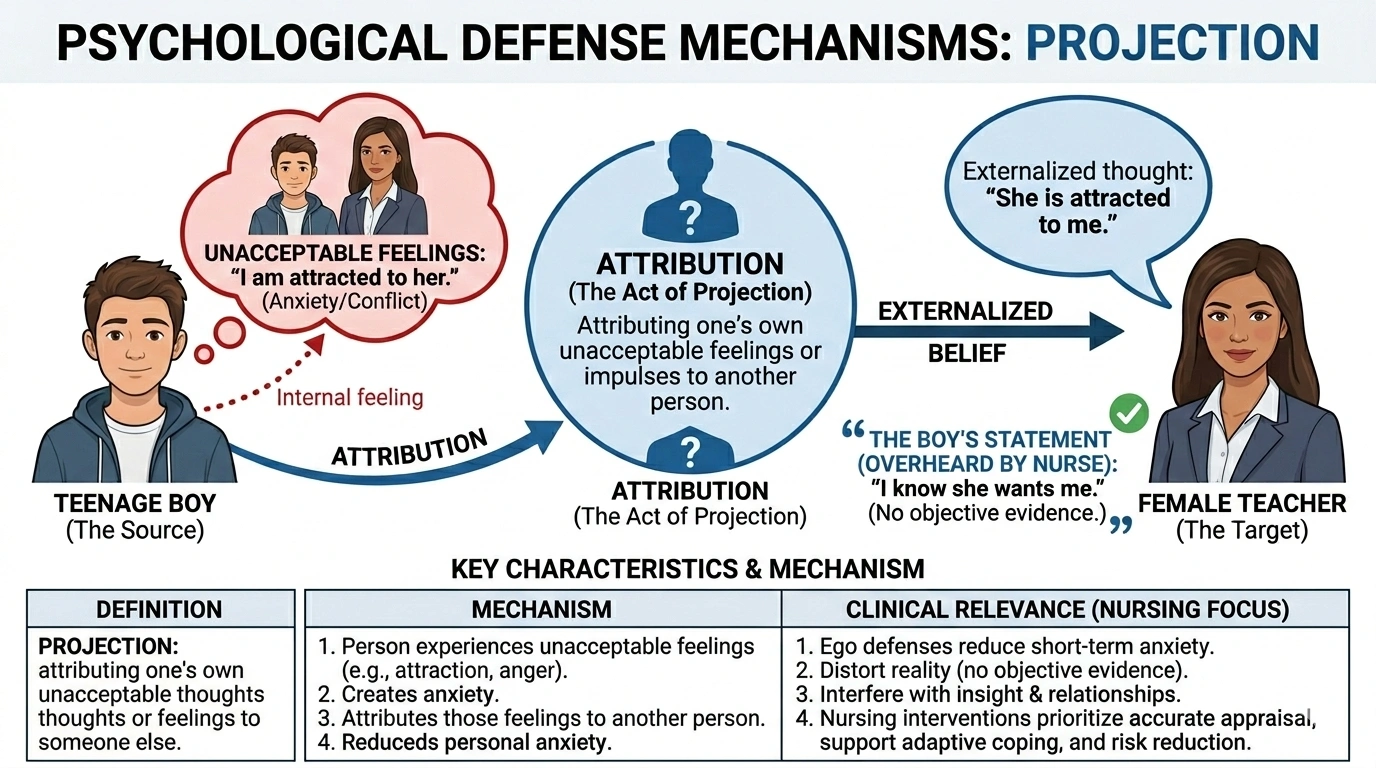
A teenage boy is attracted to a female teacher. Without objective evidence, a school nurse overhears the boy state, I know she wants me. This statement reflects which defense mechanism?
-
A
Displacement
-
B
Projection
-
C
Rationalization
-
D
Sublimation
Based on the information given, the response that addresses the question is Projection.
A. Displacement
This would apply in a different scenario where the idea in “Displacement” addresses a different mechanism or priority than the one emphasized by the stem The wording does not track the stem’s main cue, so selecting it would shift the nurse away from the most precise interpretation or priority.
B. Projection
This is supported by the detail that The nurse should determine that the clients statement reflects the defense mechanism of projection. Projection refers to the attribution of ones unacceptable feelings or impulses to another person. When the client passes the blame of the undesirable feelings, anxiety is reduced. Displacement refers to transferring feelings from one target to another. Rationalization refers to making excuses to justify behavior. Sublimation refers to channeling unacceptable drives or impulses into more constructive, acceptable activities. Need: Psychosocial Integrity Ego defenses can reduce anxiety in the short term, but they become clinically relevant when they distort reality enough to interfere with insight, relationships, or treatment adherence. From a nursing standpoint, this selection guides assessment and interventions toward what is most clinically meaningful in the moment—risk reduction, safety, accurate appraisal, and support for adaptive coping.
C. Rationalization
This sounds reasonable when the idea in “Rationalization” addresses a different mechanism or priority than the one emphasized by the stem The wording does not track the stem’s main cue, so selecting it would shift the nurse away from the most precise interpretation or priority.
D. Sublimation
This would apply in a different scenario where the idea in “Sublimation” addresses a different mechanism or priority than the one emphasized by the stem The wording does not track the stem’s main cue, so selecting it would shift the nurse away from the most precise interpretation or priority.
Conclusion
To answer correctly, prioritize what the stem is truly asking and choose the option that speaks to that question in the most specific, data-based way. The other choices are broader or presume context that is not stated.